







Question: Acting as Alan Mannik, how would you analyze the case data in order to find the best solution for transfering the product from France to
Acting as Alan Mannik, how would you analyze the case data in order to find the best solution for transfering the product from France to Vancouver.
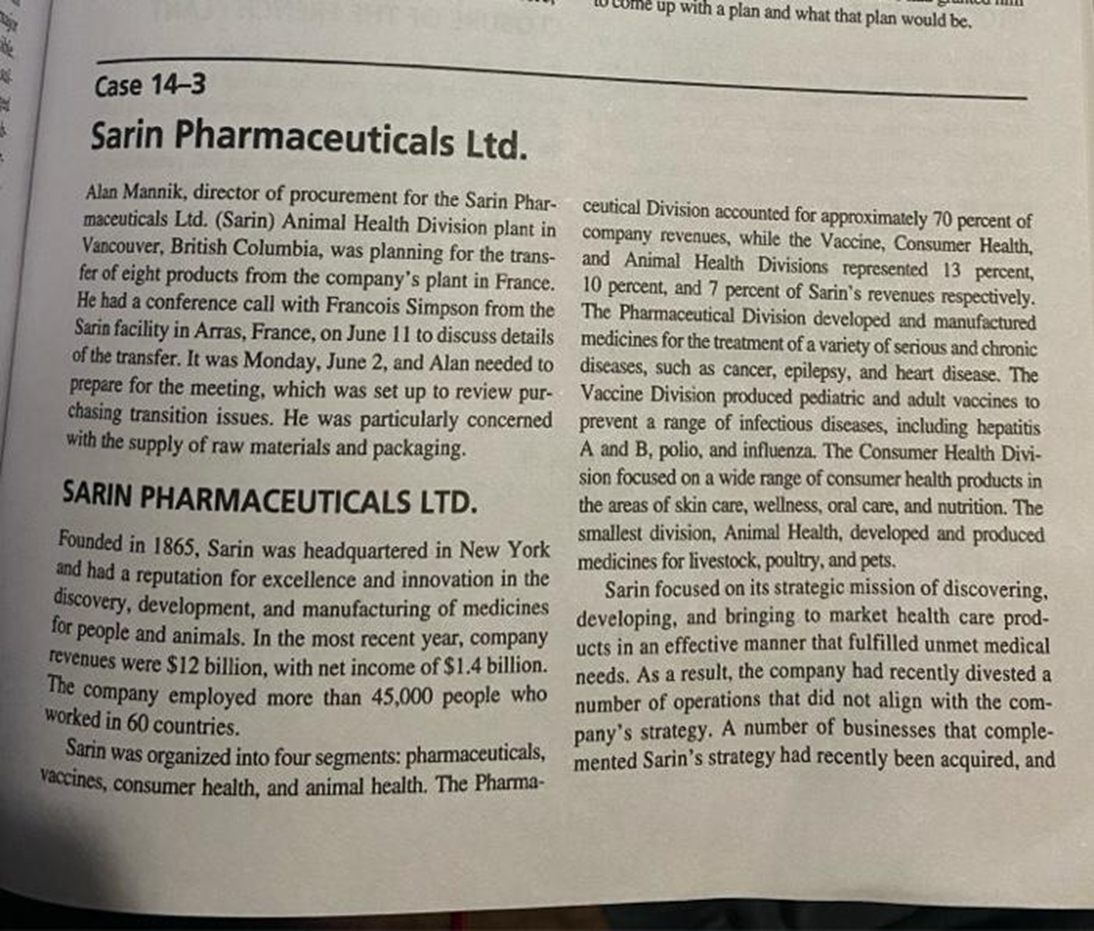
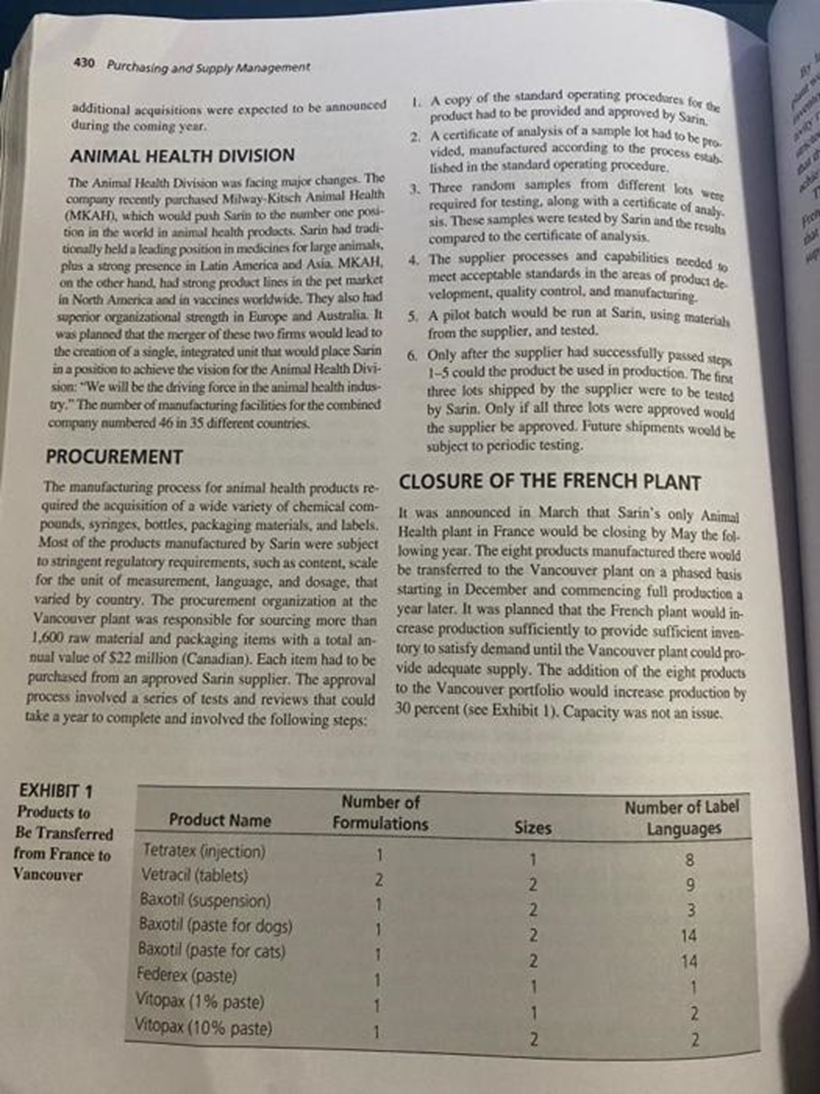
Sarin Pharmaceuticals Ltd. Alan Mannik, director of procurement for the Sarin Pharmaceuticals Ltd. (Sarin) Animal Health Division plant in Vancouver, British Columbia, was planning for the transfer of eight products from the company's plant in France. He had a conference call with Francois Simpson from the Sarin facility in Arras, France, on June 11 to discuss details of the transfer. It was Monday, June 2, and Alan needed to prepare for the meeting, which was set up to review purchasing transition issues. He was particularly concerned with the supply of raw materials and packaging. SARIN PHARMACEUTICALS LTD. Founded in 1865, Sarin was headquartered in New York and had a reputation for excellence and innovation in the discovery, development, and manufacturing of medicines for people and animals. In the most recent year, company revenues were $12 billion, with net income of $1.4 billion. The company employed more than 45,000 people who worked in 60 countries. Sarin was organized into four segments: pharmaceuticals, vaccines, consumer health, and animal health. The Pharma- ceutical Division accounted for approximately 70 percent of company revenues, while the Vaccine, Consumer Health, and Animal Health Divisions represented 13 percent, 10 percent, and 7 percent of Sarin's revenues respectively. The Pharmaceutical Division developed and manufactured medicines for the treatment of a variety of serious and chronic diseases, such as cancer, epilepsy, and heart disease. The Vaccine Division produced pediatric and adult vaccines to prevent a range of infectious diseases, including hepatitis A and B, polio, and influenza. The Consumer Health Division focused on a wide range of consumer health products in the areas of skin care, wellness, oral care, and nutrition. The smallest division, Animal Health, developed and produced medicines for livestock, poultry, and pets. Sarin focused on its strategic mission of discovering, developing, and bringing to market health care products in an effective manner that fulfilled unmet medical needs. As a result, the company had recently divested a number of operations that did not align with the company's strategy. A number of businesses that complemented Sarin's strategy had recently been acquired, and 430 Purchasing and Supply Management additional acquikitions were expected to be announced during the coming year. ANIMAL HEALTH DIVISION The Animal Health Division was facing major changes. The company recently porchased Milway-Kitsch Animal Health (MKAH, which would puih Sirin to the number one poution in the world in animal health prodocts. Sarin had tradttionally held a leading position in modicines for large animals, plus a stroag presence in Latin America and Asia. MKAH, on the ocher hand, had strong product lines in the pet manket in North America and in vaccines worldwide. They also had superior organizational strength in Europe and Australia. It was planned that the menger of these two firms would lead to the creation of a single, integrated unit that would place Sirin in a position to achieve the vision for the Animal Realth Division: "We will be the driving force in the animal bealth indus: try." The number of insinufacturing facilities for the combined corpany numbered 46 in 35 different countries. PROCUREMENT The manufacturing process for animal health products required the acquisition of a wide variety of chemical compounds, syringes, bottles, packaging materials, and labels. Most of the products manufactured by Sarin were subject to stringent regulatory requirements, such as content, scale for the unit of measurement, language, and dosage, that varied by country. The procurement organization at the Vancouver plant was responsible for sourcing more than 1,600 raw material and packaging items with a total annual value of $22 million (Canadian). Each item had to be purchesed from an approved Sarin supplier. The approval process involved a series of tests and reviews that could take a year to complete and involved the following steps: 1. A copy of the standand operating procedares for to product had to be provided and approved by Sarin. 2. A certificate of analysis of a sample lot had to be pro: vided, manufactured according to the process estab. lished in the standard operating procedure. 3. Three random samples from different loss vete required for testing, along with a certificate of ansly. sis. These samples were lested by Sarin and be rewalts compared to the certificate of analysis. 4. The supplier processes and capabilities needod to meet acceptable standards in the areas of product de. velopment, qualify control, and manufacturing. 5. A pilot batch would be run at Sarin, using materials from the supplier, and tested. 6. Only after the supplier had successfully passed sicp. 1- 5 could the product be used in production. The fins three los shipped by the supplier were to be teitod by Sarin. Only if all three lots were approved woold the supplier be approved. Future shipments woold be subject to periodic testing. CLOSURE OF THE FRENCH PLANT It was announced in March that Sarin's only Animal Health plant in France would be closing by May the fol. lowing year. The eight products manufactured there woold be transferred to the Vancouver plant on a phased basis starting in December and commencing full production a year later. It was planned that the French plant would increase production sufficiently to provide sufficient investory to satisfy demand until the Vancouver plant could provide adequate supply. The addition of the eight products to the Vancouver portfolio would increase production by 30 percent (see Exhibit 1). Capacity was not an issuc. EXHIBIT 1 Products to Be Transferred from France to Vancouver
Step by Step Solution
There are 3 Steps involved in it

Get step-by-step solutions from verified subject matter experts
 Study Help