







Question: Activity 1: Problem Solving Read and analyze each problem. Show your sequential solution through GUFSA Method. Attach a paper of any size for your answer
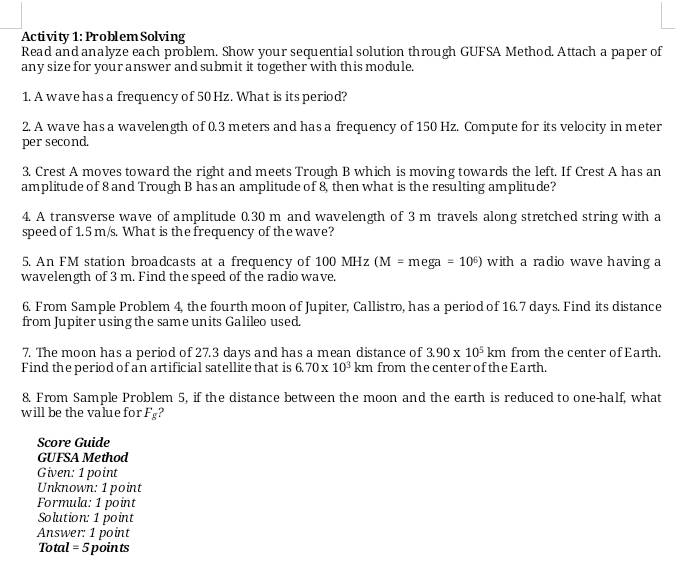
Activity 1: Problem Solving Read and analyze each problem. Show your sequential solution through GUFSA Method. Attach a paper of any size for your answer and submit it together with this module. 1. A wave has a frequency of 50 Hz. What is its period? 2. A wave has a wavelength of 0.3 meters and has a frequency of 150 Hz. Compute for its velocity in meter per second. 3. Crest A moves toward the right and meets Trough B which is moving towards the left. If Crest A has an amplitude of 8 and Trough B has an amplitude of 8 then what is the resulting amplitude? 4. A transverse wave of amplitude 0.30 m and wavelength of 3 m travels along stretched string with a speed of 1.5 m/s. What is the frequency of the wave? 5. An FM station broadcasts at a frequency of 100 MHz (M = mega = 105) with a radio wave having a wavelength of 3 m. Find the speed of the radio wave. 6. From Sample Problem 4 the fourth moon of Jupiter, Callistro, has a period of 16.7 days. Find its distance from Jupiter using the same units Galileo used. 7. The moon has a period of 27.3 days and has a mean distance of 3.90 x 10⁵ km from the center of Earth. Find the period of an artificial satellite that is 6.70 x 10³ km from the center of the Earth. B. From Sample Problem 5, if the distance between the moon and the earth is reduced to one-half, what will be the value for F? Score Guide GUFSA Method Given: 1 point Unknown: 1 point Formula: 1 point Solution: 1 point Answer: 1 point Total = 5 points
Step by Step Solution
There are 3 Steps involved in it

Get step-by-step solutions from verified subject matter experts
 Study Help