







Question: Activity 2: Problem Solving Read and analyze each problem. Show your sequential solution through GUFSA Method. Attach a paper of any size for your answer
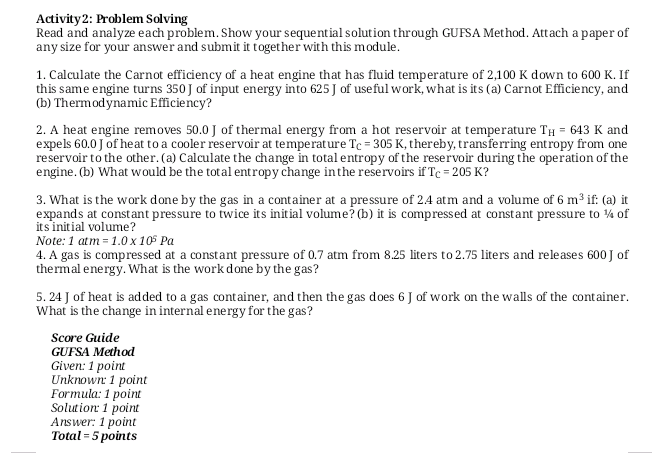
Activity 2: Problem Solving Read and analyze each problem. Show your sequential solution through GUFSA Method. Attach a paper of any size for your answer and submit it together with this module. 1. Calculate the Carnot efficiency of a heat engine that has fluid temperature of 2,100 K down to 600 K. If this same engine turns 350 J of input energy into 625 ] of useful work, what is its (a) Carnot Efficiency, and (b) Thermodynamic Efficiency? 2. A heat engine removes 50.0 J of thermal energy from a hot reservoir at temperature TH = 643 K and expels 60.0 J of heat to a cooler reservoir at temperature To = 305 K, thereby, transferring entropy from one reservoir to the other. (a) Calculate the change in total entropy of the reservoir during the operation of the engine. (b) What would be the total entropy change in the reservoirs if To = 205 K? 3. What is the work done by the gas in a container at a pressure of 24 atm and a volume of 6 m3 if: (a) it expands at constant pressure to twice its initial volume? (b) it is compressed at constant pressure to 14 of its initial volume? Note: 1 atm = 1.0 x 10⁵ Pa 4. A gas is compressed at a constant pressure of 0.7 atm from 8.25 liters to 2.75 liters and releases 600 J of thermal energy. What is the work done by the gas? 5. 24 J of heat is added to a gas container, and then the gas does 6 ] of work on the walls of the container. What is the change in internal energy for the gas? Score Guide GUFSA Method Given: 1 point Unknown 1 point Formula: 1 point Solution: 1 point Answer: 1 point Total = 5 points
Step by Step Solution
There are 3 Steps involved in it

Get step-by-step solutions from verified subject matter experts
 Study Help