







Question: Activity 1A, Activity 1B ACTIVITY 1A Draw these Forces Instruction: Given are the situations, draw the forces acting on the body or bodies using an
Activity 1A, Activity 1B
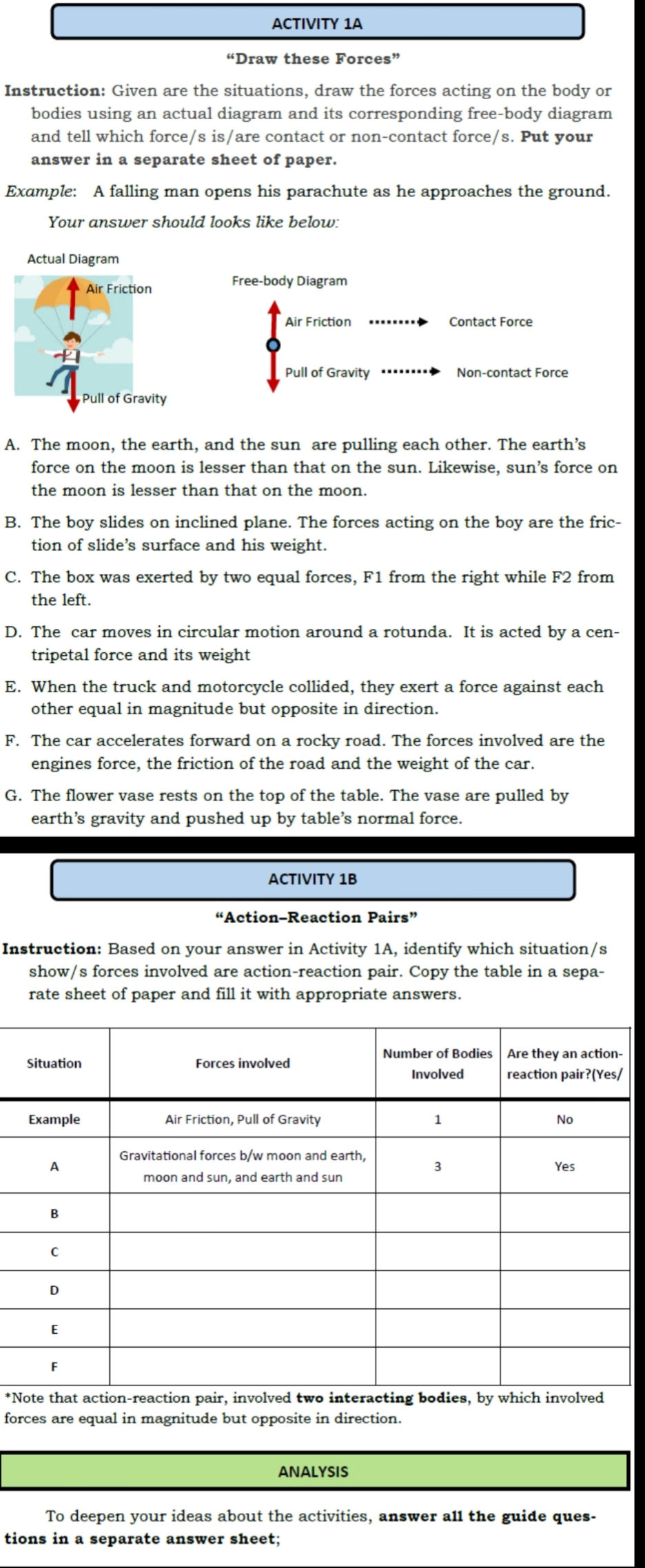
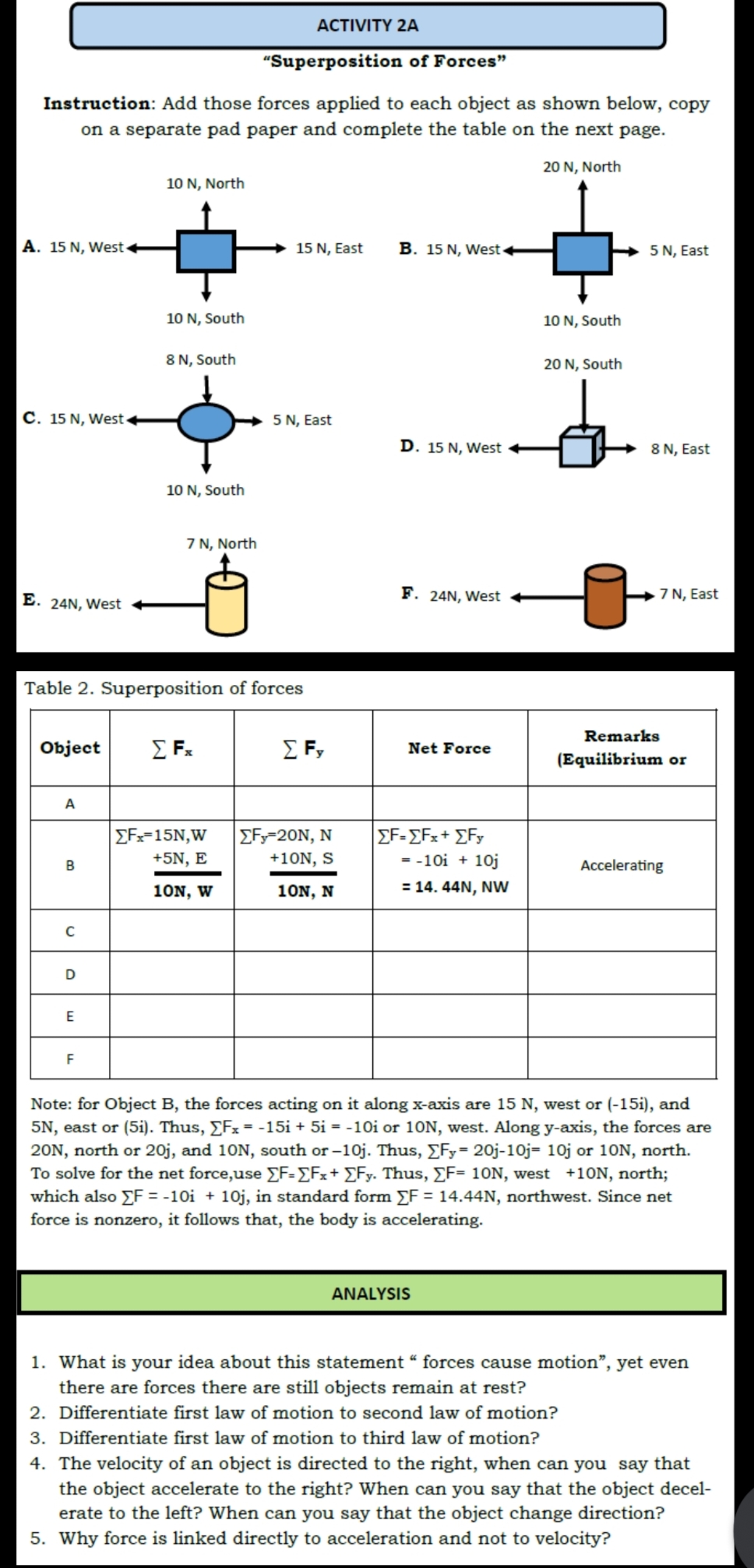
ACTIVITY 1A "Draw these Forces\" Instruction: Given are the situations, draw the forces acting on the body or bodies using an actual diagram and its corresponding free-body diagram and tell which force/s is/are contact or nonrcontact force/s. Put your answer in a separate sheet of paper. Example: A falling man opens his parachute as he approaches the ground. Your answer should looks like below: Actual Diagram tmr Friction Free-body Dlagram AirFric'non "um-b ContactForce A 44 Pull ofGraVIty "an"... Non-contact Force Pull of Gravity A. The moon, the earth, and the sun are pulling each other. The earth's force on the moon is lesser than that on the sun. Likewise, sun's force on the moon is lesser than that on the moon. B. The boy slides on inclined plane. The forces acting on the boy are the fric- tion of slide's surface and his weight. C. The box was exerted by two equal forces. F1 from the right while F2 from the left. D. The car moves in circular motion around a rotunda. It is acted by a cane tripetal force and its weight E. When the truck and motorcycle collided, they exert a force against each other equal in magnitude but opposite in direction. F. The car accelerates forward on a rocky road. The forces involved are the engines force, the friction of the road and the weight of the car. G. The ower vase rests on the top of the table. The vase are pulled by earth's gravity and pushed up by table's normal force. \"ActionReaction Pairs" Instruction: Based on your answer in Activity 1A, identify which situation/s show/s forces involved are action-reaction pair. Copy the table in a sepa- rate sheet of paper and ll it with appropriate answers. Number of Bodies Are they an action- Situat'ion Fortes involved _ Involved reamon pair'les/ Example Arr Friction, Pull of Gravity Gravitational forces b/w moon and earth. moon and sun, and earth and sun 'Note that actionreaction pair, involved two interacting bodies, by which involved forces are equal in magnitude but opposite in direction. ANALYSIS To deepen your ideas about the activities, answer all the guide quel- tionn in a separate answer sheet; ACTIVITY 2A "Superposition of Forces\" Instruction: Add those forces applied to each object as shown below, copy on a separate pad paper and complete the table on the next page. 20 N. North 10 N, North A. 15 N,West+ 15 N.East B. 15 N,West'+. SN, East 10 N, South 10 N, South 8 N. South 20 N, South C. 15 N, West 5 N, East D. 15 N, West 8N, East 10 N, South 7 N, North F- ?N E t E. 24N, West a 24N,We5t 4 , as. Table 2. Superposition of forces Remarks T N t I" FY e orcc [Equilibrium or EFx=15N.W 2F);20N, N ZF:ZF:+ sz +5N, E +10N. s = -10i + 10j = 14. 44N, NW Accelerating Note: for Object B, the forces acting on it along xaxis are 15 N, west or tlSil, and 5N, east or [51']. Thus, 2F; = -15i + 5i = -lOi or ION, west. Along y-axis, the forces are 20N, north or 201', and ION, south orle. Thus, 2F); 20j-10j= 101' or ION, north. To solve for the net force,use ZF:ZFI+ EFy. Thus, ZF= ION, west +10N, north; which also ZF = -10i + 10j, in standard form 2F 2 14.44N. northwest. Since net force is nonzero, it follows that, the body is accelerating. ANALYSIS What is your idea about this statement \" forces cause motion\". yet even there are forces there are still objects remain at rest? Differentiate rst law of motion to second law of motion? Differentiate rst law of motion to third law of motion? The velocity of an object is directed to the right, when can you say that the object accelerate to the right? When can you say that the object decele erate to the left? When can you say that the object change direction? Why force is linked directly to acceleration and not to velocity
Step by Step Solution
There are 3 Steps involved in it

Get step-by-step solutions from verified subject matter experts
 Study Help