







Question: Activity 1:Boiling Point Elevation and Freezing Point Depression Now it is time for you to solve the Boiling Point Elevation and Freezing Point Depression of
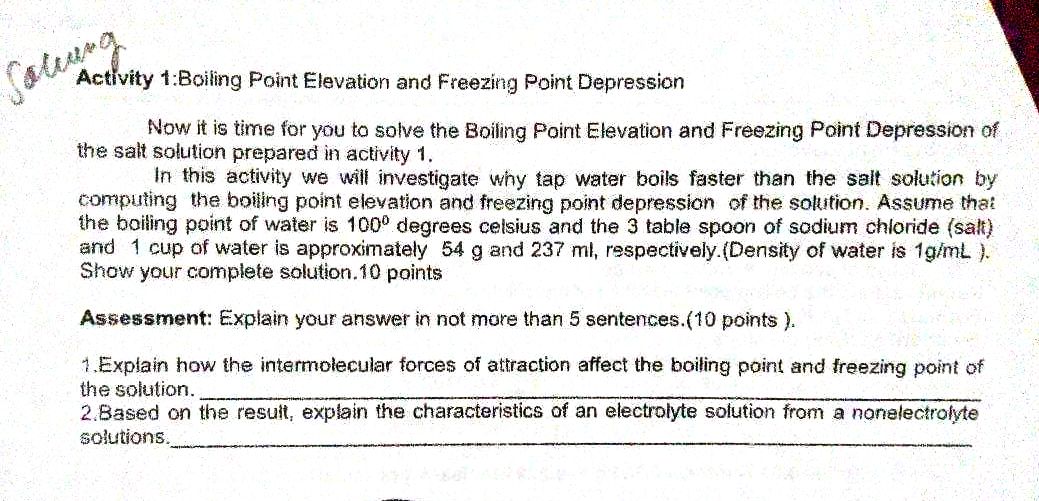
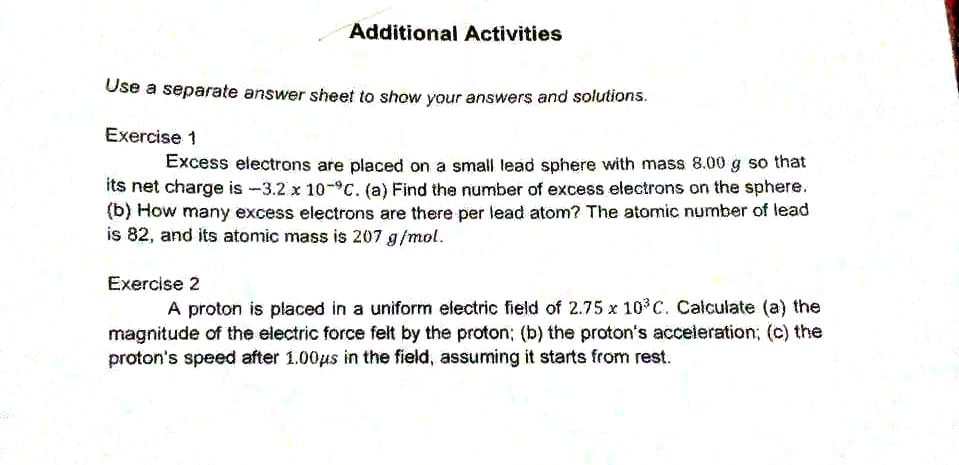
Activity 1:Boiling Point Elevation and Freezing Point Depression Now it is time for you to solve the Boiling Point Elevation and Freezing Point Depression of the salt solution prepared in activity 1. In this activity we will investigate why tap water boils faster than the salt solution by computing the boiling point elevation and freezing point depression of the solution. Assume that the boiling point of water is 100 degrees celsius and the 3 table spoon of sodium chloride (salt) and 1 cup of water is approximately 54 g and 237 ml, respectively. (Density of water is 1g/ml ). Show your complete solution. 10 points Assessment: Explain your answer in not more than 5 sentences.(10 points ). 1. Explain how the intermolecular forces of attraction affect the boiling point and freezing point of the solution. 2. Based on the result, explain the characteristics of an electrolyte solution from a nonelectrolyte solutionsAdditional Activities Use a separate answer sheet to show your answers and solutions. Exercise 1 Excess electrons are placed on a small lead sphere with mass 8.00 g so that its net charge is -3.2 x 10-C. (a) Find the number of excess electrons on the sphere. (b) How many excess electrons are there per lead atom? The atomic number of lead is 82, and its atomic mass is 207 g/mol. Exercise 2 A proton is placed in a uniform electric field of 2.75 x 10 C. Calculate (a) the magnitude of the electric force felt by the proton; (b) the proton's acceleration; (c) the proton's speed after 1.00us in the field, assuming it starts from rest
Step by Step Solution
There are 3 Steps involved in it

Get step-by-step solutions from verified subject matter experts
 Study Help