







Question: Activity 2 In this activity, we will calculate the average acceleration of the ball as it falls under the influence of gravity. As we've done
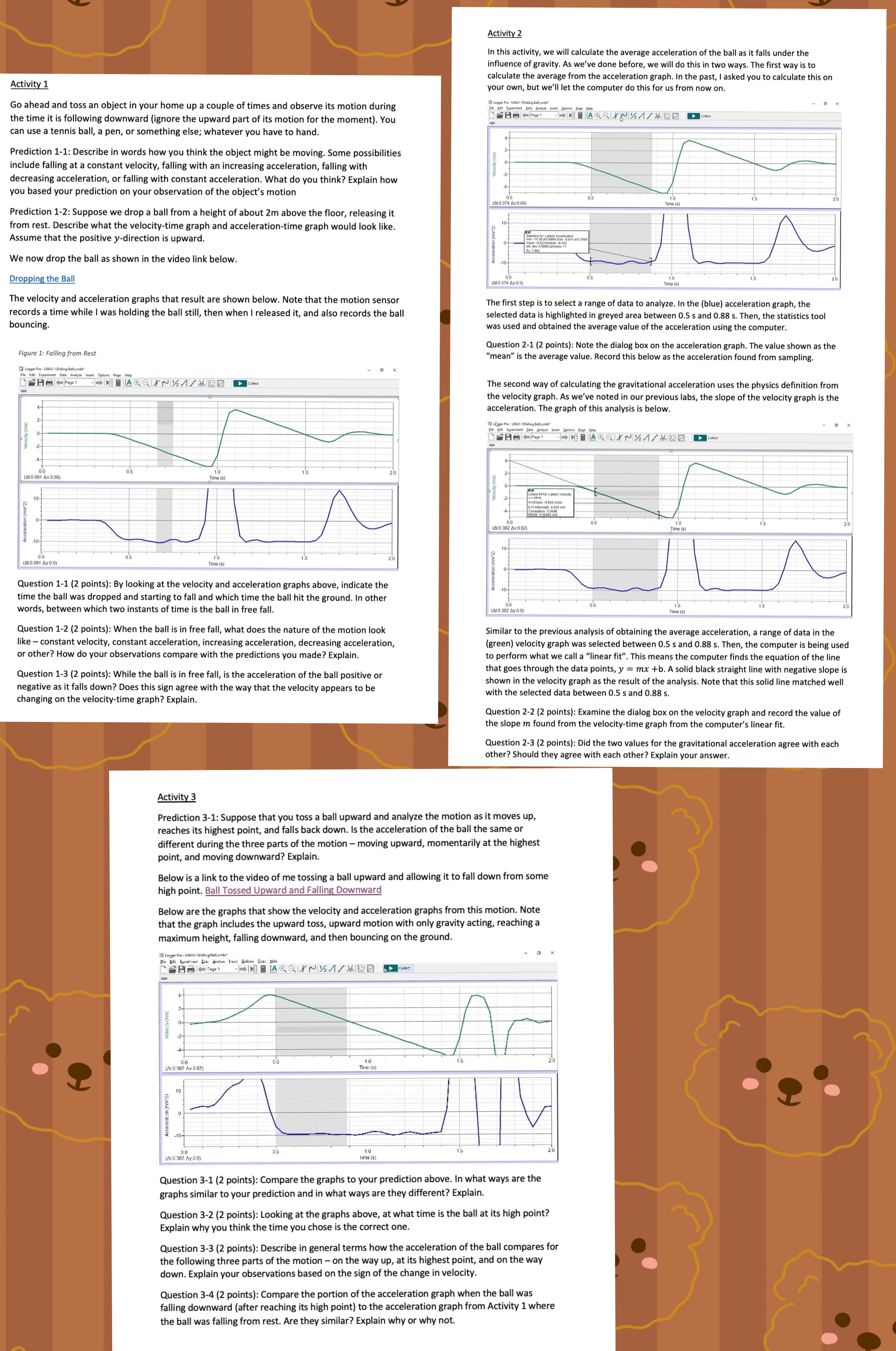
Activity 2 In this activity, we will calculate the average acceleration of the ball as it falls under the influence of gravity. As we've done before, we will do this in two ways. The first way is to calculate the average from the acceleration graph. In the past, I asked you to calculate this on Activity 1 your own, but we'll let the computer do this for us from now on. Go ahead and toss an object in your home up a couple of times and observe its motion during the time it is following downward (ignore the upward part of its motion for the moment). You can use a tennis ball, a pen, or something else; whatever you have to hand. Prediction 1-1: Describe in words how you think the object might be moving. Some possibilities Include falling at a constant velocity, falling with an increasing acceleration, falling with Velocity (m's) decreasing acceleration, or falling with constant acceleration. What do you think? Explain how you based your prediction on your observation of the object's motion (At0 374 Prediction 1-2: Suppose we drop a ball from a height of about 2m above the floor, releasing it from rest. Describe what the velocity-time graph and acceleration-time graph would look like. 10 Assume that the positive y-direction is upward We now drop the ball as shown in the video link below. . 10 Dropping the Ball 10 374 Ay 05 The velocity and acceleration graphs that result are shown below. Note that the motion sensor The first step is to select a range of data to analyze. In the (blue) acceleration graph, the records a time while I was holding the ball still, then when I released it, and also records the ball selected data is highlighted in greyed area between 0.5 s and 0.88 s. Then, the statistics tool bouncing was used and obtained the average value of the acceleration using the computer. Question 2-1 (2 points): Note the dialog box on the acceleration graph. The value shown as the Figure 1: Falling from Rest "mean" is the average value. Record this below as the acceleration found from sampling Ly Logger Pro - LOSA1-1(Faling BeAnalyses The second way of calculating the gravitational acceleration uses the physics definition from the velocity graph. As we've noted in our previous labs, the slope of the velocity graph is the acceleration. The graph of this analysis is below Lager Pre - LOGA1- 1Faling Ball.imbi (At 0 091 Av 3.58) Time (s ) Velocity im Linear Fit for Latest / Vesoon m(Slopes -9.655 mt's Acceleration (m's*2 (At 0.382 Av.0.82) 10- Acceleration (m/'s2 Question 1-1 (2 points): By looking at the velocity and acceleration graphs above, indicate the time the ball was dropped and starting to fall and which time the ball hit the ground. In other words, between which two instants of time is the ball in free fall. (At 0.382 Ay 0.0) Question 1-2 (2 points): When the ball is in free fall, what does the nature of the motion look Similar to the previous analysis of obtaining the average acceleration, a range of data in the ike - constant velocity, constant acceleration, increasing acceleration, decreasing acceleration, (green) velocity graph was selected between 0.5 s and 0.88 s. Then, the computer is being used or other? How do your observations compare with the predictions you made? Explain. to perform what we call a "linear fit". This means the computer finds the equation of the line Question 1-3 (2 points): While the ball is in free fall, is the acceleration of the ball positive or that goes through the data points, y = mx +b. A solid black straight line with negative slope is negative as it falls down? Does this sign agree with the way that the velocity appears to be shown in the velocity graph as the result of the analysis. Note that this solid line matched well changing on the velocity-time graph? Explain. with the selected data between 0.5 s and 0.88 s. Question 2-2 (2 points): Examine the dialog box on the velocity graph and record the value of the slope m found from the velocity-time graph from the computer's linear fit. Question 2-3 (2 points): Did the two values for the gravitational acceleration agree with each other? Should they agree with each other? Explain your answer. Activity 3 Prediction 3-1: Suppose that you toss a ball upward and analyze the motion as it moves up, reaches its highest point, and falls back down. Is the acceleration of the ball the same or different during the three parts of the motion - moving upward, momentarily at the highest point, and moving downward? Explain. Below is a link to the video of me tossing a ball upward and allowing it to fall down from some high point. Ball Tossed Upward and Falling Downward Below are the graphs that show the velocity and acceleration graphs from this motion. Note that the graph includes the upward toss, upward motion with only gravity acting, reaching a maximum height, falling downward, and then bouncing on the ground. Velosim's) (AID 367 Av Da2) Accelerat En :mis*2 CALD 362 Ay D Time ( 3 ) Question 3-1 (2 points): Compare the graphs to your prediction above. In what ways are the graphs similar to your prediction and in what ways are they different? Explain. Question 3-2 (2 points): Looking at the graphs above, at what time is the ball at its high point? Explain why you think the time you chose is the correct one. Question 3-3 (2 points): Describe in general terms how the acceleration of the ball compares for the following three parts of the motion - on the way up, at its highest point, and on the way down. Explain your observations based on the sign of the change in velocity. Question 3-4 (2 points): Compare the portion of the acceleration graph when the ball was falling downward (after reaching its high point) to the acceleration graph from Activity 1 where the ball was falling from rest. Are they similar? Explain why or why not
Step by Step Solution
There are 3 Steps involved in it

Get step-by-step solutions from verified subject matter experts
 Study Help