





Question: Activity 2 In this activity, we will calculate the average acceleration of the ball as it falls under the influence of gravity. As we've done
Activity 2 In this activity, we will calculate
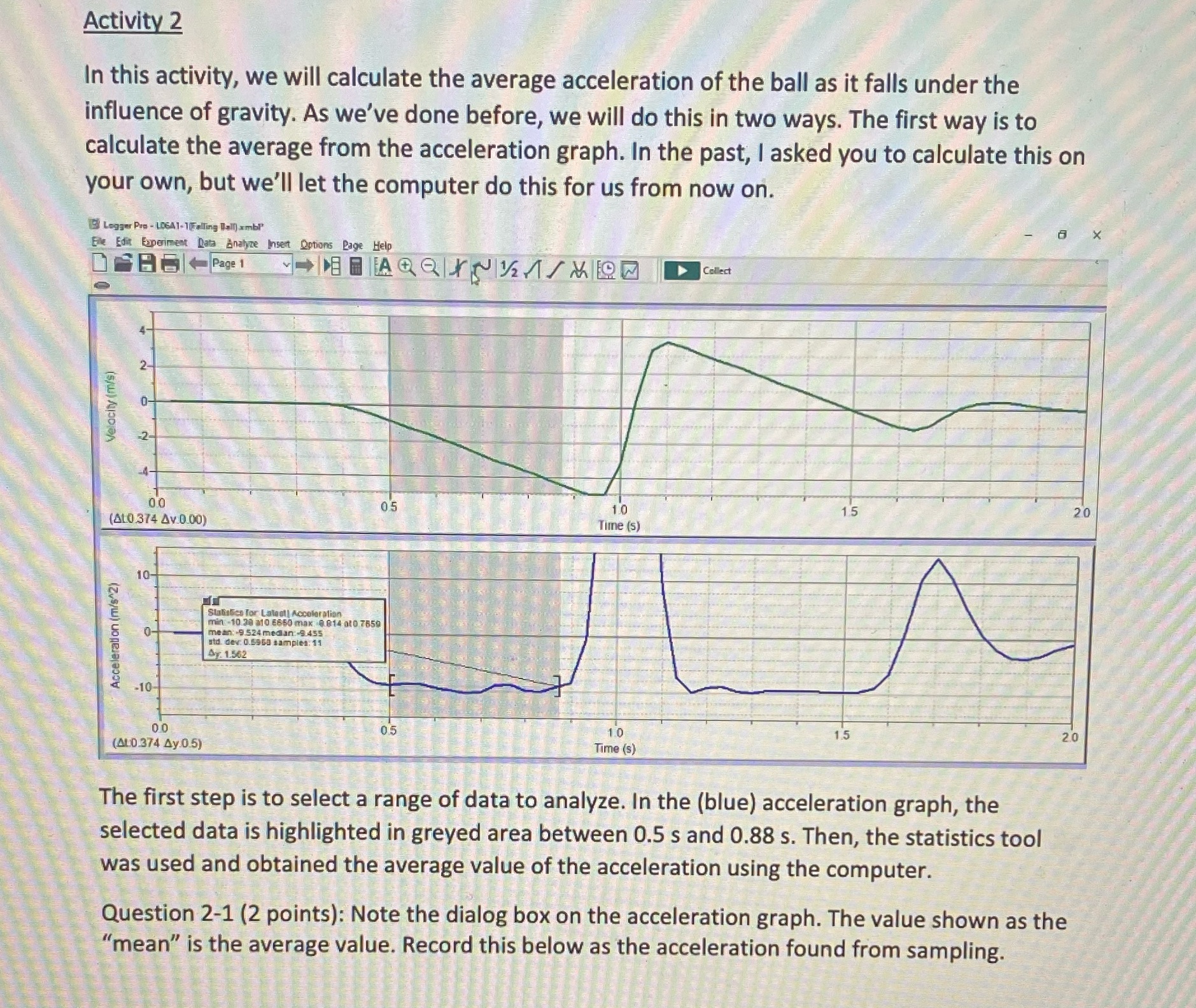
Activity 2 In this activity, we will calculate the average acceleration of the ball as it falls under the influence of gravity. As we've done before, we will do this in two ways. The first way is to calculate the average from the acceleration graph. In the past, I asked you to calculate this on your own, but we'll let the computer do this for us from now on. Legger Pro - (DGA)-1Falling Bell) ambl File Edit Experiment Data Analyze Insert Options Page Help Velocity (TV'S) 00 05 10 1'5 20 (AL0 374 Av.0.00) Time (S) 10- SlabsEco For Lateol Accolerplian mini -10 20 810 5650 max 0- mean -9 524 medan: -9455 Accelerall on (m/s^2) uld /dev: 0.5950 samples: 11 AT. 1.562 -10 00 10 20 (ALD.374 Ay.0.5) Time (s) The first step is to select a range of data to analyze. In the (blue) acceleration graph, the selected data is highlighted in greyed area between 0.5 s and 0.88 s. Then, the statistics tool was used and obtained the average value of the acceleration using the computer. Question 2-1 (2 points): Note the dialog box on the acceleration graph. The value shown as the "mean" is the average value. Record this below as the acceleration found from sampling

Step by Step Solution

There are 3 Steps involved in it

1 Expert Approved Answer
Step: 1 Unlock blur-text-image

Question Has Been Solved by an Expert!

Get step-by-step solutions from verified subject matter experts

Step: 2 Unlock
Step: 3 Unlock

Students Have Also Explored These Related Mathematics Questions!