







Question: Activity B (continued from previous page) 3. Suppose a and b have initial points at the origin, and a = and b = . A.
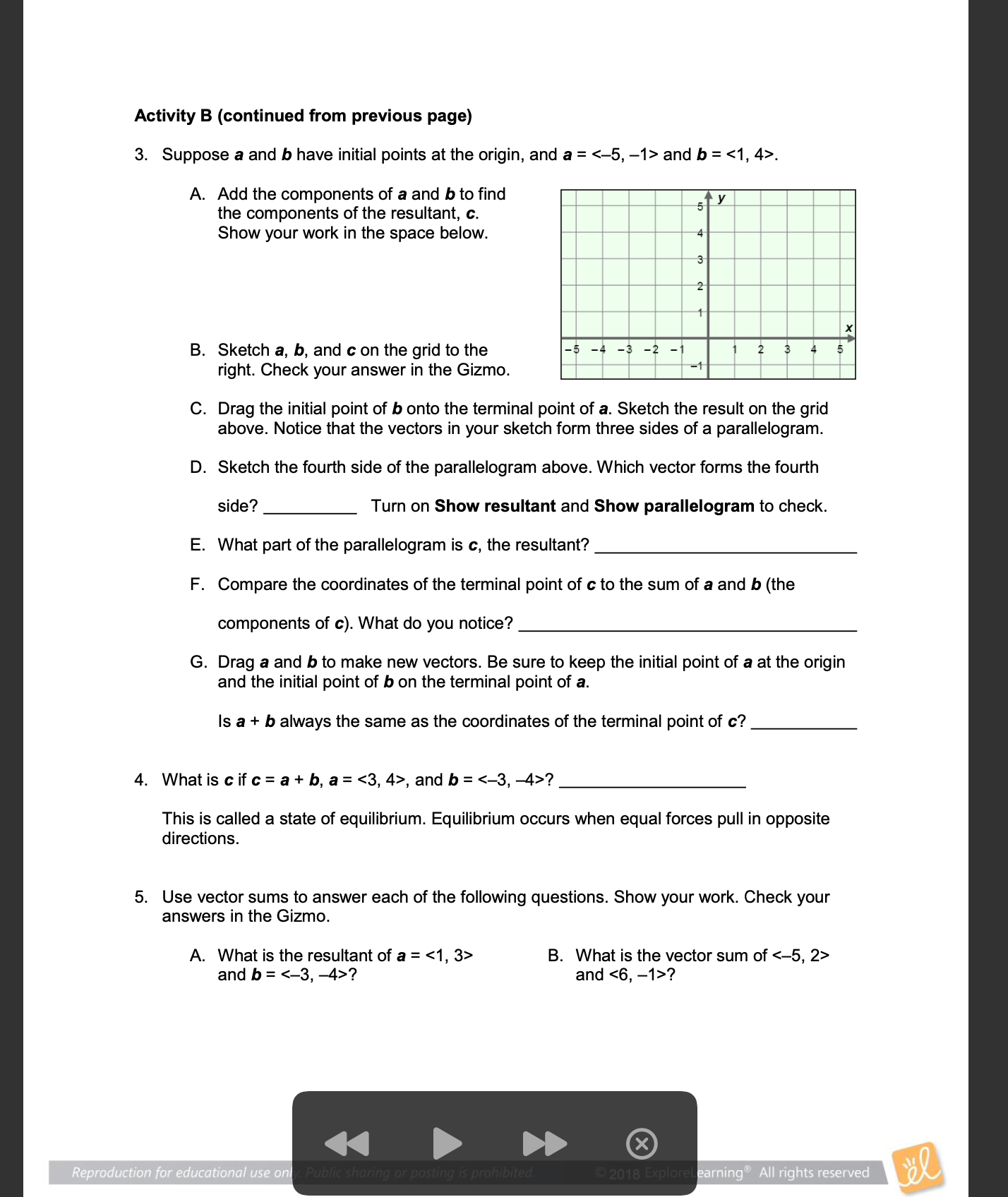
Activity B (continued from previous page) 3. Suppose a and b have initial points at the origin, and a = and b = . A. Add the components of a and b to find the components of the resultant, c. Show your work in the space below. B. Sketch a, b, and c on the grid to the right. Check your answer in the Gizmo. C. Drag the initial point of b onto the terminal point of a. Sketch the result on the grid above. Notice that the vectors in your sketch form three sides of a parallelogram. D. Sketch the fourth side of the parallelogram above. Which vector forms the fourth side? Turn on Show resultant and Show parallelogram to check. E. What part of the parallelogram is c, the resultant? F. Compare the coordinates of the terminal point of c to the sum of a and b (the components of c). What do you notice? G. Drag a and b to make new vectors. Be sure to keep the initial point of a at the origin and the initial point of b on the terminal point of a. Is a + b always the same as the coordinates of the terminal point of c? 4. Whatiscifc=a+b, a=, andb=? This is called a state of equilibrium. Equilibrium occurs when equal forces pull in opposite directions. 5. Use vector sums to answer each of the following questions. Show your work. Check your answers in the Gizmo. A. What is the resultant of a = B. What is the vector sum of and b = ? and ? earning\" All rights reserved
Step by Step Solution
There are 3 Steps involved in it

Get step-by-step solutions from verified subject matter experts
 Study Help