Question: ACTIVITY - MODULE 10 - Ledgers A. Multiple Choice. Write the letter of your chosen answer in the blank provided. 1. An entity has various
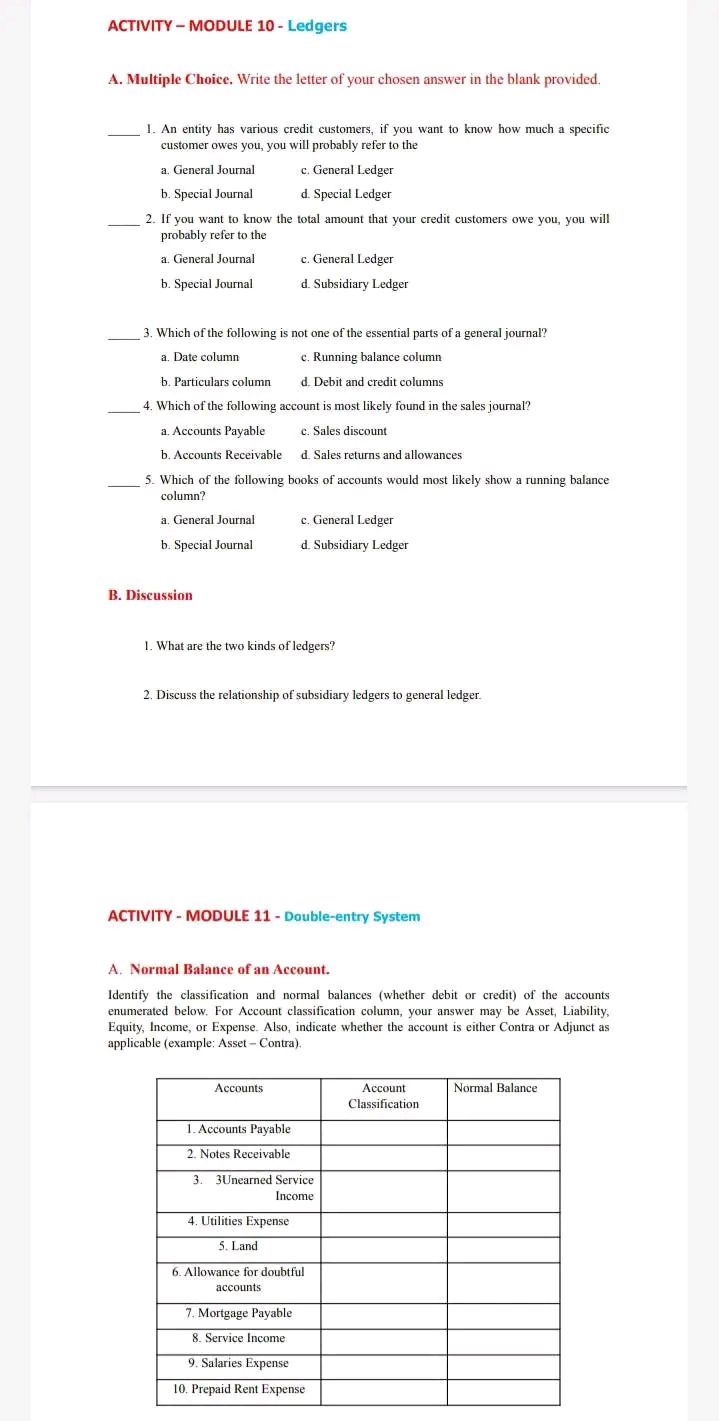
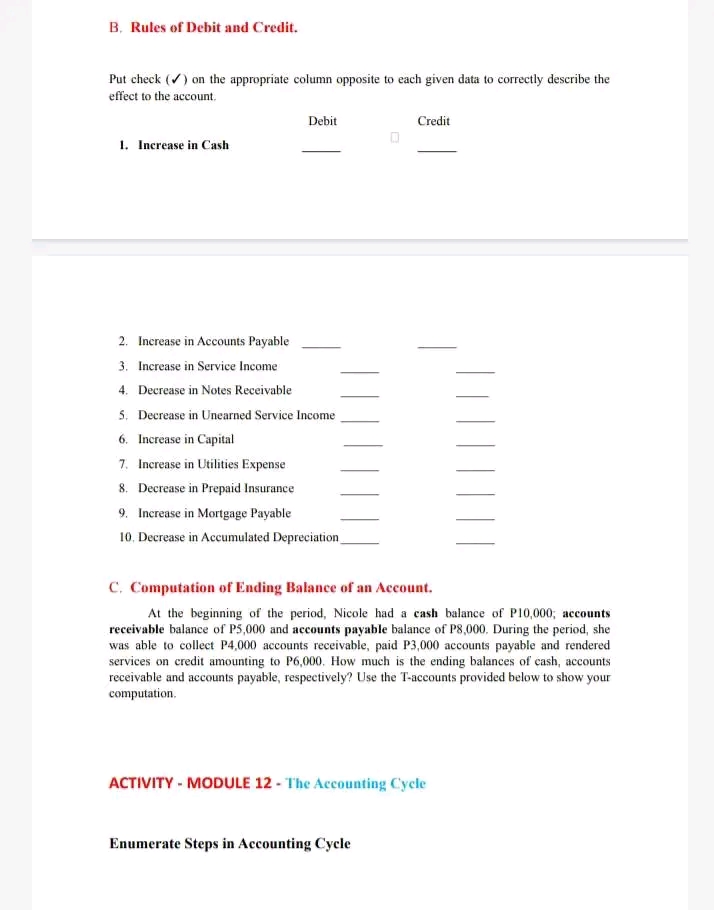
ACTIVITY - MODULE 10 - Ledgers A. Multiple Choice. Write the letter of your chosen answer in the blank provided. 1. An entity has various credit customers, if you want to know how much a specific customer owes you, you will probably refer to the a, General Journal c. General Ledger b. Special Journal d. Special Ledger 2. If you want to know the total amount that your credit customers owe you, you will probably refer to the a. General Journal c. General Ledger b. Special Journal d. Subsidiary Ledger 3. Which of the following is not one of the essential parts of a general journal? a. Date column c. Running balance column b. Particulars column d. Debit and credit columns 4. Which of the following account is most likely found in the sales journal? a. Accounts Payable c. Sales discount b. Accounts Receivable d. Sales returns and allowances 5. Which of the following books of accounts would most likely show a running balance column? a. General Journal c. General Ledger b. Special Journal d. Subsidiary Ledger B. Discussion 1. What are the two kinds of ledgers? 2. Discuss the relationship of subsidiary ledgers to general ledger. ACTIVITY - MODULE 11 - Double-entry System A. Normal Balance of an Account. Identify the classification and normal balances (whether debit or credit) of the accounts enumerated below. For Account classification column, your answer may be Asset, Liability, Equity, Income, or Expense. Also, indicate whether the account is either Contra or Adjunct as applicable (example: Asset - Contra). Accounts Account Normal Balance Classification 1. Accounts Payable 2. Notes Receivable 3. 3Unearned Service Income 4. Utilities Expense 5. Land 6. Allowance for doubtful accounts 7. Mortgage Payable 8. Service Income 9. Salaries Expense 10. Prepaid Rent ExpenseB. Rules of Debit and Credit. Put check ( ) on the appropriate column opposite to each given data to correctly describe the effect to the account. Debit Credit 1. Increase in Cash 2. Increase in Accounts Payable 3. Increase in Service Income 4. Decrease in Notes Receivable 1I1 5. Decrease in Unearned Service Income 6. Increase in Capital 7. Increase in Utilities Expense 8. Decrease in Prepaid Insurance 9. Increase in Mortgage Payable 10, Decrease in Accumulated Depreciation C. Computation of Ending Balance of an Account. At the beginning of the period, Nicole had a cash balance of P10,000, accounts receivable balance of P5,000 and accounts payable balance of P8,000. During the period, she was able to collect P4,000 accounts receivable, paid P3,000 accounts payable and rendered services on credit amounting to P6,000. How much is the ending balances of cash, accounts receivable and accounts payable, respectively? Use the T-accounts provided below to show your computation. ACTIVITY - MODULE 12 - The Accounting Cycle Enumerate Steps in Accounting Cycle
Step by Step Solution
There are 3 Steps involved in it
1 Expert Approved Answer
Step: 1 Unlock
Question Has Been Solved by an Expert!
Get step-by-step solutions from verified subject matter experts
Step: 2 Unlock
Step: 3 Unlock
Students Have Also Explored These Related Accounting Questions!









 Study Help