







Question: ( adapted from Hibbeler ( 1 0 ^ { text { th } } ) ed . prob. 5 - 1 2
adapted from Hibbeler text th ed prob.
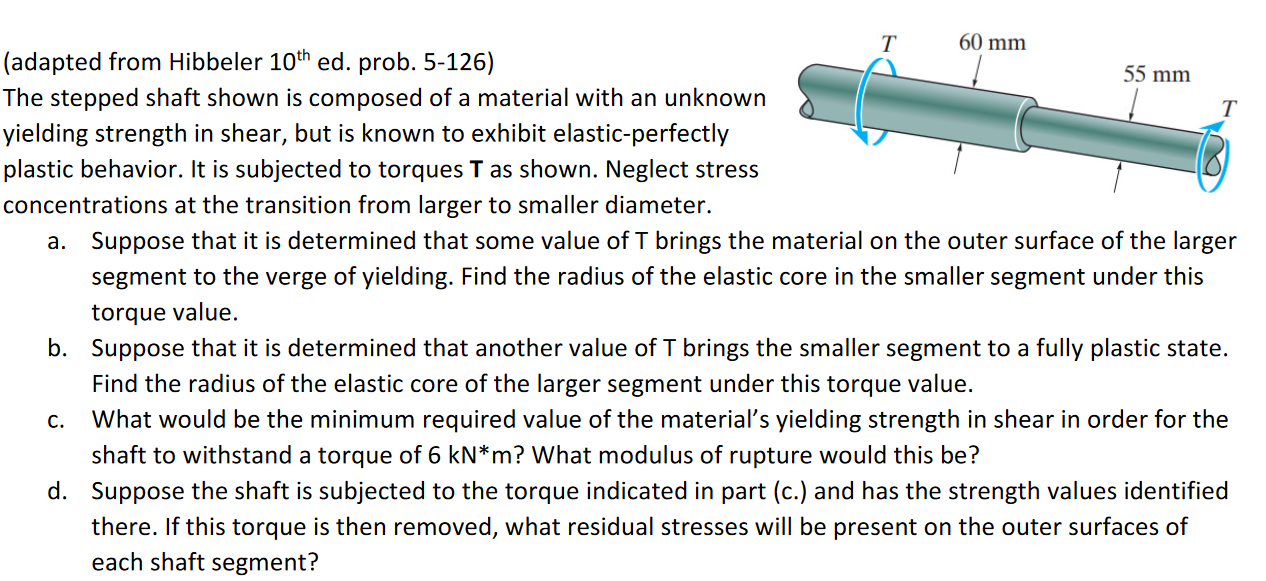
The stepped shaft shown is composed of a material with an unknown yielding strength in shear, but is known to exhibit elasticperfectly plastic behavior. It is subjected to torques mathbfT as shown. Neglect stress concentrations at the transition from larger to smaller diameter.
a Suppose that it is determined that some value of T brings the material on the outer surface of the larger segment to the verge of yielding. Find the radius of the elastic core in the smaller segment under this torque value.
b Suppose that it is determined that another value of T brings the smaller segment to a fully plastic state. Find the radius of the elastic core of the larger segment under this torque value.
c What would be the minimum required value of the material's yielding strength in shear in order for the shaft to withstand a torque of mathrmkNmathrm~m What modulus of rupture would this be
d Suppose the shaft is subjected to the torque indicated in part c and has the strength values identified there. If this torque is then removed, what residual stresses will be present on the outer surfaces of each shaft segment?
Step by Step Solution
There are 3 Steps involved in it
1 Expert Approved Answer
Step: 1 Unlock

Question Has Been Solved by an Expert!
Get step-by-step solutions from verified subject matter experts
Step: 2 Unlock
Step: 3 Unlock
 Study Help