







Question: Added methods NEED to extend ArrayBoundedStack, not added to the actual class. Test Driver to show Extended methods work correctly. package ch02.stacks; public class ArrayBoundedStack
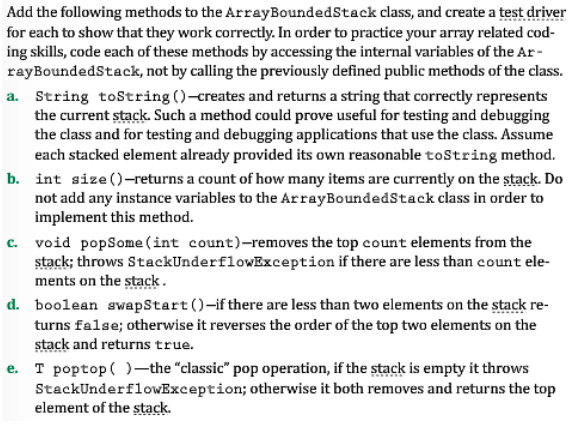
Added methods NEED to extend ArrayBoundedStack, not added to the actual class. Test Driver to show Extended methods work correctly.
package ch02.stacks; public class ArrayBoundedStackimplements StackInterface { protected final int DEFCAP = 100; // default capacity protected T[] elements; // holds stack elements protected int topIndex = -1; // index of top element in stack public ArrayBoundedStack() { elements = (T[]) new Object[DEFCAP]; } public ArrayBoundedStack(int maxSize) { elements = (T[]) new Object[maxSize]; } public void push(T element) // Throws StackOverflowException if this stack is full, // otherwise places element at the top of this stack. { if (isFull()) throw new StackOverflowException("Push attempted on a full stack."); else { topIndex++; elements[topIndex] = element; } } public void pop() // Throws StackUnderflowException if this stack is empty, // otherwise removes top element from this stack. { if (isEmpty()) throw new StackUnderflowException("Pop attempted on an empty stack."); else { elements[topIndex] = null; topIndex--; } } public T top() // Throws StackUnderflowException if this stack is empty, // otherwise returns top element of this stack. { T topOfStack = null; if (isEmpty()) throw new StackUnderflowException("Top attempted on an empty stack."); else topOfStack = elements[topIndex]; return topOfStack; } public boolean isEmpty() // Returns true if this stack is empty, otherwise returns false. { return (topIndex == -1); } public boolean isFull() // Returns true if this stack is full, otherwise returns false. { return (topIndex == (elements.length - 1)); } }
--------------------------------------------------------------------------------------------------------------------------------------
package ch02.stacks; public interface StackInterface{ void push(T element) throws StackOverflowException; // Throws StackOverflowException if this stack is full, // otherwise places element at the top of this stack. void pop() throws StackUnderflowException; // Throws StackUnderflowException if this stack is empty, // otherwise removes top element from this stack. T top() throws StackUnderflowException; // Throws StackUnderflowException if this stack is empty, // otherwise returns top element of this stack. boolean isEmpty(); // Returns true if this stack is empty, otherwise returns false. boolean isFull(); // Returns true if this stack is full, otherwise returns false. }
---------------------------------- Extended.java---------------------------------
import ch02.stacks.*;
public class Extended
Add the following methods to the ArrayBoundedStack class, and create a test driver for each to show that they work correctly. In order to practice your array related cod- ing skills, code each of these methods by accessing the internal variables of the Ar- rayBoundedStack, not by calling the previously defined public methods of the class. a. String toString()-creates and returns a string that correctly represents the current stack. Such a method could prove useful for testing and debugging the class and for testing and debugging applications that use the class. Assume each stacked element already provided its own reasonable toString method. b. int size()-returns a count of how many items are currently on the stack. Do not add any instance variables to the ArrayBoundedStack class in order to implement this method. void popSome (int count)-removes the top count elements from the stack; throws StackUnderflowException if there are less than count ele- ments on the stack. d. boolean gwapStart()-if there are less than two elements on the stack re- turns false; otherwise it reverses the order of the top two elements on the stack and returns true. e. I poptop()-the "classic" pop operation, if the stack is empty it throws StackUnderflowException; otherwise it both removes and returns the top element of the stack
Step by Step Solution
There are 3 Steps involved in it

Get step-by-step solutions from verified subject matter experts
 Study Help