







Question: public class ArrayBoundedQueue implements QueueInterface { protected final int DEFCAP = 100; // default capacity protected T[] elements; // array that holds queue elements protected
public class ArrayBoundedQueue
public ArrayBoundedQueue() { elements = (T[]) new Object[DEFCAP]; rear = DEFCAP - 1; }
public ArrayBoundedQueue(int maxSize) { elements = (T[]) new Object[maxSize]; rear = maxSize - 1; }
public void enqueue(T element) // Throws QueueOverflowException if this queue is full; // otherwise, adds element to the rear of this queue. { if (isFull()) throw new QueueOverflowException("Enqueue attempted on a full queue."); else { rear = (rear + 1) % elements.length; elements[rear] = element; numElements = numElements + 1; } }
public T dequeue() // Throws QueueUnderflowException if this queue is empty; // otherwise, removes front element from this queue and returns it. { if (isEmpty()) throw new QueueUnderflowException("Dequeue attempted on empty queue."); else { T toReturn = elements[front]; elements[front] = null; front = (front + 1) % elements.length; numElements = numElements - 1; return toReturn; } }
public boolean isEmpty() // Returns true if this queue is empty; otherwise, returns false. { return (numElements == 0); }
public boolean isFull() // Returns true if this queue is full; otherwise, returns false. { return (numElements == elements.length); } public int size() // Returns the number of elements in this queue. { return numElements; } }
package ch04.queues;
import support.LLNode;
public class LinkedQueue
public LinkedQueue() { front = null; rear = null; }
public void enqueue(T element) // Adds element to the rear of this queue. { LLNode
public T dequeue() // Throws QueueUnderflowException if this queue is empty; // otherwise, removes front element from this queue and returns it. { if (isEmpty()) throw new QueueUnderflowException("Dequeue attempted on empty queue."); else { T element; element = front.getInfo(); front = front.getLink(); if (front == null) rear = null; numElements--; return element; } }
public boolean isEmpty() // Returns true if this queue is empty; otherwise, returns false. { return (front == null); } public boolean isFull() // Returns false - a linked queue is never full. { return false; }
public int size() // Returns the number of elements in this queue. { return numElements; }
}
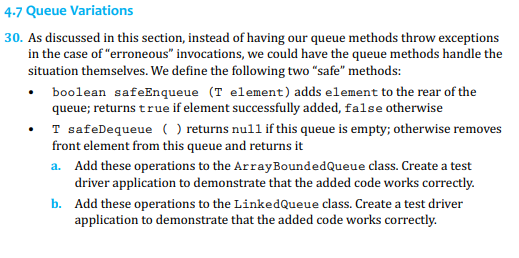
30. As discussed in this section, instead of having our queue methods throw exceptions in the case of "erroneous" invocations, we could have the queue methods handle the situation themselves. We define the following two "safe" methods: - boolean safeEnqueue (T element) adds element to the rear of the queue; returns true if element successfully added, false otherwise - T safeDequeue ( ) returns nu11 if this queue is empty; otherwise removes front element from this queue and returns it a. Add these operations to the ArrayBoundedQueue class. Create a test driver application to demonstrate that the added code works correctly. b. Add these operations to the LinkedQueue class. Create a test driver application to demonstrate that the added code works correctly
Step by Step Solution
There are 3 Steps involved in it

Get step-by-step solutions from verified subject matter experts
 Study Help