





Question: . additional problem 2: Linearization As mentioned in class, many differential equations cannot be solved analytically. We will thus discuss several strategies to at least
. additional problem 2: Linearization As
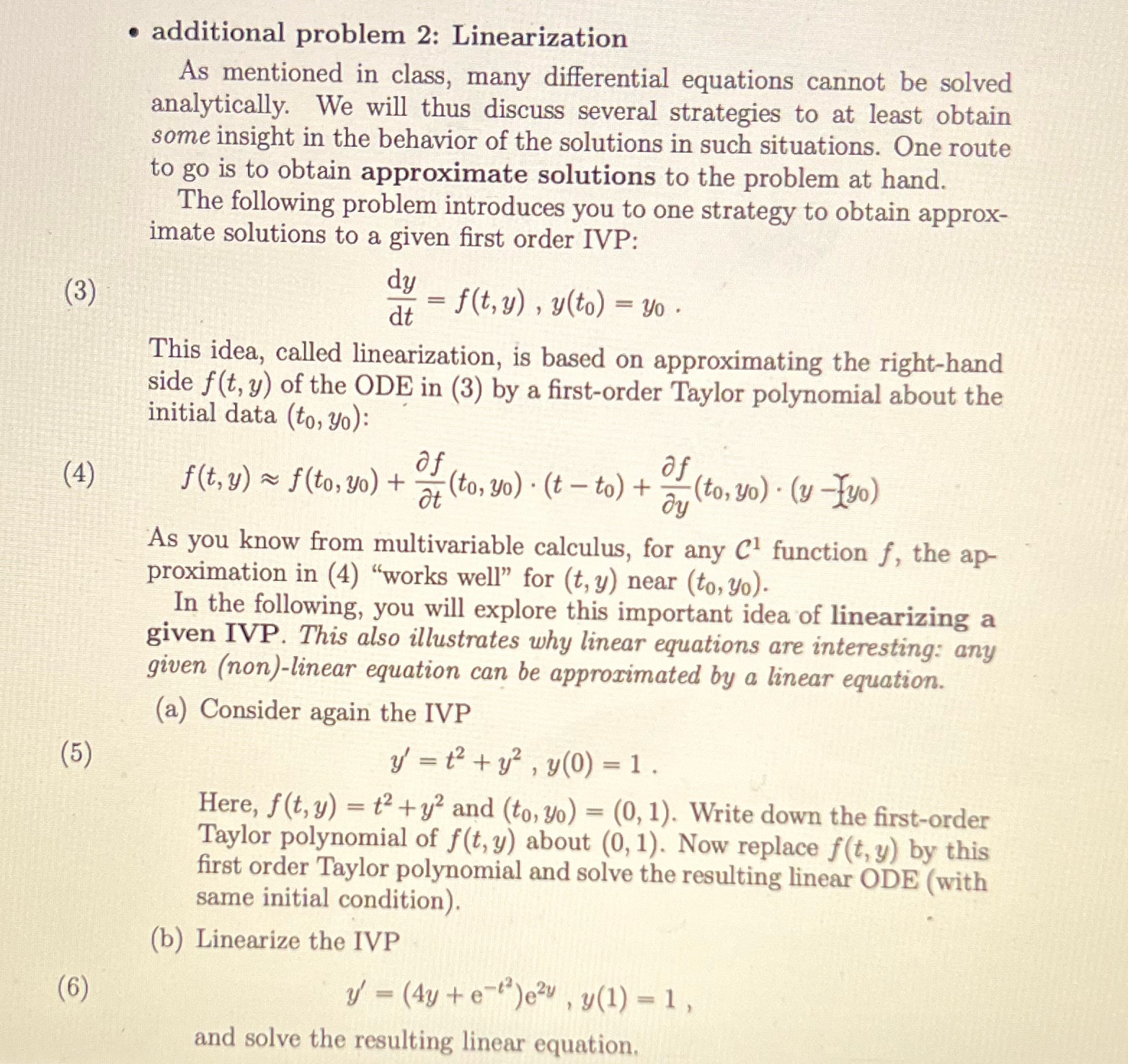
. additional problem 2: Linearization As mentioned in class, many differential equations cannot be solved analytically. We will thus discuss several strategies to at least obtain some insight in the behavior of the solutions in such situations. One route to go is to obtain approximate solutions to the problem at hand. The following problem introduces you to one strategy to obtain approx- imate solutions to a given first order IVP: (3) dt dy = f(t, y) , y(to) = yo . This idea, called linearization, is based on approximationg the right-hand side f(t, y) of the ODE in (3) by a first-order Taylor polynomial about the initial data (to, yo): (4 ) f (t, y) ~ f(to, yo) + at (to I ( to , yo ) . ( t - to ) + ay (to, yo ) . (y - yo ) As you know from multivariable calculus, for any C' function f, the ap- proximation in (4) "works well" for (t, y) near (to, yo). In the following, you will explore this important idea of linearizing a given IVP. This also illustrates why linear equations are interesting: any given (non)-linear equation can be approximated by a linear equation. (a) Consider again the IVP (5) y' = th + 2, y(0) = 1 . Here, f(t, y) = t2 + 2 and (to, yo) = (0, 1). Write down the first-order Taylor polynomial of f(t, y) about (0, 1). Now replace f(t, y) by this first order Taylor polynomial and solve the resulting linear ODE (with same initial condition). (b) Linearize the IVP (6) y' = (4y + e " )e2v, y(1) = 1 , and solve the resulting linear equation

Step by Step Solution

There are 3 Steps involved in it

1 Expert Approved Answer
Step: 1 Unlock blur-text-image

Question Has Been Solved by an Expert!

Get step-by-step solutions from verified subject matter experts

Step: 2 Unlock
Step: 3 Unlock

Students Have Also Explored These Related Mathematics Questions!