







Question: Additional tracking data for specific identification: (1) January 15 sale200 units @ $14, (2) April 1 sale200 units @ $15, and (3) November 1 sale200
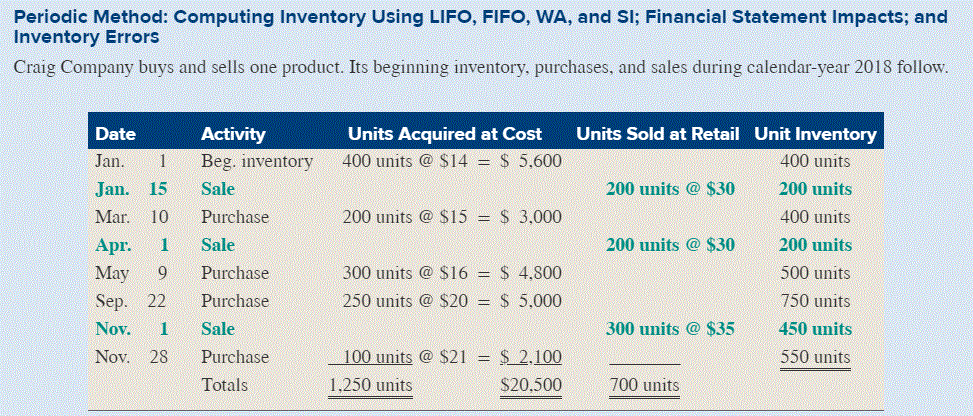
Additional tracking data for specific identification: (1) January 15 sale200 units @ $14, (2) April 1 sale200 units @ $15, and (3) November 1 sale200 units @ $14 and 100 units @ $20.
(1.) What is the Cost of Good Available for Sale ? How many units available for sale? (1 point)
(2.) Using the Periodic System, determine Cost of Goods Sold (COGS) and Ending Inventory using one of the methods: Specific Identification, Weighted Average, FIFO or LIFO. Show your work. (3 Points)
(3.) Explain how the calculation might be different if you used Perpetual System instead. (1 point)
Periodic Method: Computing Inventory Using LIFO, FIFO, WA, and SI; Financial Statement Impacts; and Inventory Errors Craig Company buys and sells one product. Its beginning inventory, purchases, and sales during calendar-year 2018 follow. Date Activity Beg. inventory Sale Units Acquired at Cost 400 units @ $14 = $ 5,600 200 units @ $15 = $ 3,000 Jan. 1 Jan. 15 Mar. 10 Apr. 1 May 9 Sep. 22 Nov. 1 Nov. 28 Purchase Sale Purchase Units Sold at Retail Unit Inventory 400 units 200 units @ $30 200 units 400 units 200 units @ $30 200 units 500 units 750 units 300 units @ $35 450 units 550 units 700 units 300 units @ $16 = $ 4,800 250 units @ $20 = $ 5.000 Purchase Sale Purchase 100 units @ $21 = $ 2.100 1.250 units $20.500 Totals
Step by Step Solution
There are 3 Steps involved in it

Get step-by-step solutions from verified subject matter experts
 Study Help