







Question: Ad-Hoc Network Simulation In this homework, you are going to simulate an Ad-Hoc Network. Your simulation will have two layers with acknowledgment and resending.
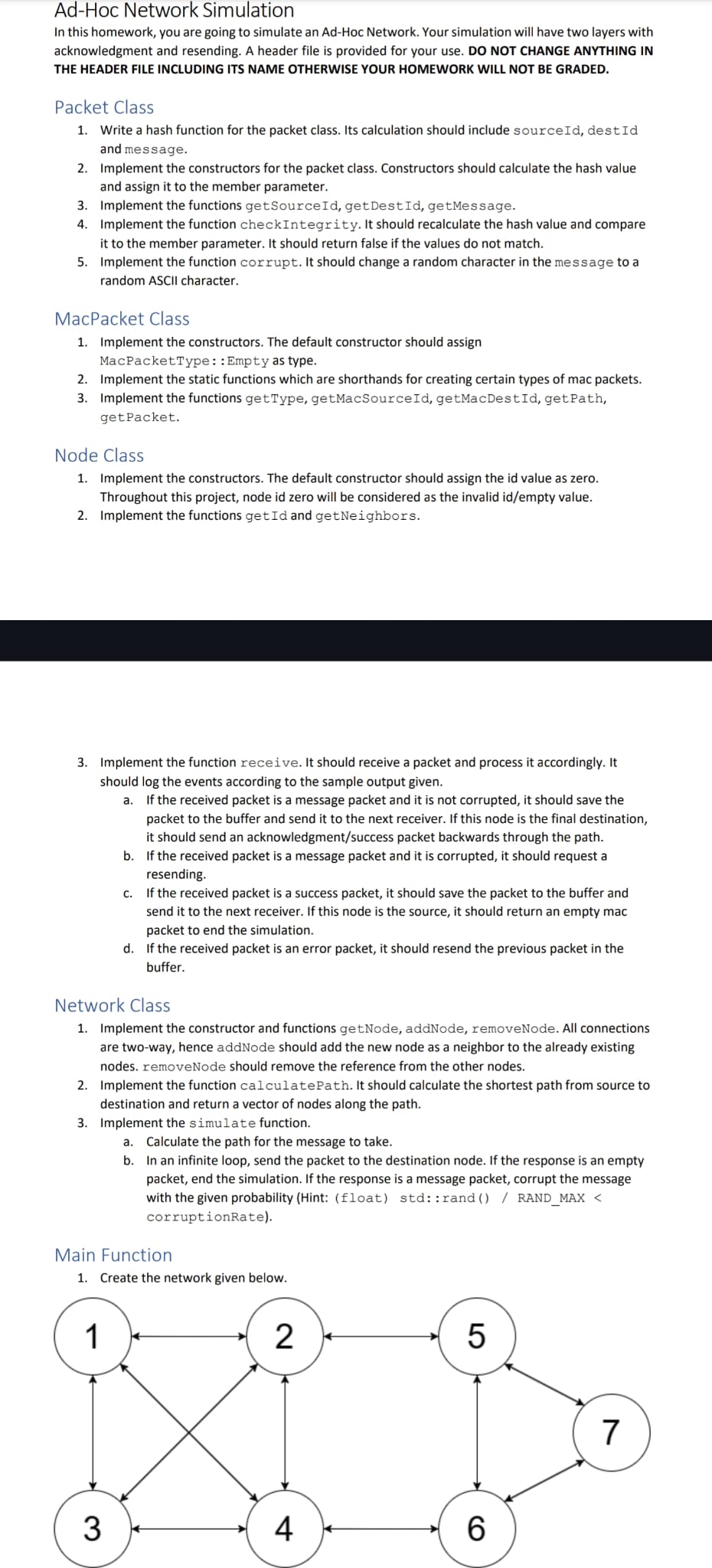
Ad-Hoc Network Simulation In this homework, you are going to simulate an Ad-Hoc Network. Your simulation will have two layers with acknowledgment and resending. A header file is provided for your use. DO NOT CHANGE ANYTHING IN THE HEADER FILE INCLUDING ITS NAME OTHERWISE YOUR HOMEWORK WILL NOT BE GRADED. Packet Class 1. Write a hash function for the packet class. Its calculation should include sourceId, destId and message. 2. Implement the constructors for the packet class. Constructors should calculate the hash value and assign it to the member parameter. 3. Implement the functions getSourceId, get DestId, getMessage. 4. Implement the function checkIntegrity. It should recalculate the hash value and compare it to the member parameter. It should return false if the values do not match. 5. Implement the function corrupt. It should change a random character in the message to a random ASCII character. MacPacket Class 1. Implement the constructors. The default constructor should assign MacPacketType:: Empty as type. 2. Implement the static functions which are shorthands for creating certain types of mac packets. 3. Implement the functions getType, getMacSourceId, getMacDestId, getPath, getPacket. Node Class 1. Implement the constructors. The default constructor should assign the id value as zero. Throughout this project, node id zero will be considered as the invalid id/empty value. 2. Implement the functions getId and getNeighbors. 3. Implement the function receive. It should receive a packet and process it accordingly. It should log the events according to the sample output given. a. If the received packet is a message packet and it is not corrupted, it should save the packet to the buffer and send it to the next receiver. If this node is the final destination, it should send an acknowledgment/success packet backwards through the path. b. If the received packet is a message packet and it is corrupted, it should request a resending. Network Class 1. Implement the constructor and functions getNode, addNode, removeNode. All connections are two-way, hence addNode should add the new node as a neighbor to the already existing nodes. removeNode should remove the reference from the other nodes. c. If the received packet is a success packet, it should save the packet to the buffer and send it to the next receiver. If this node is the source, it should return an empty mac packet to end the simulation. d. If the received packet is an error packet, it should resend the previous packet in the buffer. 2. Implement the function calculatePath. It should calculate the shortest path from source to destination and return a vector of nodes along the path. 3. Implement the simulate function. Main Function 1 a. Calculate the path for the message to take. b. In an infinite loop, send the packet to the destination node. If the response is an empty packet, end the simulation. If the response is a message packet, corrupt the message with the given probability (Hint: (float) std::rand () / RAND_MAX < corruptionRate). 1. Create the network given below. 3 2 XD 4 5 6 7
Step by Step Solution
There are 3 Steps involved in it
Heres an example implementation for the given homework description cpp Copy code Packeth ifndef PACK... View full answer

Get step-by-step solutions from verified subject matter experts
 Study Help