







Question: Adolescence is usually marked by dramatic changes in physical appearance, gaining weight can sometimes result directly from the physical changes of puberty (Santrock, 2005; Steinberge,
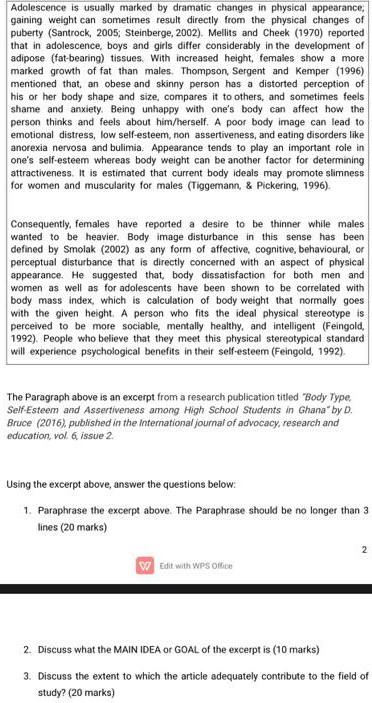
Adolescence is usually marked by dramatic changes in physical appearance, gaining weight can sometimes result directly from the physical changes of puberty (Santrock, 2005; Steinberge, 2002). Mellits and Cheek (1970) reported that in adolescence, boys and girls differ considerably in the development of adipose (fat-bearing) tissues. With increased height, females show a more marked growth of fat than males. Thompson, Sergent and Kemper (1996) mentioned that an obese and skinny person has a distorted perception of his or her body shape and size, compares it to others, and sometimes feels shame and anxiety. Being unhappy with one's body can affect how the person thinks and feels about him/herself. A poor body image can lead to emotional distress, low self-esteem, non assertiveness, and eating disorders like anorexia nervosa and bulimia. Appearance tends to play an important role in one's self-esteem whereas body weight can be another factor for determining attractiveness. It is estimated that current body ideais may promote slimness for women and muscularity for males (Tiggemann, & Pickering, 1996). Consequently, females have reported a desire to be thinner while males wanted to be heavier. Body image disturbance in this sense has been defined by Smolak (2002) as any form of affective, cognitive behavioural, or perceptual disturbance that is directly concerned with an aspect of physical appearance. He suggested that, body dissatisfaction for both men and women as well as for adolescents have been shown to be correlated with body mass index, which is calculation of body weight that normally goes with the given height. A person who fits the ideal physical stereotype is perceived to be more sociable, mentally healthy, and intelligent (Feingold, 1992). People who believe that they meet this physical stereotypical standard will experience psychological benefits in their self-esteem (Feingold, 1992). The Paragraph above is an excerpt from a research publication titled "Body Type Self-Esteem and Assertiveness among High School Students in Ghana" by D. Bruce (2016) published in the International Journal of advocacy, research and education, vol. 6 issue 2 Using the excerpt above, answer the questions below: 1. Paraphrase the excerpt above. The Paraphrase should be no longer than 3 lines (20 marks) 2 w Edit with WPS 01 2. Discuss what the MAIN IDEA OF GOAL of the excerpt is (10 marks) 3. Discuss the extent to which the article adequately contribute to the field of study? (20 marks)
Step by Step Solution
There are 3 Steps involved in it
1 Expert Approved Answer
Step: 1 Unlock

Question Has Been Solved by an Expert!
Get step-by-step solutions from verified subject matter experts
Step: 2 Unlock
Step: 3 Unlock
 Study Help