







Question: ... Let Xn Xo + k=1 $k, n = 0, 1, 2, . . . denote a Random Walk process, with Xo = x
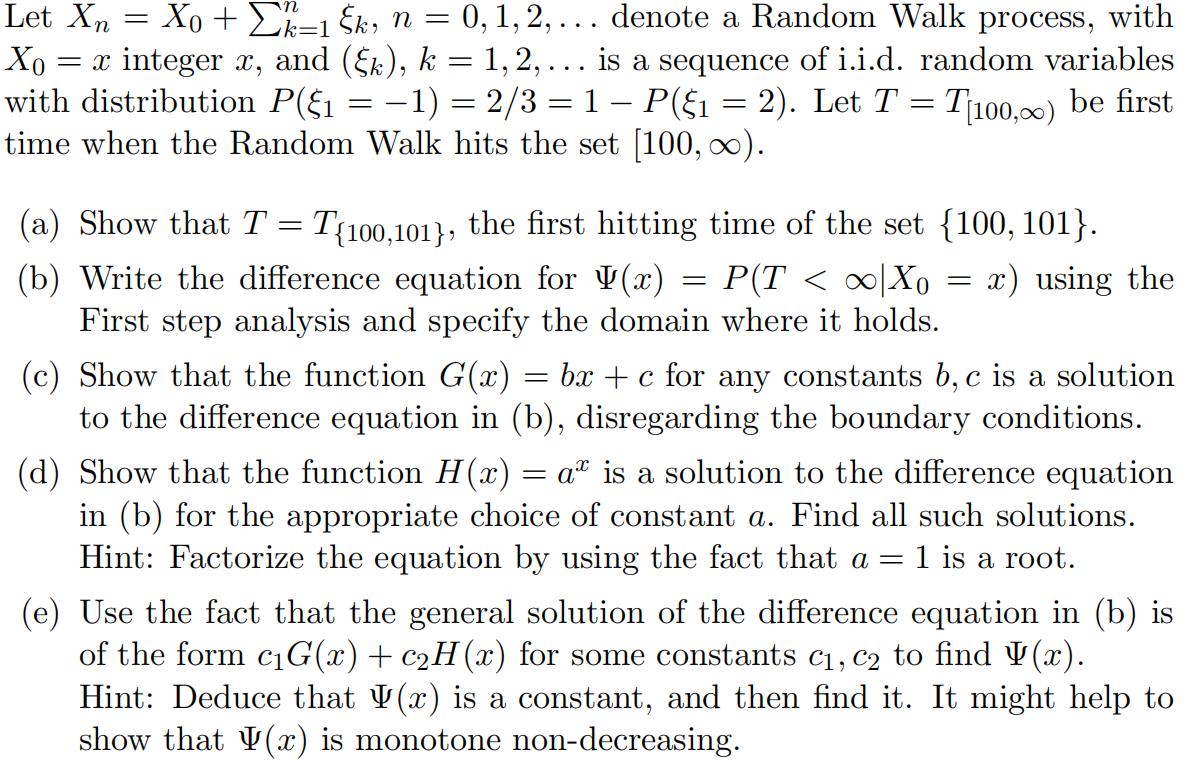
... Let Xn Xo + k=1 $k, n = 0, 1, 2, . . . denote a Random Walk process, with Xo = x integer x, and (k), k = 1, 2, . is a sequence of i.i.d. random variables with distribution P( = 1) = 2/3 = 1 P( = 2). Let T time when the Random Walk hits the set [100, ). = T[100,) be first = (a) Show that T = T{100,101}, the first hitting time of the set (b) Write the difference equation for (x) P(T < |Xo First step analysis and specify the domain where it holds. {100, 101}. = - x) using the = (c) Show that the function G(x) bx+c for any constants b, c is a solution to the difference equation in (b), disregarding the boundary conditions. (d) Show that the function H(x) = a* is a solution to the difference equation in (b) for the appropriate choice of constant a. Find all such solutions. Hint: Factorize the equation by using the fact that a = 1 is a root. (e) Use the fact that the general solution of the difference equation in (b) is of the form cG(x) + cH (x) for some constants c, C2 to find (x). Hint: Deduce that (x) is a constant, and then find it. It might help to show that (x) is monotone non-decreasing.
Step by Step Solution
3.46 Rating (156 Votes )
There are 3 Steps involved in it
Solution Random Walk process 100 101 No... View full answer

Get step-by-step solutions from verified subject matter experts
 Study Help