



Question: (Adverse Selection) In an isolated town, there are two distinct markets for cars. Buyers will pay up to $12,000 for a high-quality car or $8,000
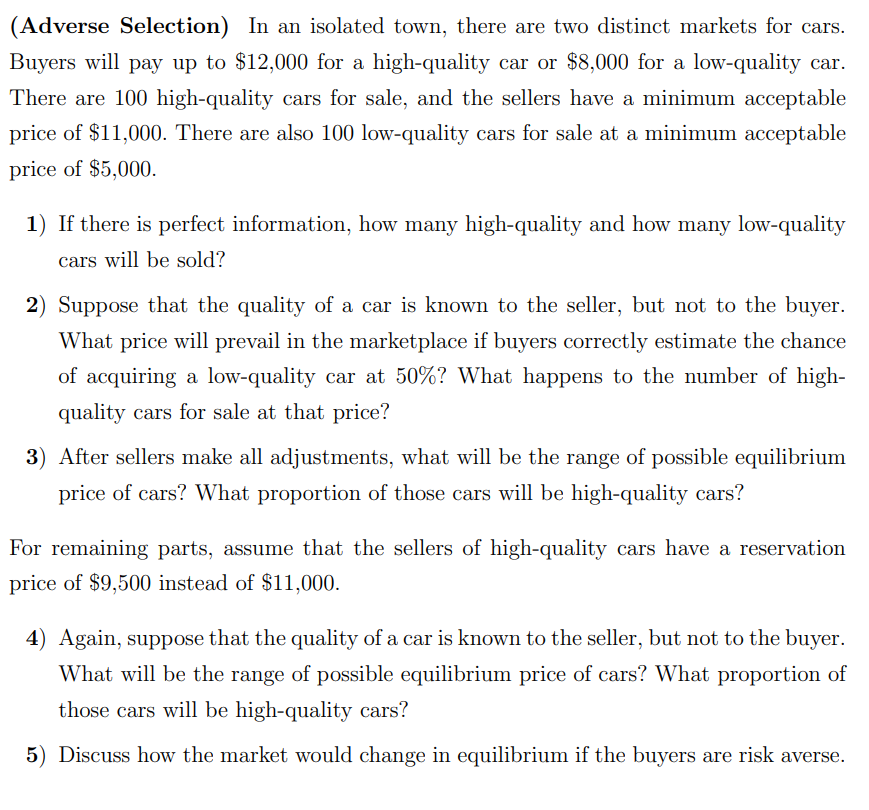
(Adverse Selection) In an isolated town, there are two distinct markets for cars. Buyers will pay up to $12,000 for a high-quality car or $8,000 for a low-quality car. There are 100 high-quality cars for sale, and the sellers have a minimum acceptable price of $11,000. There are also 100 low-quality cars for sale at a minimum acceptable price of $5,000. 1) If there is perfect information, how many high-quality and how many low-quality cars will be sold? 2) Suppose that the quality of a car is known to the seller, but not to the buyer. What price will prevail in the marketplace if buyers correctly estimate the chance of acquiring a low-quality car at 50%? What happens to the number of high- quality cars for sale at that price? 3) After sellers make all adjustments, What will be the range of possible equilibrium price of cars? 'What proportion of those cars will be high-quality cars? For remaining parts, assume that the sellers of high-quality cars have a reservation price of $9,500 instead of $11,000. 4) Again, suppose that the quality of a car is known to the seller, but not to the buyer. Vii-"hat will be the range of possible equilibrium price of cars? V's-"hat proportion of those cars will be high-quality cars? 5) Discuss how the market would change in equilibrium if the buyers are risk averse
Step by Step Solution
There are 3 Steps involved in it

Get step-by-step solutions from verified subject matter experts