after reading the article answer the following:
- What was new or surprised you?
- What you agree or disagree?
- What in your own experience corresponds to what you read?
- What was the main 'takeaway'?
- Should your peers read it or not? Why or why not?
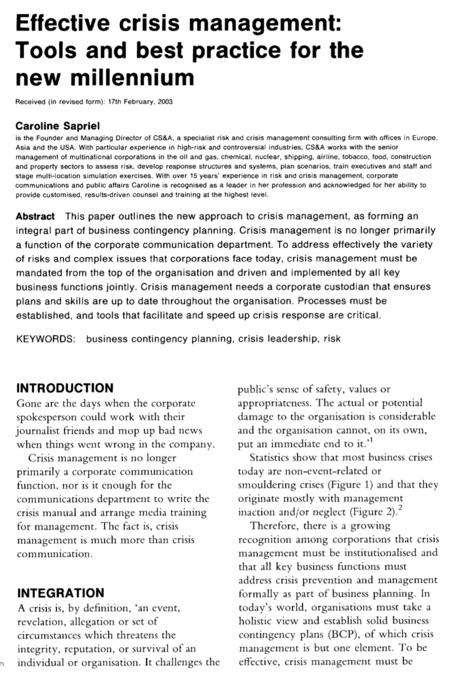
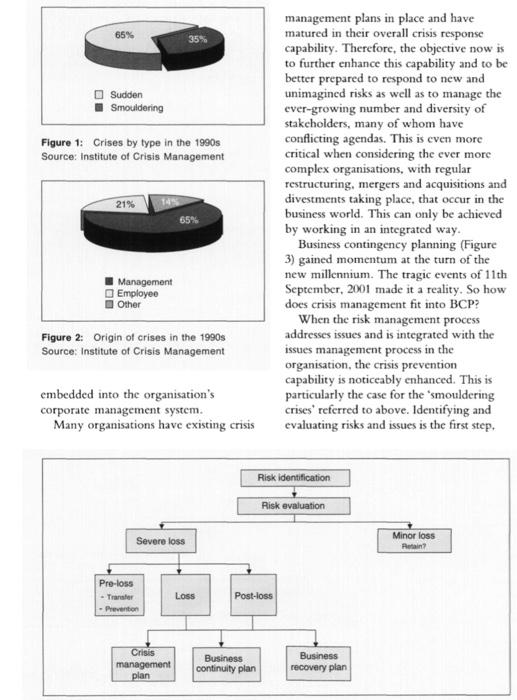
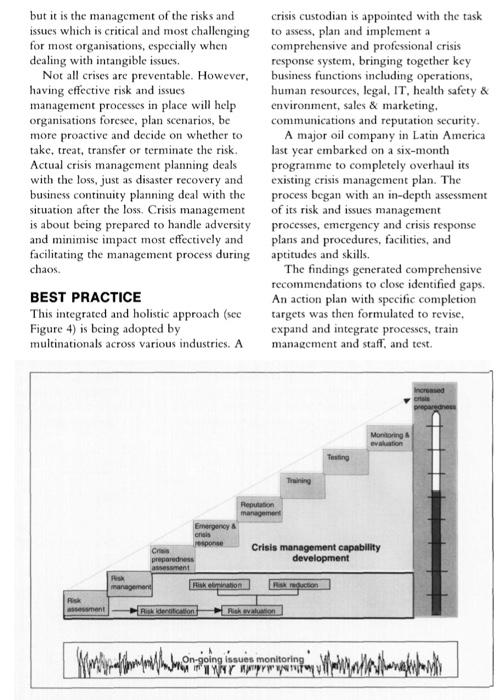
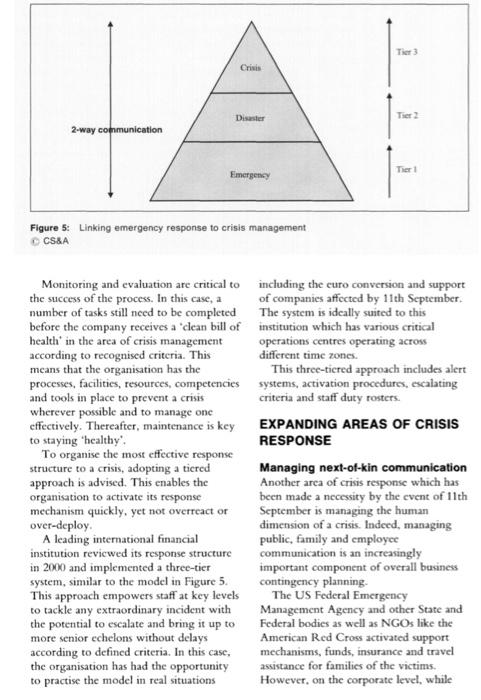
Effective crisis management: Tools and best practice for the new millennium Received in revised form): 17th February, 2003 Caroline Sapriel is the founder and Managing Director of CS&A, a specialist risk and crisis management consulting firm with offices in Europe. Asia and the USA. With particular experience in high-risk and controversial industries. CSKA works with the senior management of multinational corporations in the oil and gas. Chemical, nuclear, shipping, arinetobacco, food, construction and property sectors to assess ise develop response structures and systems, plan scenarios, train executives and staff and stage multi-location simulation exercises. With over 15 years' experience in risk and crisis management, corporate communications and public affairs Caroline is recognised as a leader in her profession and acknowledged for her ability to provide customised results-driven counsel and training at the highest level Abstract This paper outlines the new approach to crisis management, as forming an integral part of business contingency planning, Crisis management is no longer primarily a function of the corporate communication department. To address effectively the variety of risks and complex issues that corporations face today, crisis management must be mandated from the top of the organisation and driven and implemented by all key business functions jointly. Crisis management needs a corporate custodian that ensures plans and skills are up to date throughout the organisation Processes must be established, and tools that facilitate and speed up crisis response are critical. KEYWORDS: business contingency planning, crisis leadership, risk INTRODUCTION Gone are the days when the corporate spokesperson could work with their journalist friends and mop up bad news when things went wrong in the company. Crisis management is no longer primarily a corporate communication function, nor is it enough for the communications department to write the crisis manual and arrange media training for management. The fact is, crisis management is much more than crisis communication public's sense of safety, values or appropriateness. The actual or potential damage to the organisation is considerable and the organisation cannot, on its own, put an immediate end to it." Statistics show that most business crises today are non-event-related or smouldering crises (Figure 1) and that they originate mostly with management inaction and/or neglect (Figure 2). Therefore, there is a growing recognition among corporations that crisis management must be institutionalised and that all key business functions must address crisis prevention and management formally as part of business planning. In today's world, organisations must take a holistic view and establish solid business contingency plans (BCP), of which crisis management is but one element. To be effective, crisis management must be INTEGRATION A crisis is, by definition, an event, revelation, allegation or set of circumstances which threatens the integrity, reputation, or survival of an individual or organisation. It challenges the 65% 35% Sudden Smouldering Figure 1: Crises by type in the 1990s Source: Institute of Crisis Management 21% 14 65% management plans in place and have matured in their overall crisis response capability. Therefore, the objective now is to further enhance this capability and to be better prepared to respond to new and unimagined risks as well as to manage the ever-growing number and diversity of stakeholders, many of whom have conflicting agendas. This is even more critical when considering the ever more complex organisations with regular restructuring, mergers and acquisitions and divestments taking place, that occur in the business world. This can only be achieved by working in an integrated way. Business contingency planning (Figure 3) gained momentum at the turn of the new millennium. The tragic events of 11th September, 2001 made it a reality. So how does crisis management fit into BCP? When the risk management process addresses issues and is integrated with the issues management process in the organisation, the crisis prevention capability is noticeably enhanced. This is particularly the case for the 'smouldering crises referred to above. Identifying and evaluating risks and issues is the first step, Management Employee Other Figure 2: Origin of crises in the 1990s Source: Institute of Crisis Management embedded into the organisation's corporate management system. Many organisations have existing crisis Risk identification Risk evaluation Severe loss Minor loss Petan? Pre-loss - Transfer - Prevention Loss Post-loss Crisis management plan Business continuity plan Business recovery plan but it is the management of the risks and crisis custodian is appointed with the task issues which is critical and most challenging to assess, plan and implement a for most organisations, especially when comprehensive and professional crisis dealing with intangible issues. response system, bringing together key Not all crises are preventable. However, business functions including operations, having effective risk and issues human resources, legal, IT, health safety & management processes in place will help environment, sales & marketing, organisations foresee, plan scenarios, be communications and reputation security. more proactive and decide on whether to A major oil company in Latin America take, treat, transfer or terminate the risk. last year embarked on a six-month Actual crisis management planning deals programme to completely overhaul its with the loss, just as disaster recovery and existing crisis management plan. The business continuity planning deal with the process began with an in-depth assessment situation after the loss Crisis management of its risk and issues management is about being prepared to handle adversity processes, emergency and crisis response and minimise impact most effectively and plans and procedures, facilities, and facilitating the management process during aptitudes and skills. chaos. The findings generated comprehensive recommendations to close identified gaps. BEST PRACTICE An action plan with specific completion This integrated and holistic approach (sec targets was then formulated to revise, Figure 4) is being adopted by expand and integrate processes, train multinationals across various industries. A management and staff, and test. preparedness Monitoring Testing Training Reputation management Emergency crisis C preparedness amant Crisis management capability development management Faktion con Assessment Bisk identition Pick von On-going issues monitoring Tier 3 Crisis Disaster 2-way communication Emergency Tier Figure 5: Linking emergency response to crisis management CS&A Monitoring and evaluation are critical to including the euro conversion and support the success of the process. In this case, a of companies affected by 11th September number of tasks still need to be completed The system is idcally suited to this before the company receives a clean bill of institution which has various critical health' in the area of crisis management operations centres operating across according to recognised criteria. This different time zones. means that the organisation has the This three-tiered approach includes alert processes, facilities, resources, competencies systems, activation procedures, escalating and tools in place to prevent a crisis criteria and staff duty rosters. wherever possible and to manage one effectively. Thereafter, maintenance is key EXPANDING AREAS OF CRISIS to staying 'healthy RESPONSE To organise the most effective response structure to a crisis, adopting a tiered Managing next-of-kin communication approach is advised. This enables the Another arca of crisis response which has organisation to activate its response been made a necessity by the event of 11th mechanism quickly, yet not overreactor September is managing the human over-deploy. dimension of a crisis. Indeed, managing A leading international financial public, family and employee institution reviewed its response structure communication is an increasingly in 2000 and implemented a three-tier important component of overall business system, similar to the model in Figure 5. contingency planning This approach empowers staff at key levels The US Federal Emergency to tackle any extraordinary incident with Management Agency and other State and the potential to escalate and bring it up to Federal bodies as well as NGOs like the more senior echelons without delays American Red Cross activated support according to defined criteria. In this case, mechanisms, funds, insurance and travel the organisation has had the opportunity assistance for families of the victims. to practise the model in real situations However, on the corporate level, while the financial industry had insurance, risk evening, 150 buddies were fiown in from and IT contingencies, it was not prepared Singapore to assist families. to deal with the impact of a crisis on Smaller carriers are embracing industry employees, and their next-of-kin. best-practice as well. Dragonair, Hong Louis Cauffman, psychologist and Kong's second airline, last year embarked director-owner of the Korzybski on creating a family assistance support Foundation, an international training team (FAST). Ronnie Choi, General institute in solution-focused brief therapy, Manager of Customer Service at says: Dragonair, says: "Facing and supporting grieving individuals "Like other airlines, we had the systems in effectively is difficult. It requires awareness, place in the event of an accident, such as call sensitivity and skills. When a crisis involving centres, processes and trained staff. But in a injuries or fatalities occurs, the way a worst-case scenario, we wanted to be able to company manages its communication with do more for those who would be most victims and next-of-kin is critical to affected, namely the families, so we set up minimising potentially devastating and long- FAST which includes a train-the-trainer lasting impact on the affected parties. It also programme to sustain our in-house helps to protect corporate reputation. capability on a continuous basis.* Whilst the airlines had procedures in Since 11th September, companies in the place to manage next-of-kin and employee oil & gas, financial and property sectors communication on 11th September, most have considerably expanded their family companies in New York's World Trade support programmes. Teams of volunteers Center had little in place to deal with the are being trained to handle next-of-kin extent of the human tragedy facing them. telephone enquiries effectively in the event Major world airlines have established of an emergency or crisis involving processes and ongoing training casualties, and a formal telephone response programmes to deal with public, family capability is being routinely tested as part and employee assistance in the event of of crisis simulation exercises. The accidents. When an accident occurs, management of victims and next-of-kinis airlines immediately activate their often linked with enhanced security passenger information call centres and procedures. mobilise and despatch teams to provide support to victims and next-of-kin at the Leadership accident site. In a crisis, 'icadets serve as a repository for Singapore Airlines, for instance, people's fears. Leaders can also act as a established its next-of-kin buddy system mirror reflecting a group's anger, grief, in 1992 and has gradually built it up to a resolve or joy on a much larger stage than total of 385 trained company staff. is available to most. Leaders say in effect "I Buddies' are available to support families hear you"5 in the event of an accident, hijack or even On 11th September, New York City extended delays due to air traffic control turned to its leader, Mayor Giuliani, for failures as well as on-board food guidance. Leaders are essential to lead their poisoning. Tragically, the airline had to organisation through a crisis, and provide activate its next-of-kin support in their audience with a vision of the November 2001 when one of its planes aftermath of the crisis. They provide focus crash-landed on take-off at Taipei Chiang and overview and rally their team under a Kai Shek International Airport. That same mission