Question: After reading the article below identify and briefly discuss each of the following key takeaways key criticisms/oversights, how what youve read might be implemented into
After reading the article below identify and briefly discuss each of the following
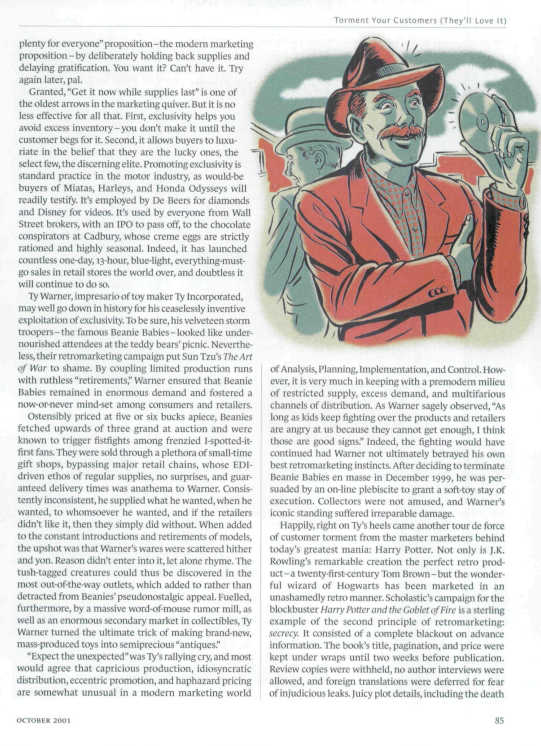
OCTOBER 2001 TORMENT YOUR CUSTOMERS (They'll Love It) by Stephen Brown D ON'T GET ME WRONG: I have nothing against cus- tomers. Some of my best friends are customers. Customers are a good thing, by and large, pro- vided they're kept well downwind. My problem is with the concept of- and I shudder to write the term-"customer centricity." Everyone in busi- ness today seems to take it as a God-given truth that com- panies were put on this earth for one purpose alone: to pander to customers. Marketers spend all their time slavishly tracking the needs of buyers, then meticulously crafting products and pitches to satisfy them. If corporate functions were Dickens characters, marketing would be Uriah Heep: unctuous, ubiquitous, unbearable. My friends, it's gone too far. The truth is, customers don't know what they want. They never have. They never will. The wretches don't even know what they don't want, as the success of countless rejected-by-focus-groups products, from the Chrysler minivan to the Sony Walkman, readily attests. A mindless devotion to customers means me-too products, copycat advertising campaigns, and marketplace stagnation. 83 Torment Your Customers (They'll Love It) And customers don't really want to be catered to, any- way. I've spent most of my career studying marketing campaigns, and my research shows that many of the mar- keting coups of recent years have been far from customer centric. Or at least, the successes have proceeded from a deeper understanding of what people want than would ever emerge from the bowels of a data mine. Whatever people may desire of their products and services, they adamantly do not want kowtowing from the companies Retromarketing eschews the modern marketing proposition by deliberately holding back supplies. You want it? Can't have it. Try again later, pal. that market to them. They do not want us to prostrate ourselves in front of them and promise to love them, till death us do part. They'd much rather be teased, tanta- lized, and tormented by deliciously insatiable desire. It's time to get back to an earlier marketing era, to the time when marketers ruled the world with creativity and style. It's time to break out the snake oil again. It's time for retromarketing. Retro Shock Retromarketing is based on an eternal truth: Marketers, like maidens, get more by playing hard to get. That's the antithesis of what passes for modern marketing. These days, marketers aim to make life simple for the consumer by getting goods to market in a timely and efficient man- ner, so that they are available when and where they're wanted, at a price people are prepared to pay. Could any- thing be more boring? By contrast, retromarketing makes 'em work for it, by limiting availability, by delaying grati- fication, by heightening expectations, by fostering an enigmatic air of unattainability. It doesn't serve demand; it creates it. As marketing strategies go,"Don't call us, we'll call you" is about as far from today's customer-hugging norm as it is possible to imagine. But it suits the times. We are, after all, in the midst of a full-blown nostalgia boom, a fact not Stephen Brown is a professor of marketing research at the University of Ulster in Northern Ireland and a visiting pro- fessor of marketing at Northwestern University's Kellogg School of Management in Evanston, Illinois. He has written 12 books on marketing, the latest of which is Marketing: The Retro Revolution (Sage, 2001). 84 lost on most successful product designers and advertisers. Retro is everywhere, whether it be Camel Lite's series of pseudonostalgic posters (a leather-helmeted flying ace lights up with a Zippo); Keds's television commercial for its old-style sneakers (reengineered, naturally, for today's demanding consumers); the McDonald's rollout of retro- fitted diners (which offer table service and 1950s favorites like mashed potatoes and gravy); Disney's Celebration, a new olde town in Florida, just like the ones that never ex- isted (outside of Hollywood studio back lots); or Restoration Hardware, a nationwide re- tail chain selling updated replicas of old- fashioned fixtures, fittings, and furnishings (perfect for redecorating that Rockwellian colonial in Celebration). Retro chic is de rigueur in everything from cameras, cof- feepots, and radios to toasters, telephones, and refrigerators. Retro roller coasters, steam trains, airships, motorbikes, and ballparks are proliferating, as are repro- ductions of sports equipment from earlier days. Tiki bars are back; polyester jumpsuits are cavorting on the catwalks; shag carpet is getting laid in the most tasteful abodes; and retro autos, such as the PT Cruiser and the new T-Bird, are turning heads all around the country. It's reached the point, comedian George Carlin says, where we don't experience dj vu, but vuj d-those rare moments when we have an uncanny sense that what we're experiencing has never happened before. People aren't just suckers for old-fashioned goods and services, they also yearn for the marketing of times gone by. They actually miss the days when a transaction was just a transaction, when purchasing a bar of soap didn't mean entering into a lifetime value relationship. Wary of CRM-inspired tactics, which are tantamount to stalking, they appreciate the true transparency of a blatant huck- ster. Retromarketing recognizes that today's consumer is nothing if not marketing savvy. Call it postmodern, but people enjoy the ironic art of a well-crafted sales pitch. The best of retromarketing hits consumers with the hard- est of sells, all the while letting them in on the joke. Going Retro Just like retrostyling, retromarketing is more art than sci- ence. It's easy to hit a false note. But can its lessons be spelled out? Is there an ABC for wannabes? They can, and there is. And although arrogant academicians always ad- vocate acronyms, aphorisms, apothegms, and absurdly affected alliterations - to ensure ever-busy executives get it-retromarketing represents a rare renunciation of this ridiculous rhetorical rule. There are just five basic principles. The first is that customers crave exclusivity. Retromar- keting eschews the "here it is, come and get it, there's HARVARD BUSINESS REVIEW plenty for everyone" proposition-the modern marketing proposition-by deliberately holding back supplies and delaying gratification. You want it? Can't have it. Try again later, pal. Granted, "Get it now while supplies last" is one of the oldest arrows in the marketing quiver. But it is no less effective for all that. First, exclusivity helps you avoid excess inventory-you don't make it until the customer begs for it. Second, it allows buyers to luxu- riate in the belief that they are the lucky ones, the select few, the discerning elite. Promoting exclusivity is standard practice in the motor industry, as would-be buyers of Miatas, Harleys, and Honda Odysseys will readily testify. It's employed by De Beers for diamonds and Disney for videos. It's used by everyone from Wall Street brokers, with an IPO to pass off, to the chocolate conspirators at Cadbury, whose creme eggs are strictly rationed and highly seasonal. Indeed, it has launched countless one-day, 13-hour, blue-light, everything-must- go sales in retail stores the world over, and doubtless it will continue to do so. Ty Warner, impresario of toy maker Ty Incorporated, may well go down in history for his ceaselessly inventive exploitation of exclusivity. To be sure, his velveteen storm troopers-the famous Beanie Babies-looked like under- nourished attendees at the teddy bears' picnic. Neverthe- less, their retromarketing campaign put Sun Tzu's The Art of War to shame. By coupling limited production runs with ruthless "retirements," Warner ensured that Beanie Babies remained in enormous demand and fostered a now-or-never mind-set among consumers and retailers. Ostensibly priced at five or six bucks apiece, Beanies fetched upwards of three grand at auction and were known to trigger fistfights among frenzied I-spotted-it- first fans. They were sold through a plethora of small-time gift shops, bypassing major retail chains, whose EDI- driven ethos of regular supplies, no surprises, and guar- anteed delivery times was anathema to Warner. Consis- tently inconsistent, he supplied what he wanted, when he wanted, to whomsoever he wanted, and if the retailers didn't like it, then they simply did without. When added to the constant introductions and retirements of models, the upshot was that Warner's wares were scattered hither and yon. Reason didn't enter into it, let alone rhyme. The tush-tagged creatures could thus be discovered in the most out-of-the-way outlets, which added to rather than detracted from Beanies' pseudonostalgic appeal. Fuelled, furthermore, by a massive word-of-mouse rumor mill, as well as an enormous secondary market in collectibles, Ty Warner turned the ultimate trick of making brand-new, mass-produced toys into semiprecious "antiques." "Expect the unexpected" was Ty's rallying cry, and most would agree that capricious production, idiosyncratic distribution, eccentric promotion, and haphazard pricing are somewhat unusual in a modern marketing world OCTOBER 2001 Torment Your Customers (They'll Love It) COO of Analysis, Planning, Implementation, and Control. How- ever, it is very much in keeping with a premodern milieu of restricted supply, excess demand, and multifarious channels of distribution. As Warner sagely observed, "As long as kids keep fighting over the products and retailers are angry at us because they cannot get enough, I think those are good signs." Indeed, the fighting would have continued had Warner not ultimately betrayed his own best retromarketing instincts. After deciding to terminate Beanie Babies en masse in December 1999, he was per- suaded by an on-line plebiscite to grant a soft-toy stay of execution. Collectors were not amused, and Warner's iconic standing suffered irreparable damage. Happily, right on Ty's heels came another tour de force of customer torment from the master marketers behind today's greatest mania: Harry Potter. Not only is J.K. Rowling's remarkable creation the perfect retro prod- uct-a twenty-first-century Tom Brown-but the wonder- ful wizard of Hogwarts has been marketed in an unashamedly retro manner. Scholastic's campaign for the blockbuster Harry Potter and the Goblet of Fire is a sterling example of the second principle of retromarketing: secrecy. It consisted of a complete blackout on advance information. The book's title, pagination, and price were kept under wraps until two weeks before publication. Review copies were withheld, no author interviews were allowed, and foreign translations were deferred for fear of injudicious leaks. Juicy plot details, including the death 85 Torment Your Customers (They'll Love It) Of all industries, the automotive business is most responsible for perfecting the art of retro. It invented the Joe Isuzu-style salesman and has been quick to tap into nostalgic yearnings in its new model designs and advertising. How sad, then, to see the industry suppressing its true nature and embracing customer centric- ity as its marketing approach. Just consider its retro credentials. The Mazda Miata, an homage to 1950s road- sters, which comes complete with a care- fully pitched tailpipe note, was the first retro auto rollout. Its triumph in the mar- ketplace set the entire motor industry on the road to yesterville. Fast followers include the Chrysler PT Cruiser, a pas- tiche of the upright sedans of the 1940s; the Jaguar S-Type, an affectionate nod to the style of the immortal Mark II, beloved by British police officers and their criminal counterparts; and, best of all, the New Beetle, which melds the distinctive shape of the old Beetle with of a key character and Harry's sexual awakening, were drip fed to a slavering press corps prior to the launch. Printers and distributors were required to sign strict con- fidentially agreements. Booksellers were bound by a ruth- lessly policed embargo, though some were allowed to dis- play the tantalizing volume in locked cages for a brief period just before "Harry Potter Day, July 8, 2000. And in a stroke of retro genius, several advance copies were "accidentally" sold from an unnamed Wal-Mart in deep- est West Virginia, though one of the "lucky" children was miraculously tracked down by the world's press and splashed across every front page worth its salt. More sadistic still, Scholastic dropped less-than-subtle hints that there weren't enough copies of the book to go around, thereby exacerbating the gotta-get-it frenzy of fans and distributors alike. In the event, the tome was ubiquitously unavoidable, available everywhere 86 from grocery stores to road- side restaurants. No one complained, of course, be- cause everyone had man- aged to get their hands on the precious Potter, and by the time they'd finished reading the magical mystery, they'd forgotten its magi- cally mysterious marketing campaign. Now you see it, now you don't. Whereas modern market- ing is upfront, above board, and transparent, retro revels in mystery, intrigue, and co- vert operations. Consider the classic "secret" recipes that have helped to purvey all sorts of comestibles-Coca- Cola, Heinz Ketchup, Ken- tucky Fried Chicken, Mrs. Fields Cookies, the list goes on-to say nothing of cos- metics (the secret of youth- fulness), proprietary medi- cines (the secret of good health), and holiday pack- ages (secret hideaways a spe- cialty). If it engages the cus- tomer in even just a moment of consideration of the prod- uct-"What could it be?" or simply, "Why is it so hush- hush?"-secrecy helps to sell. But what, you may well ask, is the secret of successful secrecy? Obviously, it's that the existence of a secret must never be kept secret. There's no point in having an exclusive product or service unless everyone who is anyone knows about it. But when big- budget marketing campaigns are unaffordable or inap- propriate, what's a brand to do? The answer, and the third principle of retromarketing, is to amplify-that is, to en- sure that the hot ticket or cool item is talked about and, more important, that the talking about is talked about. The power of amplification can be seen in the recent buzz about "Ginger," the mysterious and much-talked- about creation by Dean Kamen. Widely regarded as the heir apparent to Thomas Edison, Kamen is a throwback to the amateur inventor archetype, a garage-based, gizmo- surrounded, patent-collecting tinkerer. He made his name- and his millions- with a portable insulin pump, a suitcase-sized dialysis machine, and, most recently, a gyroscopic, stair-climbing wheelchair. And now he has HARVARD BUSINESS REVIEW TIME FOR A NEW MOTOWN REVIVAL the latest automotive technology to pro- duce a modern car with anachronistic styling. Not to be outdone, the retro auto prototype, Mazda's Miata, recently cele- brated its decade-long heritage with a tenth anniversary special edition, thus making it a neo retro auto. Yet despite the success of the retro products, the automobile industry hasn't fully embraced retromarketing. For every old-style publicity stunt, there are dozens of oleaginous allusions to market respon- siveness, customer care, and our duty is to serve. Saturn says it all. Auto marketers are unnecessarily ashamed of their Artful Dodger an- tecedents. They try to hide inveigling away, to disguise their deceitful DNA, only to suffer from the return of retro- marketing repressed. It's time for the madness to end. The return of Joe Isuzu is a start, but the therapy must go deeper. It's time, carmakers, to get in touch with your inner huckster. created Ginger, the code name for what is allegedly the greatest invention since the sliced bread clich. The Net- propelled speculation surrounding the invention, known simply as "IT," has been overwhelming. Starved for actual information about the invention, the media has scram- bled to report on the reports of the media. In the process, Ginger's become famous for being famous, as historian Daniel Boorstin famously put it-and marketed for being unmarketed. To date, no one knows what IT is exactly, and the seer's not saying. All we know for certain is that IT is so revolutionary that entire cities will be retrofitted to accommodate IT. Seal off those sidewalks. Rip up those autoroutes. Tear down those tollbooths. Ginger's coming down the turnpike, powered by a perpetual-motion motor that runs on hot air and hyperbole. Surprisingly, no one seems to have noticed the echoes in this craze of a classic P.T. Barnum marketing caper of 1860. Barnum's "it" turned out to be an encephalitic giantess from New Jersey; Kamen, it seems, simply plans to encephalize the New Jersey expressways. Clearly, they're being born at more than one a minute these days. In a world of incessant commercial chatter, amplifica- tion is vitally necessary, and it can be induced in many ways beyond just mystery. One of the most cost-effective techniques is affront. Whether it be Calvin Klein, Benet- ton, or even Citron-its Picasso minivan tweaked French aesthetes by appropriating the master's moniker-there's nothing like a little outrage to attract attention and turn a tiny advertising spend into a megabudget monster. Bet- ter yet, it bestows an aura of attractive insouciance on the I-fought-the-law offenders. Another powerful amplifier is surprise. An unexpected marketing campaign can send shock waves through the media-as when Pizza Hut paid to have its logo placed on the side of a Russian rocket, or when Taco Bell offered a free taco to everyone in the United States if the decommissioned Mir man- aged to hit a 40-by-40-foot floating target placed at the anticipated splashdown site. So much the better if all this marketing is en- tertaining, which brings us to principle number four of retromarketing: Marketing must divert. It must engage. It must amuse. Entertainment, in many ways, is the essence of retromarketing - and the lack of it is modern marketing's greatest failure. I blame my esteemed colleague Philip Kotler, the renowned Northwestern University marketing professor, for this sorry state of affairs. He, more than anyone, has convinced managers that marketing is the backbone of business and must integrate the work of all other func- tions. Weighed down by this awesome responsibility, mar- keting has become a sober-sided discipline. It has lost its sense of fun. It has forgotten how to flirt. The marketers of Hollywood, not surprisingly, have been resolute holdouts-not least in their latter-day use of OCTOBER 2001 Torment Your Customers (They'll Love It) the Internet. The Web site to promote the recent remake of Planet of the Apes, for example, contains an elaborate treasure hunt. Swordfish's site offers a $100,000 prize to anyone who can crack ten passwords. Most ambitious of all is the Web-based promotion of Steven Spielberg's Al, which premiered in June 2001. It's a surreptitious cam- paign, designed to be discovered and passed on from one cool person to another. Like the old record producer's trick of planting hidden messages between tracks (re- member "I buried Paul"?), the process begins with a fake name inserted into the credits of a trailer for the movie. A Web search on that name leads the curious to a series of planted Web sites, a discovery of a murder, and a grow- ing body of clues. Before long, cryptic e-mails and spooky phone messages come into play-and those who have fol- lowed the thread to that point are embroiled in a story quite separate from the film. Clearly, the marketers in- volved-highly aware that a movie lives or dies on its first two weeks of word of mouth-engineered a way to gen- erate that buzz just before Al premiered. And it's more creative than concocting fake columnists or planting vox- pop puffery. The Al campaign also exemplifies the final principle of retromarketing: marketing must deal in tricksterism, using tactics akin to those of Loki (of Norse myth), the wily Coyote (of Native American legend), and Hermes (the Greek god of the marketplace). The tricks don't have to be particularly elaborate; on the contrary, tricks can come cheap, as the now classic Blair Witch Project-is it a snuff movie or not?-bears eloquent witness. Similarly, the recent turn to sneaky sales promotions, where, for instance, the gregarious, round-buying barfly in the way cool club is actually an employee of a liquor company, There's nothing like a little outrage to attract attention and turn a tiny advertising spend into a megabudget monster. involves minimal expenditure on the marketer's part. However, the rewards can be great if the brand is em- braced, even briefly, by the in-crowd. A particularly sly bit of tricksterism was served up by the makers of Tango, a fruit juice soda popular in the United Kingdom. In 1994, the company bought advertis- ing time and used it for what appeared to be a public ser- vice announcement; its "marketing director" warned viewers that some rogue supermarkets and convenience stores were selling a knockoff of the brand-it could be de- tected because it was not fizzy-and asked them to report 87 Torment Your Customers (They'll Love It) the miscreant outlets by calling a special, toll-free hot line. Apparently, some 30,000 people rang up, only to be in- formed that they had been tricked ("Tango'd") as part of the company's promotion for a new, noncarbonated ver- sion of the drink. The ITC-Britain's TV-advertising watch- dog-was not amused, and it rapped Tango's knuckles for abusing the public-information service format. In the meantime, the promotion had succeeded in amplifying the product launch and adding to Tango's incorrigibly irreverent image. Being a trickster is not the same as being a downright cheater. Cheating, to state the obvious, is wrong, and peo- ple won't stand for it. The charlatanry I'm advocating Marketing managers have fallen for their own line. They actually believe that if you love the customer enough, the customer will love you back. That is complete nonsense. comes with an extra dimension of panache, of exaggera- tion, of sheer chutzpah, which renders the unacceptable acceptable. Modern marketers set great store by the truth, and one can understand why, given marketing's less-than- illustrious heritage of diddling, double-dealing, and de- ceit. The truth, however, is that people don't want the truth, the whole truth, and nothing but the truth. And JFMA SOND 88 100 90 80 70 60 50 40 30 20 10 THICK LINE THIN LINE DOTTED LINE -DASHED LINE ***** Sy's even if they did, the last place they'd look for it would be a marketing campaign. Marketing is about glitz and glamour. It's mischievous and mysterious. Marketing, lest we forget, is fun. From Four P's to Pure Tease Retromarketing, then, is based on exclusivity, secrecy, amplification, entertainment, and tricksterism. At least this list of principles doesn't create an acronym...unless, of course, the sequence is reversed. To be sure, retromarket- ing is not appropriate on every occasion, nor is it applica- ble to every product, service, or market segment. But, then, the modern marketing concept of caring, sharing, all hold hands is not always the right approach, either. Marketing managers, admittedly, may be dismayed by the thought of deliberately thwarting consumers. That's because they've fallen for their own line. They actually believe that if you love the customer enough, the customer will love you back. That is complete nonsense. Consumers, as a rule, don't love or care for marketing types, especially when they purport to have the cus- tomers' interests at heart. Consumers want to dislike mar- keters, they like to dislike marketers, they need someone to hate, particularly in politically correct times when eth- nic stereotyping and other such nastiness is effectively forbidden. Contemporary consumers are embarrassed by marketers who get down on one knee and promise to love, honor, and obey. Get real! They would much prefer a good old-fashioned lovable rogue. Indeed, if marketers were really customer oriented, they'd give their customers what they want. Namely, old- style, gratuitously provocative marketing rather than the neutered, defanged, Disneyfied version that's ped- dled today. Retromarketing, in sum, harks back to the good old bad old days when marketers were pranksters and proud of it. It replaces the Seven S's with seven veils. Its Five Forces are flim, flam, flirt, fiddle, and fi- nagle. Its Four P's are perturb, puzzle, perplex, and perhaps. Its Three C's are chafe, chide, and chortle. It puts the mark into marketing, the con into concept, the cuss into customers. It's a marketing philosophy for a retro-besotted world. It's tried and true. It's the greatest show on earth. Would I lie to you? Reprint RO109E To order reprints, see the last page of Executive Summaries. To further explore the topic of this article, go to www.hbr.org/explore. HARVARD BUSINESS REVIEW DRAWING SIDNEY HARRIS









 Study Help