







Question: After reading the article below identify and briefly discuss each of the following key takeaways key criticisms/oversights, how what youve read might be implemented into
After reading the article below identify and briefly discuss each of the following
-
key takeaways
-
key criticisms/oversights,
-
how what youve read might be implemented into daily business practices.
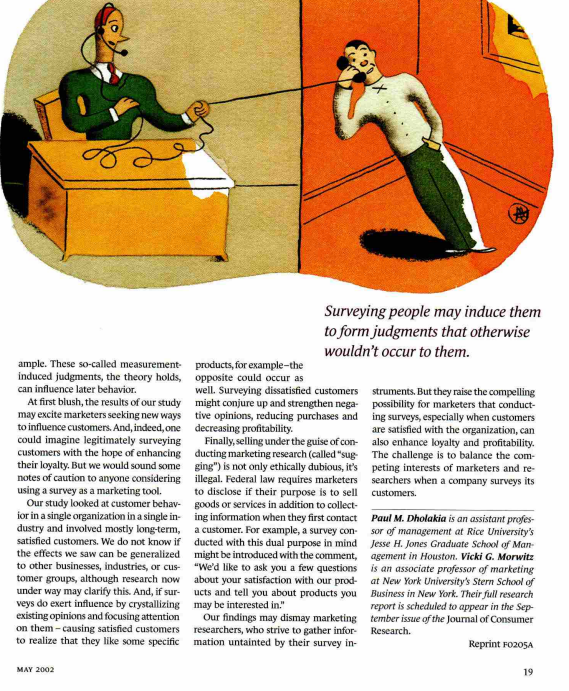
idea How Surveys Influence Customers New research shows that simply asking customers their opinion can increase their profitability over the long term. by Paul M. Dholakia and Vicki G. Morwitz Marketers have long appreciated that surveys engage people; a single yes-or- no question on a direct-mail envelope can induce them to look inside. But can a company survey influence customers' loyalty or buying habits? Research over the past two decades has shown that it can, but the studies have been narrow- looking at how surveys affect attitudes in the short term or influence one-time behavior, like a single purchase. We set out to study the scope of this survey effect, and we were astonished by what we found. We conducted a field experiment with over 2,000 customers enrolled in the customer relationship program of a large U.S. financial services company. One randomly selected group of 945 people participated in a single, ten- to 12-minute telephone survey investigat- ing customer satisfaction. During the call, they were asked to rate various fea- 18 tures of the program, like estate plan- ning, account monitoring, and retire- ment planning. At the call's end, they were asked to rate their overall satisfac- tion with the company; most said they were highly satisfied. A second group of 1,064 randomly selected customers wasn't surveyed and served as the con- trol. We tracked these two groups for a full year, measuring their purchasing behavior, defection rates, and profit- ability. Neither group received any di- rect marketing from the company for the duration of the study. A year after the survey was con ducted, the customers we surveyed were more than three times as likely to have opened new accounts, were less than half as likely to have defected, and were more profitable than the customers who hadn't been surveyed. These differences reached their maximum levels several months after the survey was done and persisted throughout the year. Even at the end of the year, surveyed customers continued to open new accounts at a faster rate and defect at a slower rate than the people in the control group. How could ten minutes on the phone lead to these broad, sustained effects? Several theories of consumer psychol- ogy might apply. The simplest is that satisfaction surveys appeal to custom- ers' desire to be coddled, reinforcing pos itive feelings they may already have about the surveying organization and making them more likely to buy its products. Surveys may also increase people's awareness of a company's prod- ucts and thereby encourage future pur- chases. More subtle is the idea that the very process of asking people their opin- ions can induce them to form judg- ments that otherwise wouldn't occur to them-that they really do like a com- pany's estate-planning services, for ex- HARVARD BUSINESS REVIEW ample. These so-called measurement induced judgments, the theory holds, can influence later behavior. At first blush, the results of our study may excite marketers seeking new ways to influence customers. And, indeed, one could imagine legitimately surveying customers with the hope of enhancing their loyalty. But we would sound some notes of caution to anyone considering using a survey as a marketing tool. Our study looked at customer behav- ior in a single organization in a single in- dustry and involved mostly long-term, satisfied customers. We do not know if the effects we saw can be generalized to other businesses, industries, or cus- tomer groups, although research now under way may clarify this. And, if sur- veys do exert influence by crystallizing existing opinions and focusing attention on them-causing satisfied customers to realize that they like some specific MAY 2002 Surveying people may induce them to form judgments that otherwise wouldn't occur to them. struments. But they raise the compelling possibility for marketers that conduct- ing surveys, especially when customers are satisfied with the organization, can also enhance loyalty and profitability. The challenge is to balance the com- peting interests of marketers and re- searchers when a company surveys its customers. Paul M. Dholakia is an assistant profes- sor of management at Rice University's Jesse H. Jones Graduate School of Man- agement in Houston. Vicki G. Morwitz is an associate professor of marketing at New York University's Stern School of Business in New York. Their full research report is scheduled to appear in the Sep- tember issue of the Journal of Consumer Research. Reprint F0205A 19 products, for example-the opposite could occur as well. Surveying dissatisfied customers might conjure up and strengthen nega- tive opinions, reducing purchases and decreasing profitability. Finally, selling under the guise of con- ducting marketing research (called "sug ging") is not only ethically dubious, it's illegal. Federal law requires marketers to disclose if their purpose is to sell goods or services in addition to collect- ing information when they first contact a customer. For example, a survey con- ducted with this dual purpose in mind might be introduced with the comment, "We'd like to ask you a few questions about your satisfaction with our prod- ucts and tell you about products you may be interested in." Our findings may dismay marketing researchers, who strive to gather infor mation untainted by their survey in
Step by Step Solution
There are 3 Steps involved in it
1 Expert Approved Answer
Step: 1 Unlock

Question Has Been Solved by an Expert!
Get step-by-step solutions from verified subject matter experts
Step: 2 Unlock
Step: 3 Unlock
 Study Help