







Question: After reading the case please answer Q5 relating to the case Q5: (a) How has the situation changed in terms of the management decision/challenges identified?
After reading the case please answer Q5 relating to the case Q5: (a) How has the situation changed in terms of the management decision/challenges identified? Provide your perspectives on key changes (b) Identify and explain at least 3 relevant International business lessons learned from this case in terms of the implications of national cultural differences.
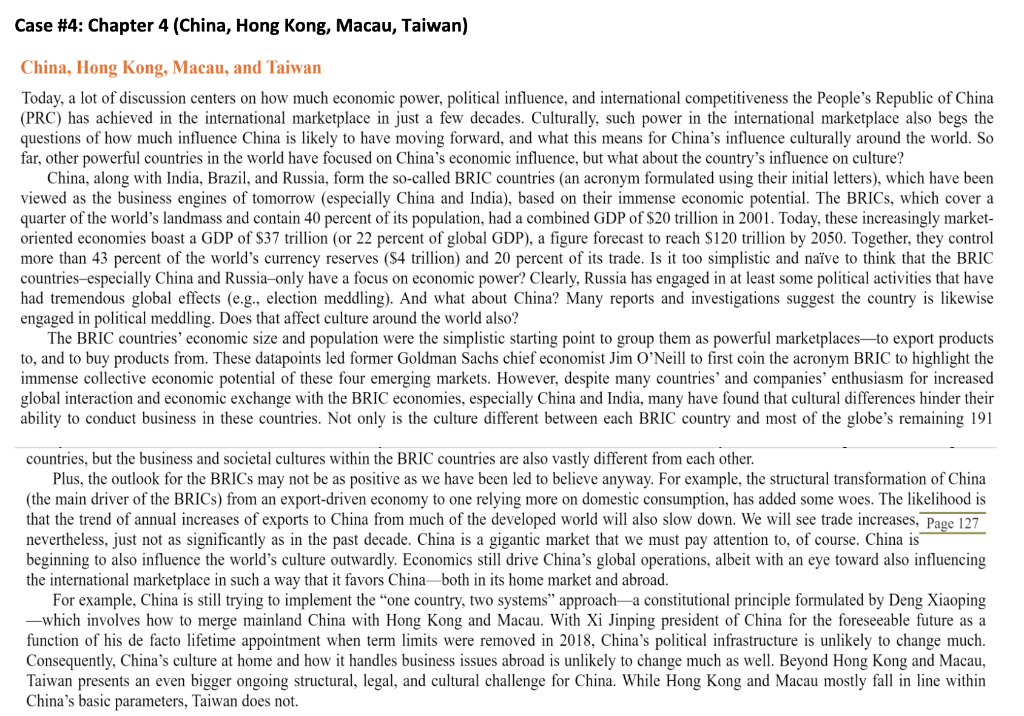
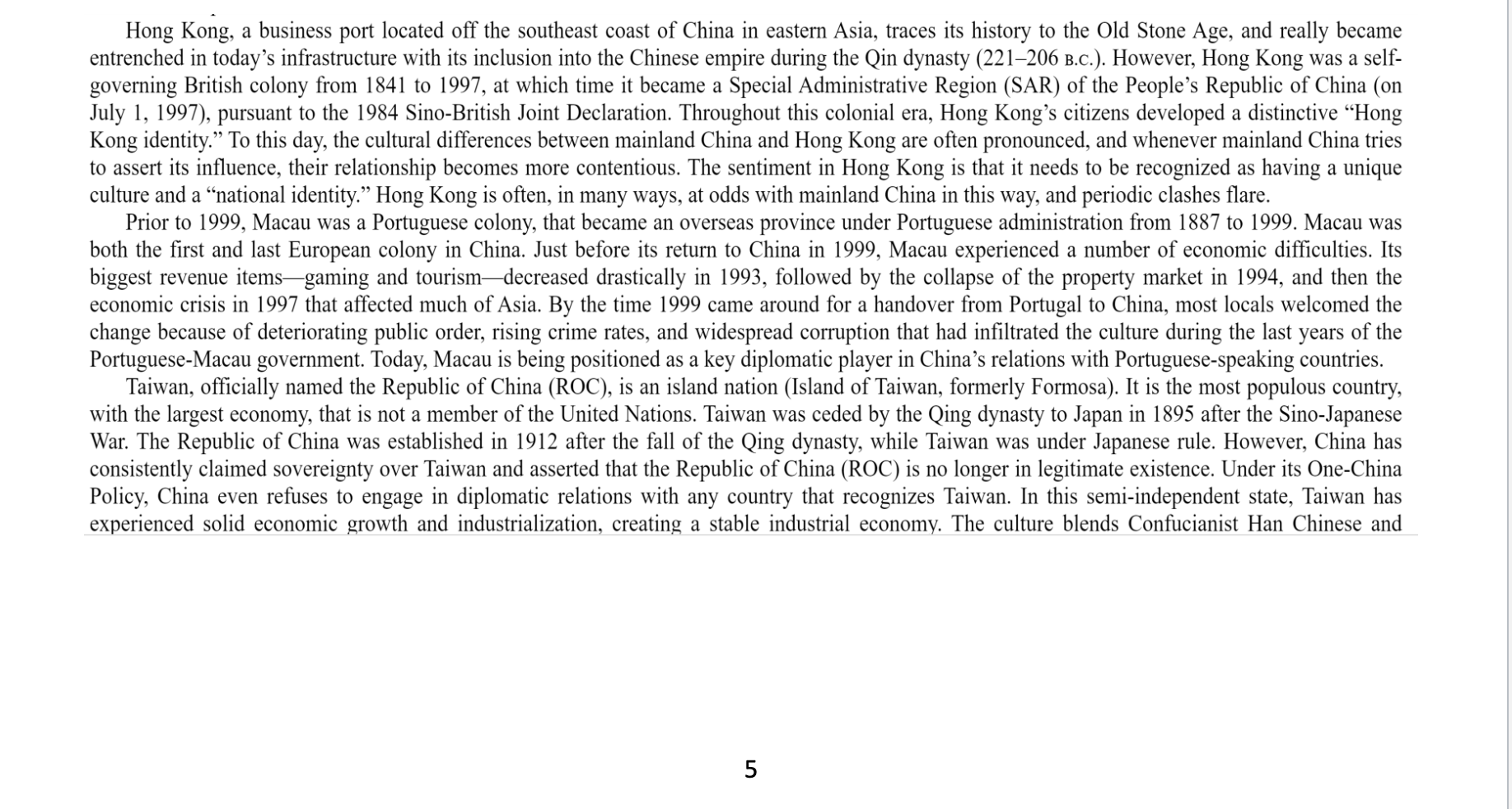
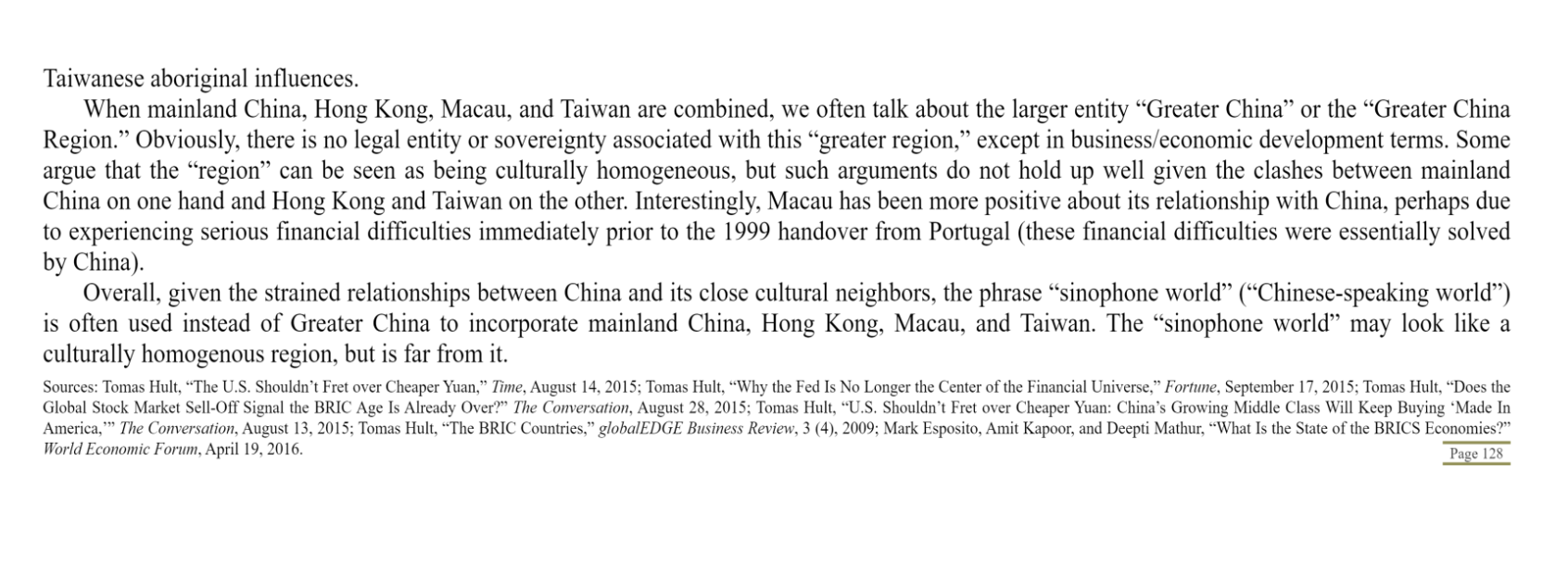
China, Hong Kong, Macau, and Taiwan Today, a lot of discussion centers on how much economic power, political influence, and international competitiveness the People's Republic of China (PRC) has achieved in the international marketplace in just a few decades. Culturally, such power in the international marketplace also begs the questions of how much influence China is likely to have moving forward, and what this means for China's influence culturally around the world. So far, other powerful countries in the world have focused on China's economic influence, but what about the country's influence on culture? China, along with India, Brazil, and Russia, form the so-called BRIC countries (an acronym formulated using their initial letters), which have been viewed as the business engines of tomorrow (especially China and India), based on their immense economic potential. The BRICs, which cover a quarter of the world's landmass and contain 40 percent of its population, had a combined GDP of \$20 trillion in 2001. Today, these increasingly marketoriented economies boast a GDP of \$37 trillion (or 22 percent of global GDP), a figure forecast to reach \$120 trillion by 2050 . Together, they control more than 43 percent of the world's currency reserves ( $4 trillion) and 20 percent of its trade. Is it too simplistic and nave to think that the BRIC countries-especially China and Russia-only have a focus on economic power? Clearly, Russia has engaged in at least some political activities that have had tremendous global effects (e.g., election meddling). And what about China? Many reports and investigations suggest the country is likewise engaged in political meddling. Does that affect culture around the world also? The BRIC countries' economic size and population were the simplistic starting point to group them as powerful marketplaces-to export products to, and to buy products from. These datapoints led former Goldman Sachs chief economist Jim O'Neill to first coin the acronym BRIC to highlight the immense collective economic potential of these four emerging markets. However, despite many countries' and companies' enthusiasm for increased global interaction and economic exchange with the BRIC economies, especially China and India, many have found that cultural differences hinder their ability to conduct business in these countries. Not only is the culture different between each BRIC country and most of the globe's remaining 191 countries, but the business and societal cultures within the BRIC countries are also vastly different from each other. Plus, the outlook for the BRICs may not be as positive as we have been led to believe anyway. For example, the structural transformation of China (the main driver of the BRICs) from an export-driven economy to one relying more on domestic consumption, has added some woes. The likelihood is that the trend of annual increases of exports to China from much of the developed world will also slow down. We will see trade increases, Page 127 nevertheless, just not as significantly as in the past decade. China is a gigantic market that we must pay attention to, of course. China is beginning to also influence the world's culture outwardly. Economics still drive China's global operations, albeit with an eye toward also influencing the international marketplace in such a way that it favors China - both in its home market and abroad. For example, China is still trying to implement the "one country, two systems" approach-a constitutional principle formulated by Deng Xiaoping - which involves how to merge mainland China with Hong Kong and Macau. With Xi Jinping president of China for the foreseeable future as a function of his de facto lifetime appointment when term limits were removed in 2018, China's political infrastructure is unlikely to change much. Consequently, China's culture at home and how it handles business issues abroad is unlikely to change much as well. Beyond Hong Kong and Macau, Taiwan presents an even bigger ongoing structural, legal, and cultural challenge for China. While Hong Kong and Macau mostly fall in line within China's basic parameters, Taiwan does not. Hong Kong, a business port located off the southeast coast of China in eastern Asia, traces its history to the Old Stone Age, and really became entrenched in today's infrastructure with its inclusion into the Chinese empire during the Qin dynasty (221-206 .c.). However, Hong Kong was a selfgoverning British colony from 1841 to 1997, at which time it became a Special Administrative Region (SAR) of the People's Republic of China (on July 1, 1997), pursuant to the 1984 Sino-British Joint Declaration. Throughout this colonial era, Hong Kong's citizens developed a distinctive "Hong Kong identity." To this day, the cultural differences between mainland China and Hong Kong are often pronounced, and whenever mainland China tries to assert its influence, their relationship becomes more contentious. The sentiment in Hong Kong is that it needs to be recognized as having a unique culture and a "national identity." Hong Kong is often, in many ways, at odds with mainland China in this way, and periodic clashes flare. Prior to 1999, Macau was a Portuguese colony, that became an overseas province under Portuguese administration from 1887 to 1999. Macau was both the first and last European colony in China. Just before its return to China in 1999, Macau experienced a number of economic difficulties. Its biggest revenue items - gaming and tourism - decreased drastically in 1993, followed by the collapse of the property market in 1994, and then the economic crisis in 1997 that affected much of Asia. By the time 1999 came around for a handover from Portugal to China, most locals welcomed the change because of deteriorating public order, rising crime rates, and widespread corruption that had infiltrated the culture during the last years of the Portuguese-Macau government. Today, Macau is being positioned as a key diplomatic player in China's relations with Portuguese-speaking countries. Taiwan, officially named the Republic of China (ROC), is an island nation (Island of Taiwan, formerly Formosa). It is the most populous country, with the largest economy, that is not a member of the United Nations. Taiwan was ceded by the Qing dynasty to Japan in 1895 after the Sino-Japanese War. The Republic of China was established in 1912 after the fall of the Qing dynasty, while Taiwan was under Japanese rule. However, China has consistently claimed sovereignty over Taiwan and asserted that the Republic of China (ROC) is no longer in legitimate existence. Under its One-China Policy, China even refuses to engage in diplomatic relations with any country that recognizes Taiwan. In this semi-independent state, Taiwan has experienced solid economic growth and industrialization, creating a stable industrial economy. The culture blends Confucianist Han Chinese and Taiwanese aboriginal influences. When mainland China, Hong Kong, Macau, and Taiwan are combined, we often talk about the larger entity "Greater China" or the "Greater China Region." Obviously, there is no legal entity or sovereignty associated with this "greater region," except in business/economic development terms. Some argue that the "region" can be seen as being culturally homogeneous, but such arguments do not hold up well given the clashes between mainland China on one hand and Hong Kong and Taiwan on the other. Interestingly, Macau has been more positive about its relationship with China, perhaps due to experiencing serious financial difficulties immediately prior to the 1999 handover from Portugal (these financial difficulties were essentially solved by China). Overall, given the strained relationships between China and its close cultural neighbors, the phrase "sinophone world" ("Chinese-speaking world") is often used instead of Greater China to incorporate mainland China, Hong Kong, Macau, and Taiwan. The "sinophone world" may look like a culturally homogenous region, but is far from it. World Economic Forum, April 19, 2016. Page 128
Step by Step Solution
There are 3 Steps involved in it

Get step-by-step solutions from verified subject matter experts
 Study Help