Question: After reading the Case Study on the Ford Pinto, discuss your opinion on whether or not management made the right decision to release the vehicle
After reading the Case Study on the Ford Pinto, discuss your opinion on whether or not management made the right decision to release the vehicle knowing the statistical data they had uncovered during testing. Write a full detailed response to the question listed above.
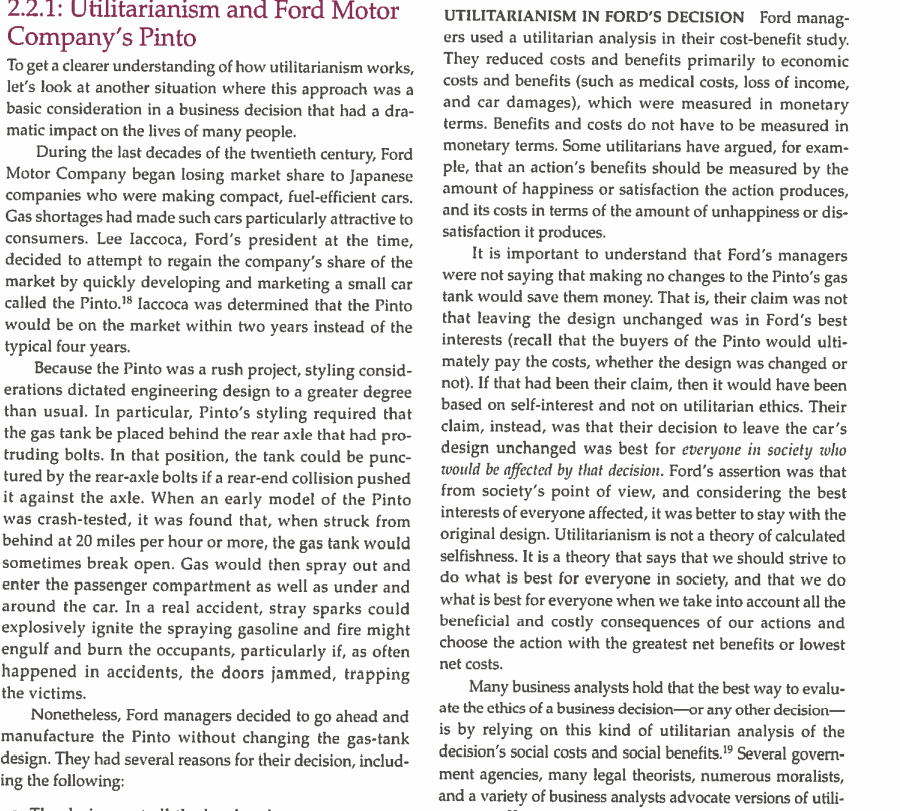
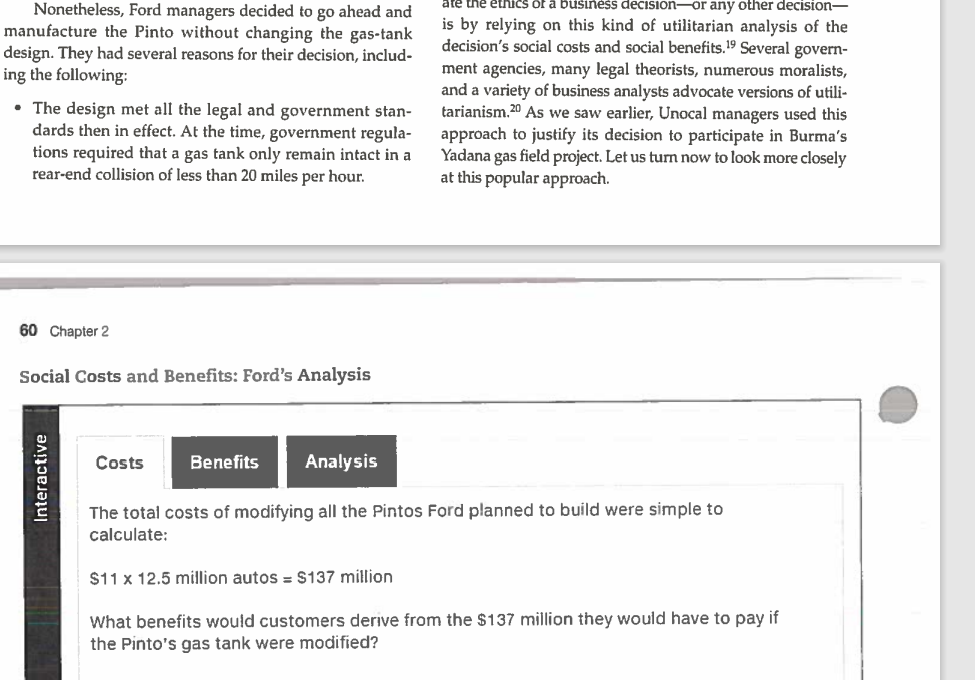
2.2.1: Utilitarianism and Ford Motor Company's Pinto To get a clearer understanding of how utilitarianism works, let's look at another situation where this approach was a basic consideration in a business decision that had a dra- matic impact on the lives of many people. During the last decades of the twentieth century, Ford Motor Company began losing market share to Japanese companies who were making compact, fuel-efficient cars. Gas shortages had made such cars particularly attractive to consumers. Lee Iaccoca, Ford's president at the time, decided to attempt to regain the company's share of the market by quickly developing and marketing a small car called the Pinto 18 laccoca was determined that the Pinto would be on the market within two years instead of the typical four years. Because the Pinto was a rush project, styling consid- erations dictated engineering design to a greater degree than usual. In particular, Pinto's styling required that the gas tank be placed behind the rear axle that had pro- truding bolts. In that position, the tank could be punc- tured by the rear-axle bolts if a rear-end collision pushed it against the axle. When an early model of the Pinto was crash-tested, it was found that, when struck from behind at 20 miles per hour or more, the gas tank would sometimes break open. Gas would then spray out and enter the passenger compartment as well as under and around the car. In a real accident, stray sparks could explosively ignite the spraying gasoline and fire might engulf and burn the occupants, particularly if, as often happened in accidents, the doors jammed, trapping the victims. Nonetheless, Ford managers decided to go ahead and manufacture the Pinto without changing the gas-tank design. They had several reasons for their decision, includ- ing the following: UTILITARIANISM IN FORD'S DECISION Ford manag- ers used a utilitarian analysis in their cost-benefit study. They reduced costs and benefits primarily to economic costs and benefits (such as medical costs, loss of income, and car damages), which were measured in monetary terms. Benefits and costs do not have to be measured in monetary terms. Some utilitarians have argued, for exam- ple, that an action's benefits should be measured by the amount of happiness or satisfaction the action produces, and its costs in terms of the amount of unhappiness or dis- satisfaction it produces. It is important to understand that Ford's managers were not saying that making no changes to the Pinto's gas tank would save them money. That is, their claim was not that leaving the design unchanged was in Ford's best interests (recall that the buyers of the Pinto would ulti- mately pay the costs, whether the design was changed or not). If that had been their claim, then it would have been based on self-interest and not on utilitarian ethics. Their claim, instead, was that their decision to leave the car's design unchanged was best for everyone in society wlio would be affected by that decision. Ford's assertion was that from society's point of view, and considering the best interests of everyone affected, it was better to stay with the original design. Utilitarianism is not a theory of calculated selfishness. It is a theory that says that we should strive to do what is best for everyone in society, and that we do what is best for everyone when we take into account all the beneficial and costly consequences of our actions and choose the action with the greatest net benefits or lowest net costs. Many business analysts hold that the best way to evalu- ate the ethics of a business decision-or any other decision- is by relying on this kind of utilitarian analysis of the decision's social costs and social benefits.! Several govern- ment agencies, many legal theorists, numerous moralists, and a variety of business analysts advocate versions of utili- Nonetheless, Ford managers decided to go ahead and manufacture the Pinto without changing the gas-tank design. They had several reasons for their decision, includ- ing the following: The design met all the legal and government stan- dards then in effect. At the time, government regula- tions required that a gas tank only remain intact in a rear-end collision of less than 20 miles per hour. the ethics of a business decision or any other decision- is by relying on this kind of utilitarian analysis of the decision's social costs and social benefits. Several govern- ment agencies, many legal theorists, numerous moralists, and a variety of business analysts advocate versions of utili- tarianism.20 As we saw earlier, Unocal managers used this approach to justify its decision to participate in Burma's Yadana gas field project. Let us turn now to look more closely at this popular approach. 60 Chapter 2 Social Costs and Benefits: Ford's Analysis Costs Benefits Analysis Interactive The total costs of modifying all the Pintos Ford planned to build were simple to calculate: $11 X 12.5 million autos = $137 million What benefits would customers derive from the $137 million they would have to pay if the Pinto's gas tank were modified









 Study Help