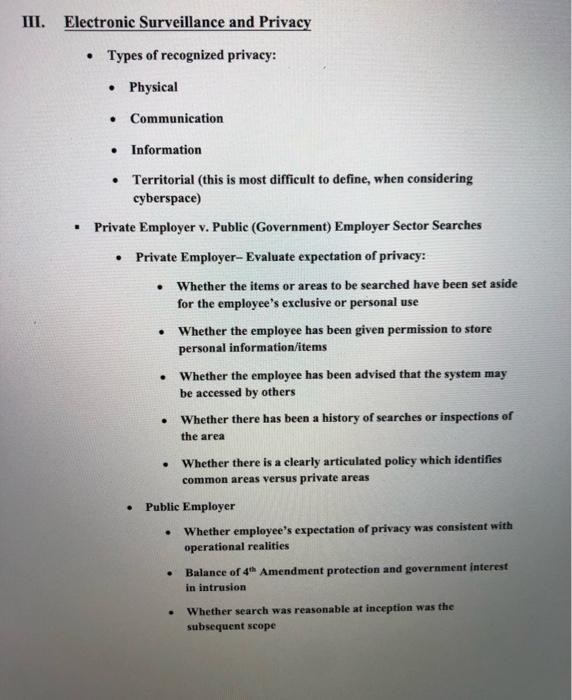
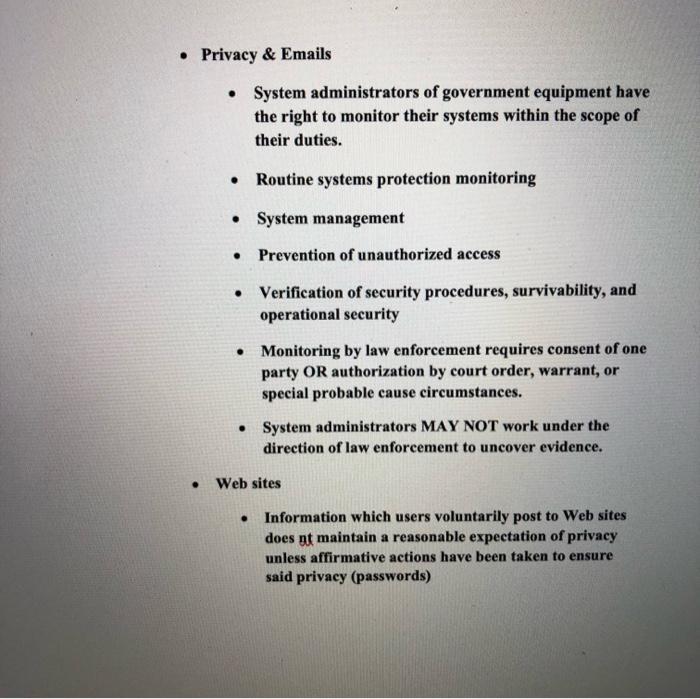
Question: After reading the lecture notes answer the following questions. 1. Describe the circumstances where a search warrant may be waived prior to a search. 2.

After reading the lecture notes answer the
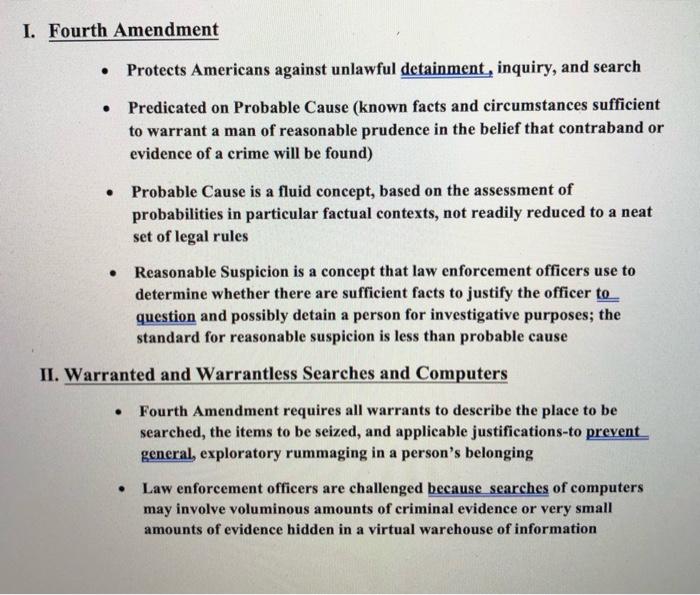
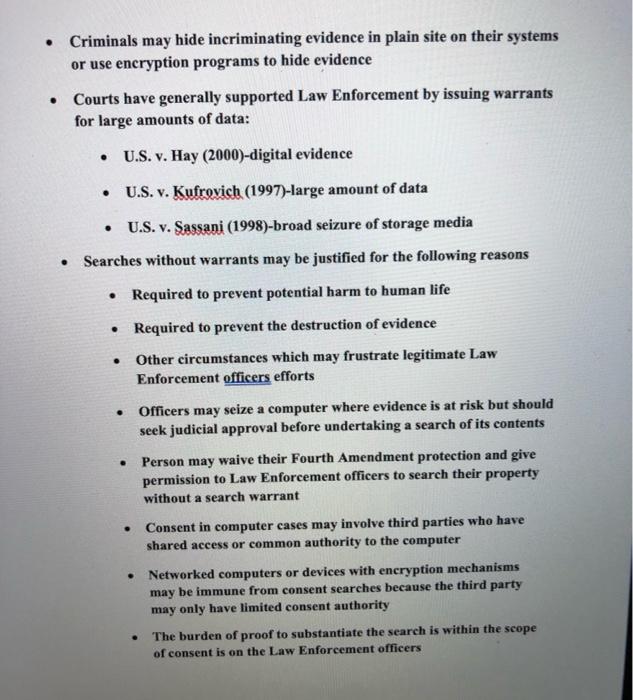
After reading the lecture notes answer the following questions. 1. Describe the circumstances where a search warrant may be waived prior to a search. 2. Discuss the Fourth Amendment according to the lecture notes. 3. Compare and contrast searches in a private employer location vs. a goverment employer venue. I. Fourth Amendment . Protects Americans against unlawful detainment, inquiry, and search . Predicated on Probable Cause (known facts and circumstances sufficient to warrant a man of reasonable prudence in the belief that contraband or evidence of a crime will be found) a Probable Cause is a fluid concept, based on the assessment of probabilities in particular factual contexts, not readily reduced to a neat set of legal rules . Reasonable Suspicion is a concept that law enforcement officers use to determine whether there are sufficient facts to justify the officer to question and possibly detain a person for investigative purposes; the standard for reasonable suspicion is less than probable cause II. Warranted and Warrantless Searches and Computers Fourth Amendment requires all warrants to describe the place to be searched, the items to be seized, and applicable justifications to prevent general, exploratory rummaging in a person's belonging . Law enforcement officers are challenged because searches of computers may involve voluminous amounts of criminal evidence or very small amounts of evidence hidden in a virtual warehouse of information . Criminals may hide incriminating evidence in plain site on their systems or use encryption programs to hide evidence Courts have generally supported Law Enforcement by issuing warrants for large amounts of data: . U.S. v. Hay (2000)-digital evidence U.S. v. Kufrovich (1997)-large amount of data U.S. v. Sassani (1998)-broad seizure of storage media . Searches without warrants may be justified for the following reasons Required to prevent potential harm to human life Required to prevent the destruction of evidence Other circumstances which may frustrate legitimate Law Enforcement officers efforts Officers may seize a computer where evidence is at risk but should seek judicial approval before undertaking a search of its contents . Person may waive their Fourth Amendment protection and give permission to Law Enforcement officers to search their property without a search warrant Consent in computer cases may involve third parties who have shared access or common authority to the computer Networked computers or devices with encryption mechanisms may be immune from consent searches because the third party may only have limited consent authority The burden of proof to substantiate the search is within the scope of consent is on the Law Enforcement officers III. Electronic Surveillance and Privacy Types of recognized privacy: Physical Communication Information . Territorial (this is most difficult to define, when considering cyberspace) Private Employer v. Public (Government) Employer Sector Searches Private Employer-Evaluate expectation of privacy: Whether the items or areas to be searched have been set aside for the employee's exclusive or personal use Whether the employee has been given permission to store personal information/items Whether the employee has been advised that the system may be accessed by others Whether there has been a history of searches or inspections of . . . the area . . Whether there is a clearly articulated policy which identifies common areas versus private areas Public Employer Whether employee's expectation of privacy was consistent with operational realities Balance of 4 Amendment protection and government interest . in intrusion Whether search was reasonable at inception was the subsequent scope Privacy & Emails System administrators of government equipment have the right to monitor their systems within the scope of their duties. . Routine systems protection monitoring System management . Prevention of unauthorized access . Verification of security procedures, survivability, and operational security Monitoring by law enforcement requires consent of one party OR authorization by court order, warrant, or special probable cause circumstances. System administrators MAY NOT work under the direction of law enforcement to uncover evidence. Web sites . Information which users voluntarily post to Web sites does nt maintain a reasonable expectation of privacy unless affirmative actions have been taken to ensure said privacy (passwords)
Step by Step Solution

There are 3 Steps involved in it

1 Expert Approved Answer
Step: 1 Unlock blur-text-image

Question Has Been Solved by an Expert!

Get step-by-step solutions from verified subject matter experts

Step: 2 Unlock
Step: 3 Unlock

Students Have Also Explored These Related General Management Questions!