



Question: After reading the opening case study in Chapter 8, Toyoto's European Drive, which is also UPLOADED HERE (3 FILES) , discuss why did the Europeans
After reading the opening case study in Chapter 8, "Toyoto's European Drive", which is also UPLOADED HERE (3 FILES), discuss why did the Europeans try to protect their auto industry from Japanese imports, and do you think this was fair to European consumers? Write 10 sentences!!!!
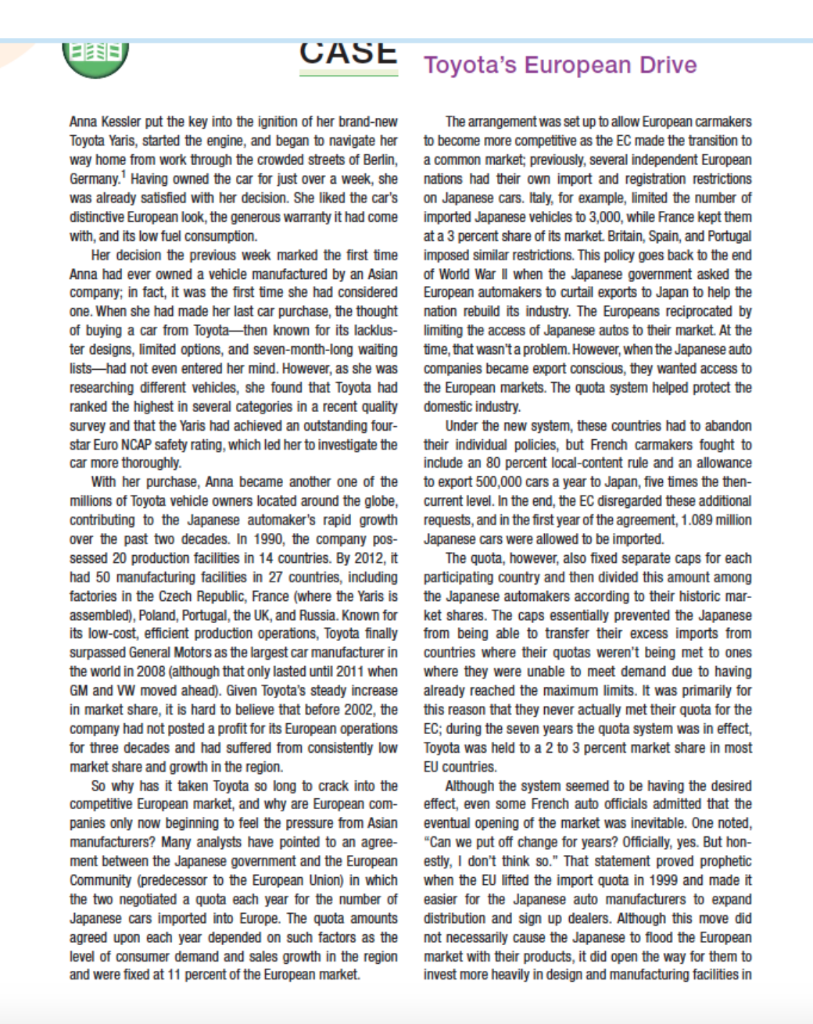
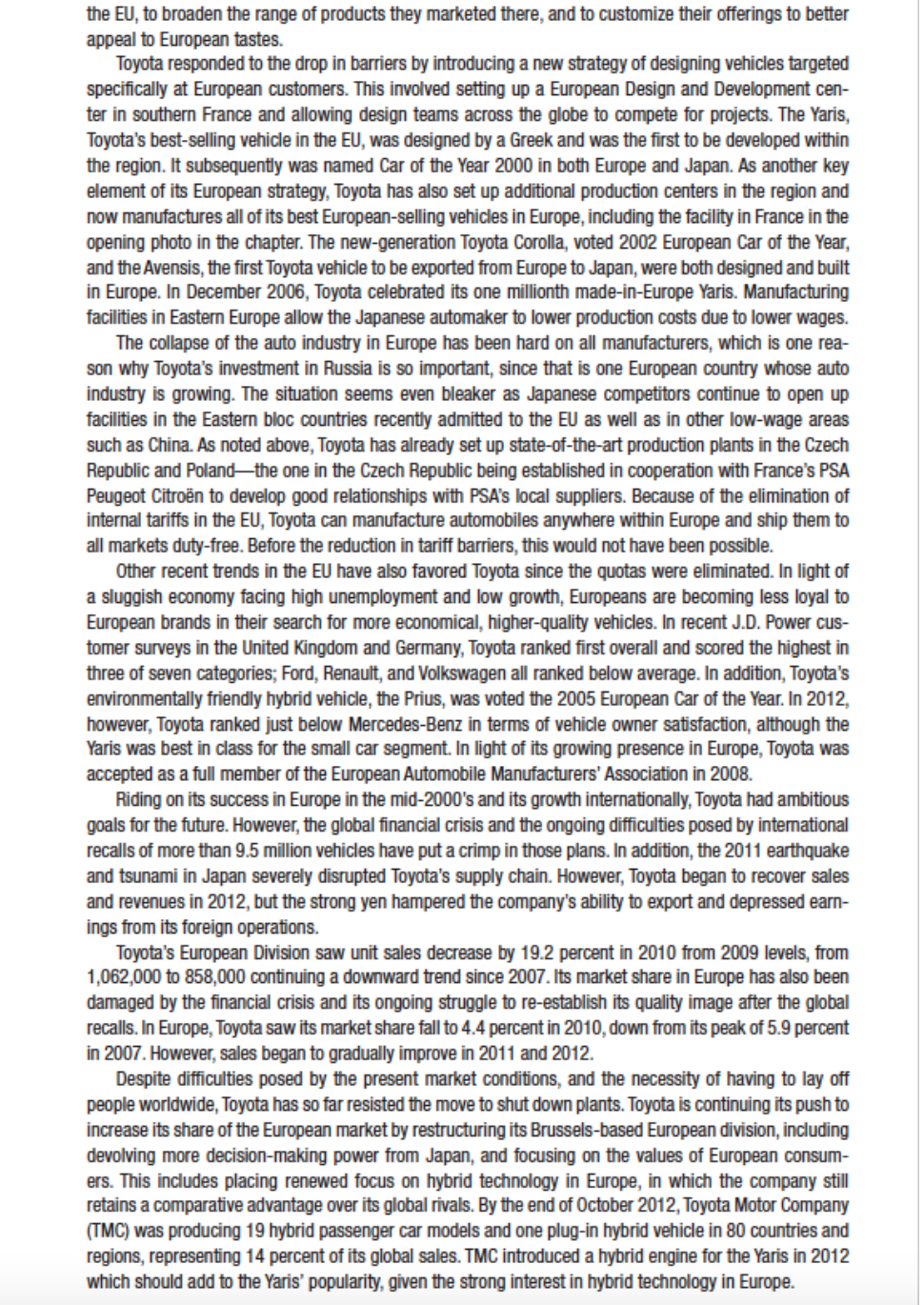
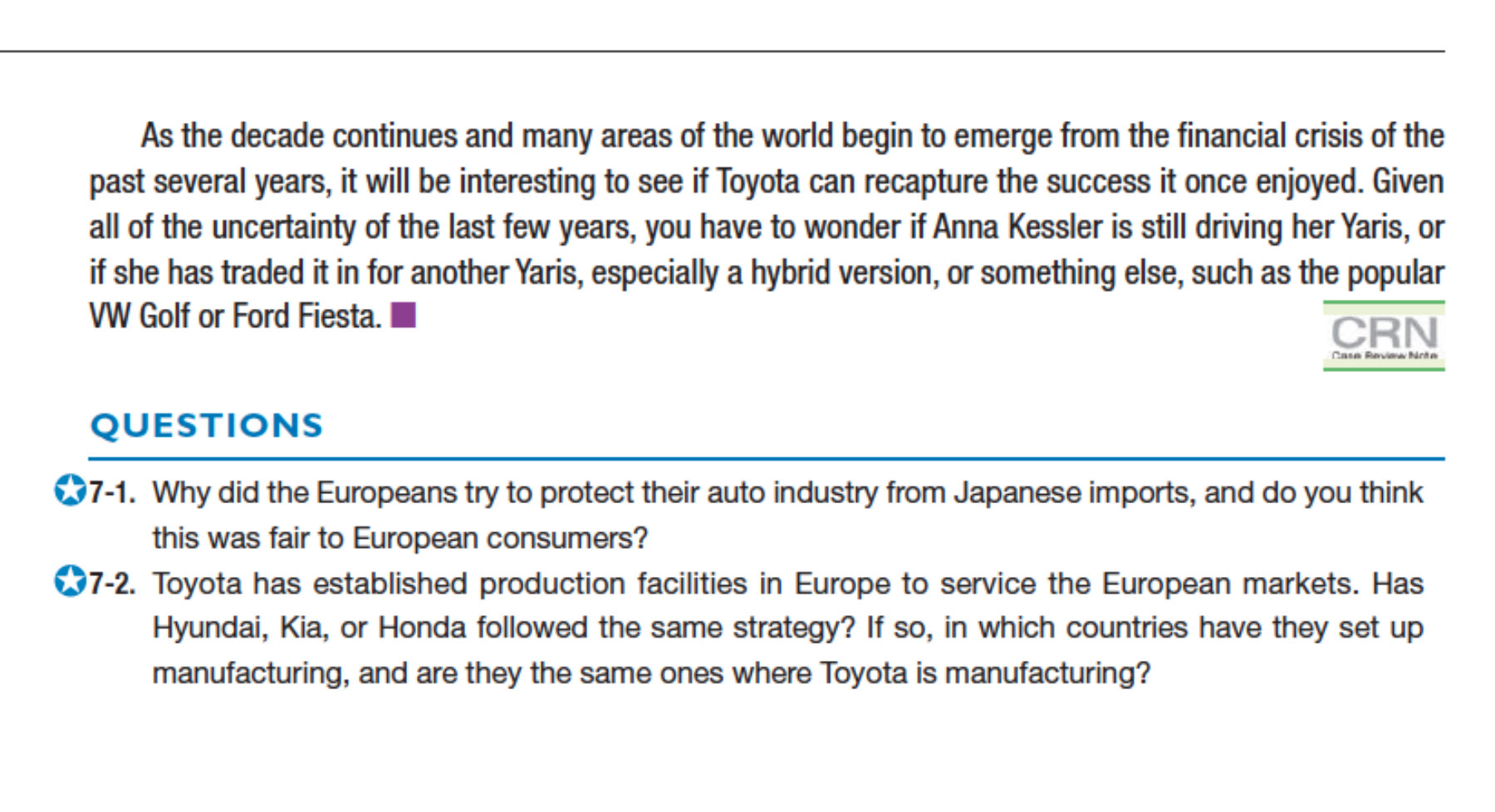
Toyota's European Drive Anna Kessler put the key into the ignition of her brand-new The arrangement was set up to allow European carmakers Toyota Yaris, started the engine, and began to navigate her to become more competitive as the EC made the transition to way home from work through the crowded streets of Berlin, a common market; previously, several independent European Germany. 1 Having owned the car for just over a week, she nations had their own import and registration restrictions was already satisfied with her decision. She liked the car's on Japanese cars. ltaly, for example, limited the number of distinctive European look, the generous warranty it had come imported Japanese vehicles to 3,000, while France kept them with, and its low fuel consumption. at a 3 percent share of its market. Britain, Spain, and Portugal Her decision the previous week marked the first time imposed similar restrictions. This policy goes back to the end Anna had ever owned a vehicle manufactured by an Asian of World War II when the Japanese government asked the company; in fact, it was the first time she had considered European automakers to curtail exports to Japan to help the one. When she had made her last car purchase, the thought nation rebuild its industry. The Europeans reciprocated by of buying a car from Toyota - then known for its lacklus- limiting the access of Japanese autos to their market. At the ter designs, limited options, and seven-month-long waiting time, that wasn't a problem. However, when the Japanese auto lists-had not even entered her mind. However, as she was companies became export conscious, they wanted access to researching different vehicles, she found that Toyota had the European markets. The quota system helped protect the ranked the highest in several categories in a recent quality domestic industry. survey and that the Yaris had achieved an outstanding four- Under the new system, these countries had to abandon star Euro NCAP safety rating, which led her to investigate the their individual policies, but French carmakers fought to car more thoroughly. include an 80 percent local-content rule and an allowance With her purchase, Anna became another one of the to export 500,000 cars a year to Japan, five times the thenmillions of Toyota vehicle owners located around the globe, current level. In the end, the EC disregarded these additional contributing to the Japanese automaker's rapid growth requests, and in the first year of the agreement, 1.089 million over the past two decades. In 1990, the company pos- Japanese cars were allowed to be imported. sessed 20 production facilities in 14 countries. By 2012, it The quota, however, also fixed separate caps for each had 50 manufacturing facilities in 27 countries, including participating country and then divided this amount among factories in the Czech Republic, France (where the Yaris is the Japanese automakers according to their historic marassembled), Poland, Portugal, the UK, and Russia. Known for ket shares. The caps essentially prevented the Japanese its low-cost, efficient production operations, Toyota finally from being able to transfer their excess imports from surpassed General Motors as the largest car manufacturer in countries where their quotas weren't being met to ones the world in 2008 (although that only lasted until 2011 when where they were unable to meet demand due to having GM and VW moved ahead). Given Toyota's steady increase already reached the maximum limits. It was primarily for in market share, it is hard to believe that before 2002, the this reason that they never actually met their quota for the company had not posted a profit for its European operations EC; during the seven years the quota system was in effect, for three decades and had suffered from consistently low Toyota was held to a 2 to 3 percent market share in most market share and growth in the region. EU countries. So why has it taken Toyota so long to crack into the Although the system seemed to be having the desired competitive European market, and why are European com- effect, even some French auto officials admitted that the panies only now beginning to feel the pressure from Asian eventual opening of the market was inevitable. One noted, manufacturers? Many analysts have pointed to an agree- "Can we put off change for years? Officially, yes. But honment between the Japanese government and the European estly, I don't think so." That statement proved prophetic Community (predecessor to the European Union) in which when the EU lifted the import quota in 1999 and made it the two negotiated a quota each year for the number of easier for the Japanese auto manufacturers to expand Japanese cars imported into Europe. The quota amounts distribution and sign up dealers. Although this move did agreed upon each year depended on such factors as the not necessarily cause the Japanese to flood the European level of consumer demand and sales growth in the region market with their products, it did open the way for them to and were fixed at 11 percent of the European market. invest more heavily in design and manufacturing facilities in the EU, to broaden the range of products they marketed there, and to customize their offerings to better appeal to European tastes. Toyota responded to the drop in barriers by introducing a new strategy of designing vehicles targeted specifically at European customers. This involved setting up a European Design and Development center in southern France and allowing design teams across the globe to compete for projects. The Yaris, Toyota's best-selling vehicle in the EU, was designed by a Greek and was the first to be developed within the region. It subsequently was named Car of the Year 2000 in both Europe and Japan. As another key element of its European strategy, Toyota has also set up additional production centers in the region and now manufactures all of its best European-selling vehicles in Europe, including the facility in France in the opening photo in the chapter. The new-generation Toyota Corolla, voted 2002 European Car of the Year, and the Avensis, the first Toyota vehicle to be exported from Europe to Japan, were both designed and built in Europe. In December 2006, Toyota celebrated its one millionth made-in-Europe Yaris. Manufacturing facilities in Eastern Europe allow the Japanese automaker to lower production costs due to lower wages. The collapse of the auto industry in Europe has been hard on all manufacturers, which is one reason why Toyota's investment in Russia is so important, since that is one European country whose auto industry is growing. The situation seems even bleaker as Japanese competitors continue to open up facilities in the Eastern bloc countries recently admitted to the EU as well as in other low-wage areas such as China. As noted above, Toyota has already set up state-of-the-art production plants in the Czech Republic and Poland-the one in the Czech Republic being established in cooperation with France's PSA Peugeot Citron to develop good relationships with PSA's local suppliers. Because of the elimination of internal tariffs in the EU, Toyota can manufacture automobiles anywhere within Europe and ship them to all markets duty-free. Before the reduction in tariff barriers, this would not have been possible. Other recent trends in the EU have also favored Toyota since the quotas were eliminated. In light of a sluggish economy facing high unemployment and low growth, Europeans are becoming less loyal to European brands in their search for more economical, higher-quality vehicles. In recent J.D. Power customer surveys in the United Kingdom and Germany, Toyota ranked first overall and scored the highest in three of seven categories; Ford, Renault, and Volkswagen all ranked below average. In addition, Toyota's environmentally friendly hybrid vehicle, the Prius, was voted the 2005 European Car of the Year. In 2012, however, Toyota ranked just below Mercedes-Benz in terms of vehicle owner satisfaction, although the Yaris was best in class for the small car segment. In light of its growing presence in Europe, Toyota was accepted as a full member of the European Automobile Manufacturers' Association in 2008. Riding on its success in Europe in the mid-2000's and its growth internationally, Toyota had ambitious goals for the future. However, the global financial crisis and the ongoing difficulties posed by international recalls of more than 9.5 million vehicles have put a crimp in those plans. In addition, the 2011 earthquake and tsunami in Japan severely disrupted Toyota's supply chain. However, Toyota began to recover sales and revenues in 2012, but the strong yen hampered the company's ability to export and depressed earnings from its foreign operations. Toyota's European Division saw unit sales decrease by 19.2 percent in 2010 from 2009 levels, from 1,062,000 to 858,000 continuing a downward trend since 2007. Its market share in Europe has also been damaged by the financial crisis and its ongoing struggle to re-establish its quality image after the global recalls. In Europe, Toyota saw its market share fall to 4.4 percent in 2010, down from its peak of 5.9 percent in 2007. However, sales began to gradually improve in 2011 and 2012. Despite difficulties posed by the present market conditions, and the necessity of having to lay off people worldwide, Toyota has so far resisted the move to shut down plants. Toyota is continuing its push to increase its share of the European market by restructuring its Brussels-based European division, including devolving more decision-making power from Japan, and focusing on the values of European consumers. This includes placing renewed focus on hybrid technology in Europe, in which the company still retains a comparative advantage over its global rivals. By the end of October 2012, Toyota Motor Company (TMC) was producing 19 hybrid passenger car models and one plug-in hybrid vehicle in 80 countries and regions, representing 14 percent of its global sales. TMC introduced a hybrid engine for the Yaris in 2012 which should add to the Yaris' popularity, given the strong interest in hybrid technology in Europe. As the decade continues and many areas of the world begin to emerge from the financial crisis of the past several years, it will be interesting to see if Toyota can recapture the success it once enjoyed. Given all of the uncertainty of the last few years, you have to wonder if Anna Kessler is still driving her Yaris, or if she has traded it in for another Yaris, especially a hybrid version, or something else, such as the popular VW Golf or Ford Fiesta. QUESTIONS 7-1. Why did the Europeans try to protect their auto industry from Japanese imports, and do you think this was fair to European consumers? 7-2. Toyota has established production facilities in Europe to service the European markets. Has Hyundai, Kia, or Honda followed the same strategy? If so, in which countries have they set up manufacturing, and are they the same ones where Toyota is manufacturing
Step by Step Solution
There are 3 Steps involved in it

Get step-by-step solutions from verified subject matter experts