







Question: After reading the opening vignette about Nikes forecast and errors, how will you as a colleague defend the person/s that were involved in making these
After reading the opening vignette about Nikes forecast and errors, how will you as a colleague defend the person/s that were involved in making these forecasts.
Please explain in great detail. Thank you!
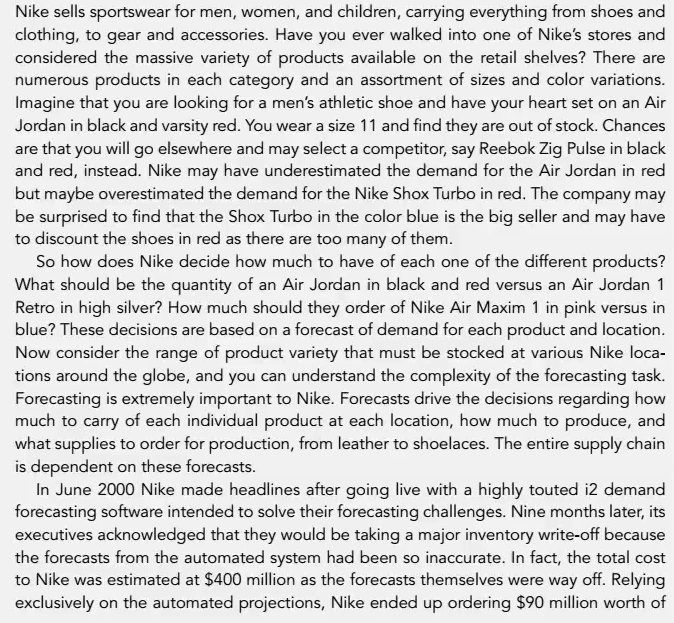
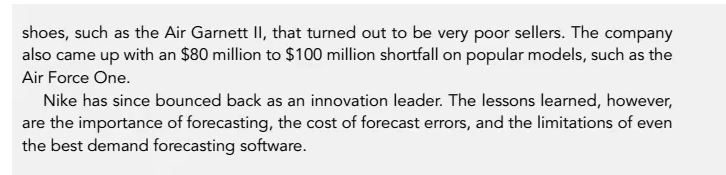
Nike sells sportswear for men, women, and children, carrying everything from shoes and clothing, to gear and accessories. Have you ever walked into one of Nike's stores and considered the massive variety of products available on the retail shelves? There are numerous products in each category and an assortment of sizes and color variations. Imagine that you are looking for a men's athletic shoe and have your heart set on an Air Jordan in black and varsity red. You wear a size 11 and find they are out of stock. Chances are that you will go elsewhere and may select a competitor, say Reebok Zig Pulse in black and red, instead. Nike may have underestimated the demand for the Air Jordan in red but maybe overestimated the demand for the Nike Shox Turbo in red. The company may be surprised to find that the Shox Turbo in the color blue is the big seller and may have to discount the shoes in red as there are too many of them. So how does Nike decide how much to have of each one of the different products? What should be the quantity of an Air Jordan in black and red versus an Air Jordan 1 Retro in high silver? How much should they order of Nike Air Maxim 1 in pink versus in blue? These decisions are based on a forecast of demand for each product and location. Now consider the range of product variety that must be stocked at various Nike loca- tions around the globe, and you can understand the complexity of the forecasting task. Forecasting is extremely important to Nike. Forecasts drive the decisions regarding how much to carry of each individual product at each location, how much to produce, and what supplies to order for production, from leather to shoelaces. The entire supply chain is dependent on these forecasts. In June 2000 Nike made headlines after going live with a highly touted i2 demand forecasting software intended to solve their forecasting challenges. Nine months later, its executives acknowledged that they would be taking a major inventory write-off because the forecasts from the automated system had been so inaccurate. In fact, the total cost to Nike was estimated at $400 million as the forecasts themselves were way off. Relying exclusively on the automated projections, Nike ended up ordering $90 million worth of shoes, such as the Air Garnett II, that turned out to be very poor sellers. The company also came up with an $80 million to $100 million shortfall on popular models, such as the Air Force One. Nike has since bounced back as an innovation leader. The lessons learned, however, are the importance of forecasting, the cost of forecast errors, and the limitations of even the best demand forecasting softwareStep by Step Solution
There are 3 Steps involved in it
1 Expert Approved Answer
Step: 1 Unlock

Question Has Been Solved by an Expert!
Get step-by-step solutions from verified subject matter experts
Step: 2 Unlock
Step: 3 Unlock
 Study Help