







Question: Agent Theory 1. Problem Set 8: Principal Agent Theory (11) Consider a team of 11. agents. Agent II chooses effort al- 2 0 for i
Agent Theory
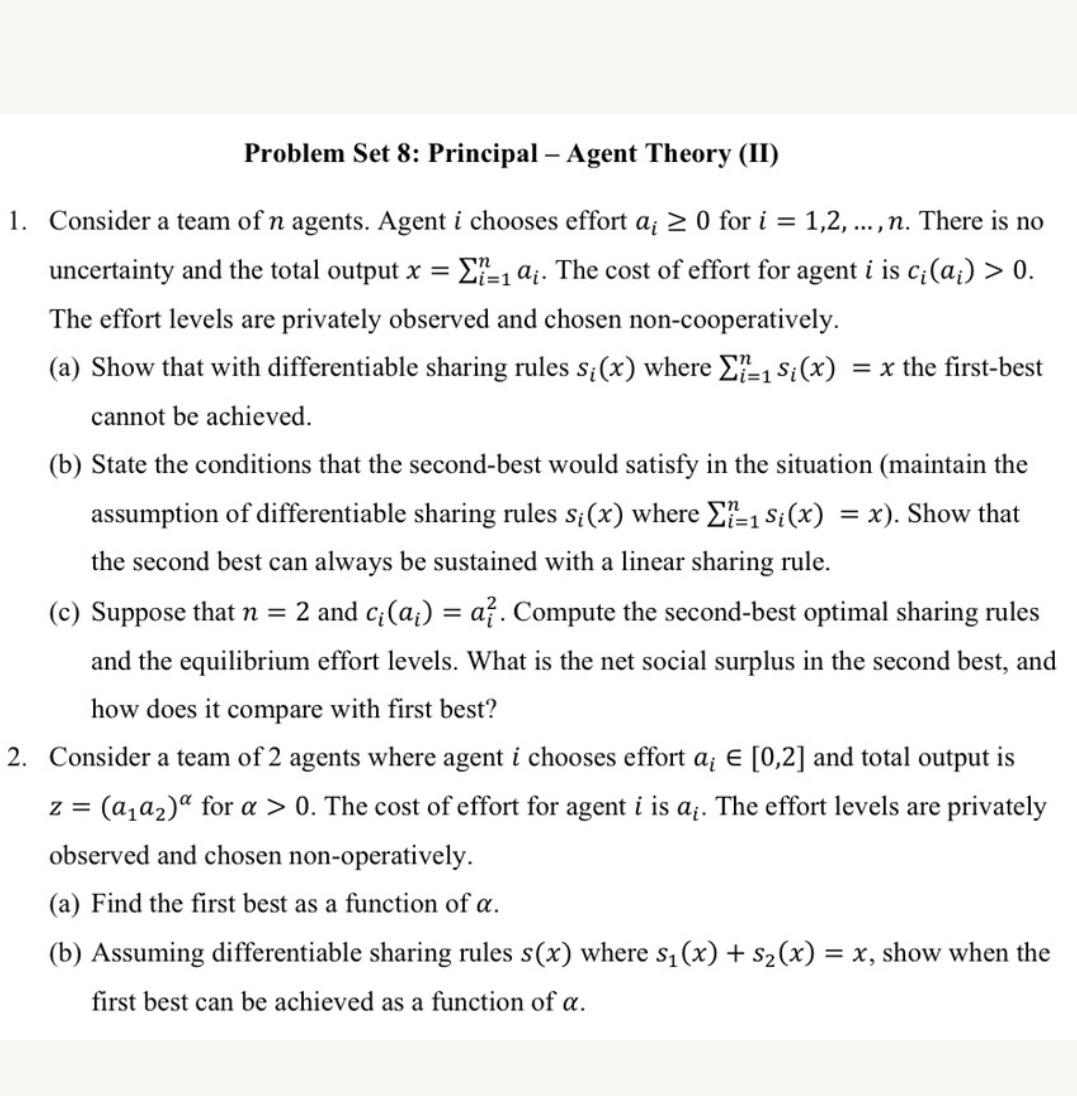
1. Problem Set 8: Principal Agent Theory (11) Consider a team of 11. agents. Agent II chooses effort al- 2 0 for i = 1.2, ...,n. There is no uncertainty and the total output at = }'=1 (1;. The cost of effort for agent i is ci(al-) > 0. The effort levels are privately observed and chosen non-cooperatively. (a) Show that with differentiable sharing rules si(x) where 213:1 530:) = x the rst-best cannot be achieved. (b) State the conditions that the second-best would satisfy in the situation (maintain the assumption of differentiable sharing rules 8: (x) where 2&1 s[(x) = 2:). Show that the second best can always be sustained with a linear sharing rule. (c) Suppose that n = 2 and c(ai) = af. Compute the second-best optimal sharing rules and the equilibrium effort levels. What is the net social surplus in the second best, and how does it compare with rst best? Consider a team of 2 agents where agent i chooses effort a; E [0.2] and total output is z = (a1a2)\" for a > 0. The cost of effort for agent i is a1. The effort levels are privately observed and chosen non-operatively. (a) Find the rst best as a function of a. (b) Assuming differentiable sharing rules 50:) where s1(x) + 32 (x) = I, show when the rst best can be achieved as a mction of 0
Step by Step Solution
There are 3 Steps involved in it

Get step-by-step solutions from verified subject matter experts
 Study Help