







Question: Algebra 2 Name Now..let's apply 5.6 to the Fundamental Theorem of Algebra The Fundamental Theorem of Algebra is a polynomial of nth degree, where n
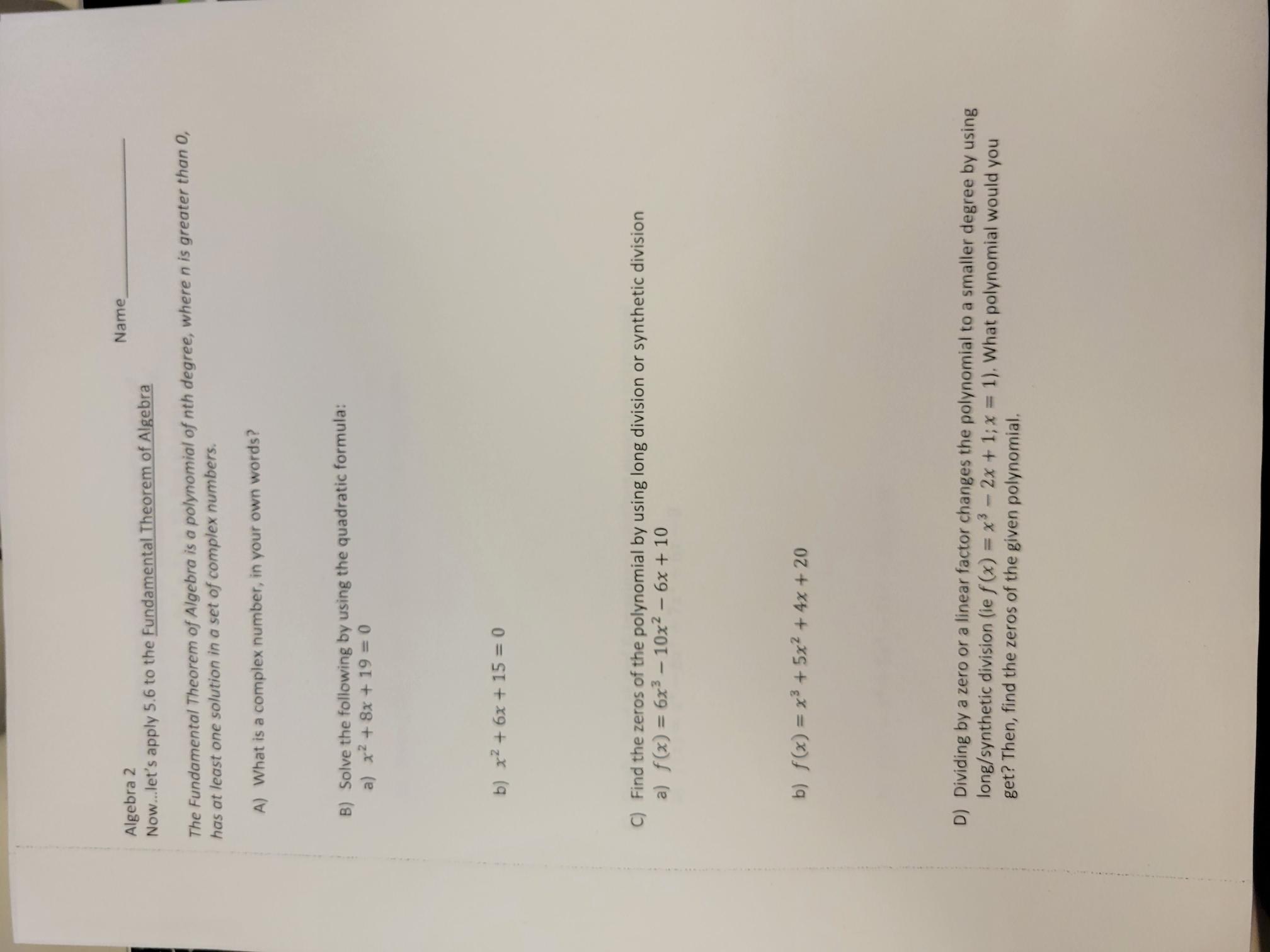
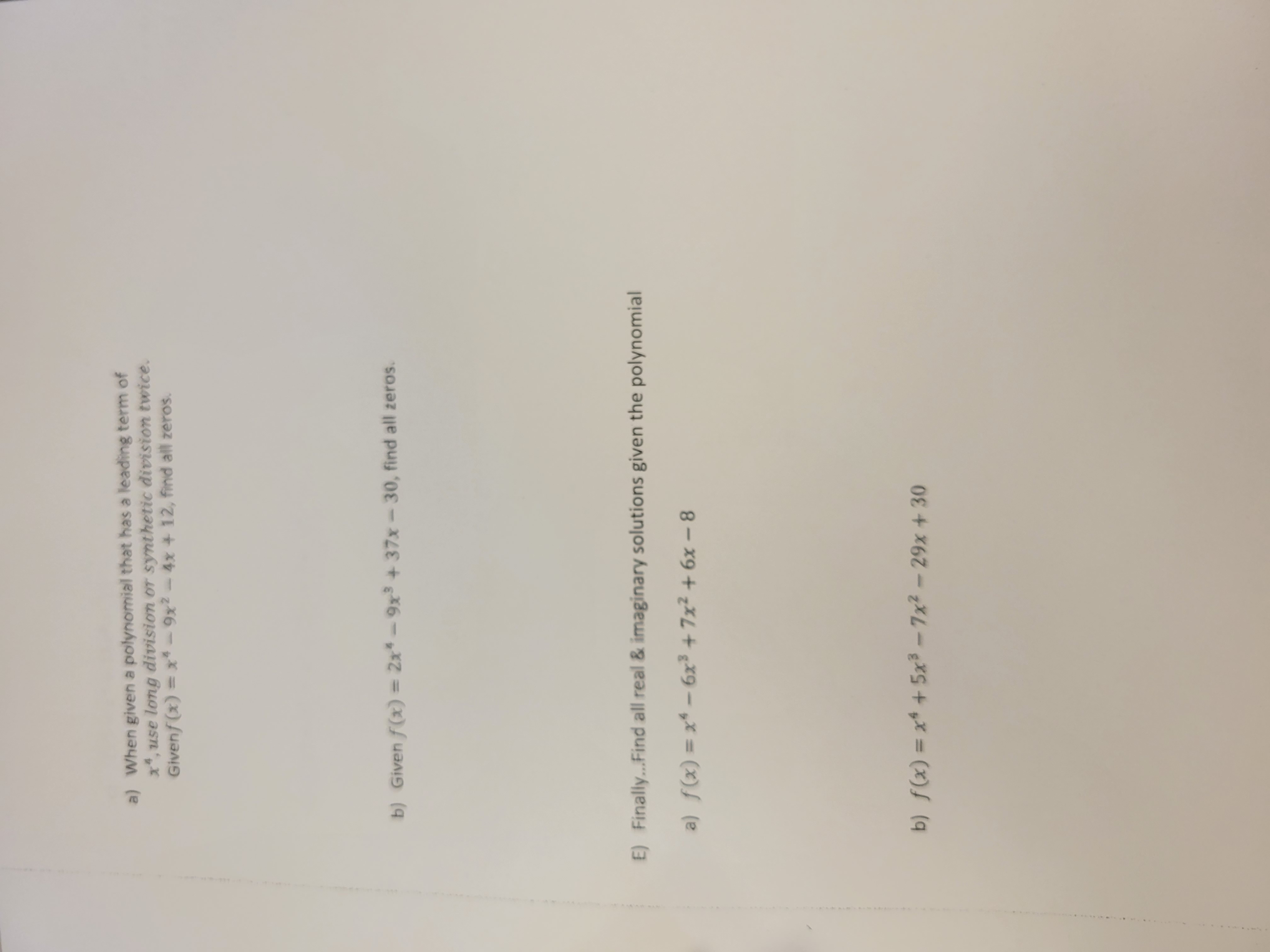

Algebra 2 Name Now..let's apply 5.6 to the Fundamental Theorem of Algebra The Fundamental Theorem of Algebra is a polynomial of nth degree, where n is greater than 0, has at least one solution in a set of complex numbers. A) What is a complex number, in your own words? B) Solve the following by using the quadratic formula: a) x2+ 8x +19=0 b) x2+ 6x + 15=0 C) Find the zeros of the polynomial by using long division or synthetic division a) f(x) = 6x3-10x2 - 6x + 10 b) f (x) = x3+5x2+4x+20 D) Dividing by a zero or a linear factor changes the polynomial to a smaller degree by using long/synthetic division (ie f (x) = x3 - 2x + 1; x = 1), What polynomial would you get? Then, find the zeros of the given polynomial.a) When given a polynomial that has a leading term of x4, use long division or synthetic division twice. Givenf (x) = x4- 9x2 - 4x + 12, find all zeros. b) Given f (x) = 2x4 -9x3 + 37x - 30, find all zeros. E) Finally.. Find all real & imaginary solutions given the polynomial a) f(x) = x4 -6x3+7x2+6x -8 b) f (x) = x4+5x3-7x2-29x +30\f
Step by Step Solution
There are 3 Steps involved in it

Get step-by-step solutions from verified subject matter experts
 Study Help