



Question: (Algorithmic) (LO. 1) Sally owns real property for which the annual property taxes are $14,430. She sells the property to Kate on April 2,
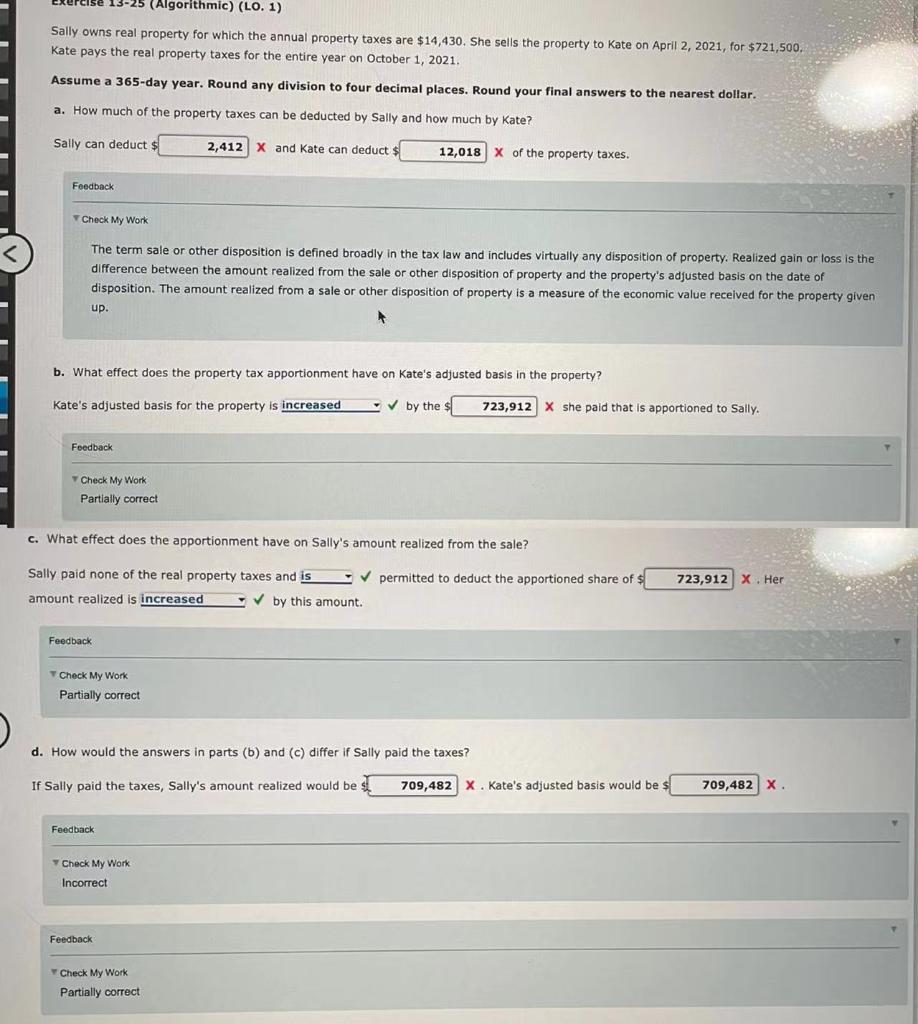
(Algorithmic) (LO. 1) Sally owns real property for which the annual property taxes are $14,430. She sells the property to Kate on April 2, 2021, for $721,500. Kate pays the real property taxes for the entire year on October 1, 2021. Assume a 365-day year. Round any division to four decimal places. Round your final answers to the nearest dollar. a. How much of the property taxes can be deducted by Sally and how much by Kate? Sally can deduct $ Feedback 2,412 X and Kate can deduct $ 12,018 X of the property taxes. Check My Work The term sale or other disposition is defined broadly in the tax law and includes virtually any disposition of property. Realized gain or loss is the difference between the amount realized from the sale or other disposition of property and the property's adjusted basis on the date of disposition. The amount realized from a sale or other disposition of property is a measure of the economic value received for the property given up. b. What effect does the property tax apportionment have on Kate's adjusted basis in the property? Kate's adjusted basis for the property is increased Feedback by the $ 723,912 X she paid that is apportioned to Sally. Check My Work Partially correct c. What effect does the apportionment have on Sally's amount realized from the sale? Sally paid none of the real property taxes and is amount realized is increased Feedback Check My Work Partially correct permitted to deduct the apportioned share of $ 723,912 X. Her by this amount. d. How would the answers in parts (b) and (c) differ if Sally paid the taxes? If Sally paid the taxes, Sally's amount realized would be Feedback Check My Work Incorrect Feedback Check My Work Partially correct 709,482 X. Kate's adjusted basis would be $ 709,482 X.
Step by Step Solution
There are 3 Steps involved in it

Get step-by-step solutions from verified subject matter experts