







Question: Algorithms analysis class Problem 1. A queue datastructure Q can be implemented using two stacks s1 and S2 as follows: ENQUEUE Q, x) PUSH(Q.S1, x)
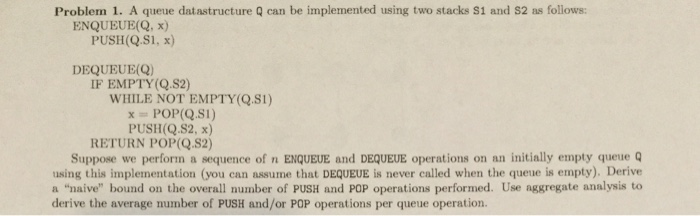
Problem 1. A queue datastructure Q can be implemented using two stacks s1 and S2 as follows: ENQUEUE Q, x) PUSH(Q.S1, x) DEQUEUE(Q) IF EMPTY(Q.S2) WHILE NOT EMPTY(Q.si) x POP(Q.si) PUSH(Q.S2, x) RETURN POP(Q.S2) Suppose we perform a sequence of n ENQUEUE and DEQUEUE operations on an initially empty queue q using this implementation (you can assume that DEQUEUE is never called when the queue is empty). Derive a "naive" bound on the overall number of PUSH and POP operations performed. Use aggregate analysis to derive the average number of PUSH and/or POP operations per queue operation. Problem 1. A queue datastructure Q can be implemented using two stacks s1 and S2 as follows: ENQUEUE Q, x) PUSH(Q.S1, x) DEQUEUE(Q) IF EMPTY(Q.S2) WHILE NOT EMPTY(Q.si) x POP(Q.si) PUSH(Q.S2, x) RETURN POP(Q.S2) Suppose we perform a sequence of n ENQUEUE and DEQUEUE operations on an initially empty queue q using this implementation (you can assume that DEQUEUE is never called when the queue is empty). Derive a "naive" bound on the overall number of PUSH and POP operations performed. Use aggregate analysis to derive the average number of PUSH and/or POP operations per queue operation
Step by Step Solution
There are 3 Steps involved in it

Get step-by-step solutions from verified subject matter experts
 Study Help