







Question: All (2) The problem - You are working at a particle collider and measure how much force it takes to accelerate a particle. You find
All
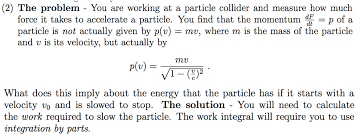
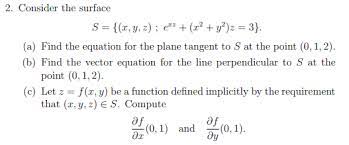
(2) The problem - You are working at a particle collider and measure how much force it takes to accelerate a particle. You find that the momentum p of a particle is not actually given by p(v) = mo, where m is the mass of the particle and v is its velocity, but actually by P(v) = V What does this imply about the energy that the particle has if it starts with a velocity up and is slowed to stop. The solution - You will need to calculate the work required to slow the particle. The work integral will require you to use integration by parts.2. Consider the surface + (x'+7 )= =3). (a) Find the equation for the plane tangent to $ at the point (0, 1, 2). (b) Find the vector equation for the line perpendicular to S at the point (0. 1.2). (c) Let am f(x, v) be a function defined implicitly by the requirement that (r. p. z) e S. Compute of 0. 1) and 0. 1).
Step by Step Solution
There are 3 Steps involved in it

Get step-by-step solutions from verified subject matter experts
 Study Help