







Question: (All figures in millions) 2013 2014 2015 2016 Notes Payable Long-Term Debt Accounts Payable Retained Earnings Inventories Common Stock Accumulated Depreciation Cash Accruals Intangible Assets
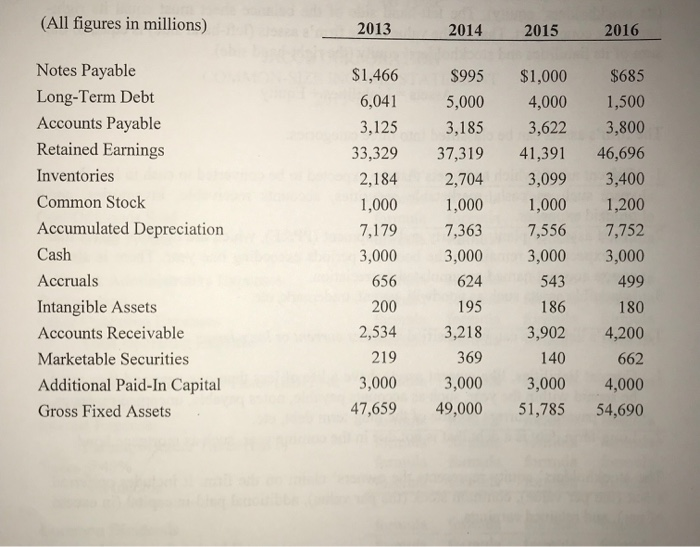
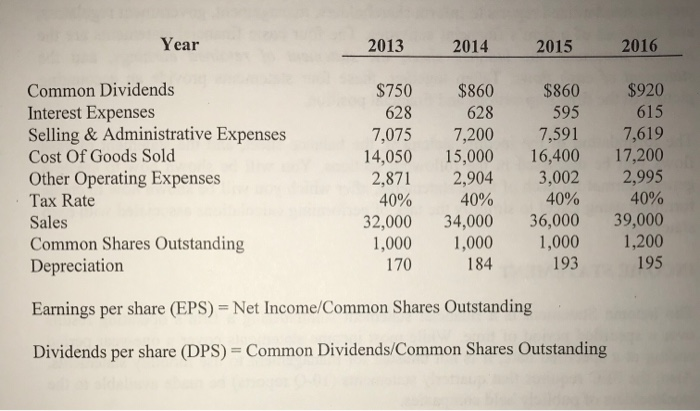
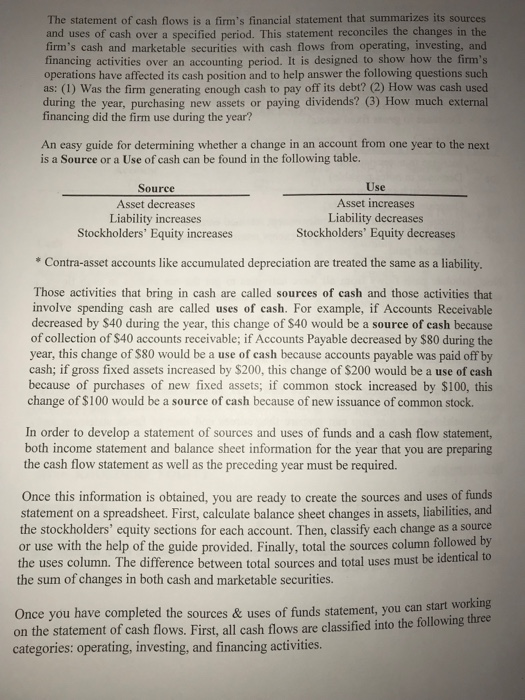
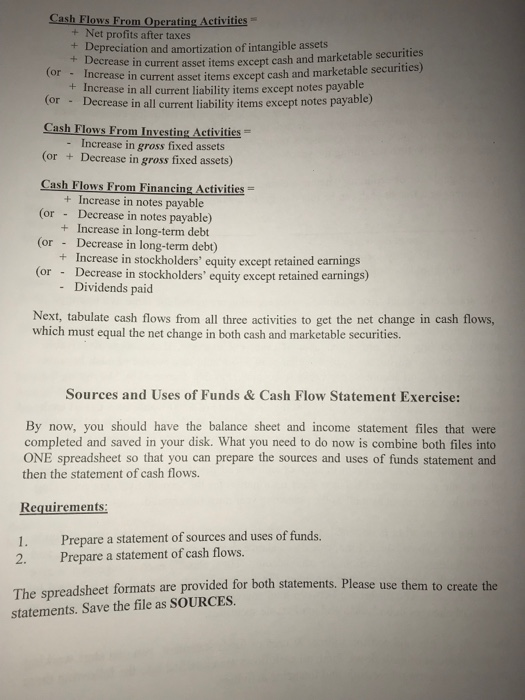
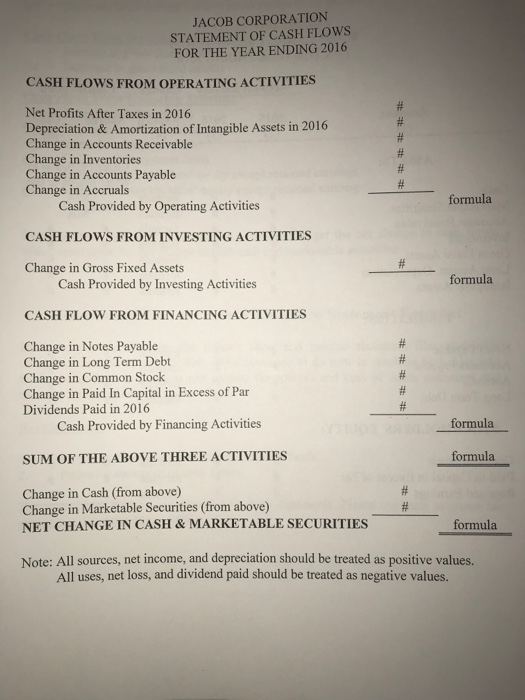
(All figures in millions) 2013 2014 2015 2016 Notes Payable Long-Term Debt Accounts Payable Retained Earnings Inventories Common Stock Accumulated Depreciation Cash Accruals Intangible Assets Accounts Receivable Marketable Securities Additional Paid-In Capital Gross Fixed Assets $1,466 $995 $1,000 $685 6,041 5,000 4,000 1,500 3,125 3,185 3,622 3,800 33,329 37,319 41,39 46,696 2,184 2,704 3,099 3,400 1,000 1,000 1,000 1,200 7,179 7,363 7,556 7,752 3,000 3,000 3,000 3,000 499 180 2,534 3,218 3,902 4,200 662 3,000 3,000 3,000 4,000 47,659 49,000 51,785 54,690 656 200 624 195 543 186 219 369 140 Year 2013 2014 2015 2016 Common Dividends Interest Expenses Selling& Administrative Expenses Cost Of Goods Solod Other Operating Expenses Tax Rate Sales Common Shares Outstanding Depreciation $750 $860 $860 $920 615 7,075 7,200 7,591 7,619 14,050 15,000 16,400 17,200 2,871 2,904 3,002 2,995 40% 32,000 34,000 36,000 39,000 1,000 1,000 1,000 1,200 195 628 628 595 40% 40% 40% 170 184 193 Earnings per share (EPS) Net Income/Common Shares Outstanding Dividends per share (DPS) Common Dividends/Common Shares Outstanding The statement of cash flows is a firm's financial statement that summarizes it and uses of cash over a specified period. This statement reconciles the changes in the firm's cash and marketable securities with cash flows from operating, investing, and financing activities over an accounting period. It is designed to show how the firm operations have affected its cash position and to help answer the following questions such as: (1) Was the firm generating enough cash to pay off its debt? 2) How was cash used during the year, purchasing new assets or paying dividends? (3) How much external financing did the firm use during the year? An easy guide for determining whether a change in an account from one year to the next is a Source or a Use of cash can be found in the following table. Source Asset decreases Liability increases Stockholders' Equity increases Use Asset increases Liability decreases Stockholders' Equity decreases Contra-asset accounts like accumulated depreciation are treated the same as a liability. Those activities that bring in cash are called sources of cash and those activities that involve spending cash are called uses of cash. For example, if Accounts Receivable decreased by $40 during the year, this change of $40 would be a source of cash because of collection of $40 accounts receivable; if Accounts Payable decreased by $80 during the year, this change of $80 would be a use of cash because accounts payable was paid off by cash; if gross fixed assets increased by $200, this change of $200 would be a use of eash because of purchases of new fixed assets; if common stock increased by $100, this change of S100 would be a source of cash because of new issuance of common stock. In order to develop a statement of sources and uses of funds and a cash flow statement, both income statement and balance sheet information for the year that you are preparing the cash flow statement as well as the preceding year must be required. Once this information is obtained, you are ready to create the sources and uses of funds statement on a spreadsheet. First, calculate balance sheet changes in assets, liabilities, and the stockholders' equity sections for each account. Then, classify each change as a source or use with the help of the guide provided. Finally, total the sources column followed b the uses column. The difference between total sources and total uses must be identucal to the sum of changes in both cash and marketable securities. Once you have completed the sources & uses of funds statement, you can categories: operating, investing, and financing activities. start working on the statement of cash flows. First, all cash flows are classified into the following three Cash Flows From Operating Activities + Net profits after taxes + Depreciation and amortization of intangible assets in current asset items except cash and marketable securities n current asset items except cash and marketable securities) (or Increase in as + Increase in all current liability items except notes payable or - Decrease in all current liability items except notes payable) Cash Flows From 1nvestingActivities Increase in gross fixed assets + Decrease in gross fixed assets) - (or Cash Flows Frorn FinancingActivities- + Increase in notes payable (or Decrease in notes payable) + Increase in long-term debt (or Decrease in long-term debt) + Increase in stockholders' equity except retained earnings (or Decrease in stockholders' equity except retained earnings) - Dividends paid Next, tabulate cash flows from all three activities to get the net change in cash flows, which must equal the net change in both cash and marketable securities. Sources and Uses of Funds & Cash Flow Statement Exercise: By now, you should have the balance sheet and income statement files that were completed and saved in your disk. What you need to do now is combine both files into ONE spreadsheet so that you can prepare the sources and uses of funds statement and then the statement of cash flows. Requirements 1. Prepare a statement of sources and uses of funds. Prepare a statement of cash flows. The spreadsheet formats are provided for both statements. statements. Save the file as SOURCES. Please use them to create the JACOB CORPORATION STATEMENT OF CASH FLOWS FOR THE YEAR ENDING 2016 CASH FLOWS FROM OPERATING ACTIVITIES Net Profits After Taxes in 2016 Depreciation & Amortization of Intangible Assets in 2016 Change in Accounts Receivable Change in Inventories Change in Accounts Payable Change in Accruals formula Cash Provided by Operating Activities CASH FLOWS FROM INVESTING ACTIVITIES Change in Gross Fixed Assets Cash Provided by Investing Activities formula CASH FLOW FROM FINANCING ACTIVITIES Change in Notes Payable Change in Long Term Debt Change in Common Stock Change in Paid In Capital in Excess of Par Dividends Paid in 2016 Cash Provided by Financing Activities formula SUM OF THE ABOVE THREE ACTIVITIES formula Change in Cash (from above) Change in Marketable Securities (from above) NET CHANGE IN CASH & MARKETABLE SECURITIES formula Note: All sources, net income, and depreciation should be treated as positive values. All uses, net loss, and dividend paid should be treated as negative values
Step by Step Solution
There are 3 Steps involved in it

Get step-by-step solutions from verified subject matter experts
 Study Help