



Question: All I need is help with 1-3. This is what I did so far for question #1: -A teacher can teach a class, and each
All I need is help with 1-3. This is what I did so far for question #1:
-A teacher can teach a class, and each class is taught by one teacher. So, the teacher can have a One-to-Many (1:M) relationship with the class.
-A student can enroll in many classes, and each class is enrolled by many students.
So, the students have a Many-to-Many (M:N) relationship with classes.
-A student can make attendance, and each attendance is made by each student.
So, the student have a One-to-One (1:1) relationship with the attendance.
-A teacher can check attendances, and attendances are checked by teachers.
So, the teachers have Many-to-Many (M:N) relationship with the attendances.
-A student can attend school, and the school is attended by many students.
So, the student have a One-to-One (1:1) relationship with the school.
-Parents meet with the teacher, and the teacher is met by parents.
So, the teacher has a One-to-Many (1:M) relationship with the students.
-A student has parents. So, the student has a One-to-Many (1:M) relationship with the parents.
-A school can contain classes, and classes are contained in each school. So, the school has a One-to-One (1:1) relationship with the school.
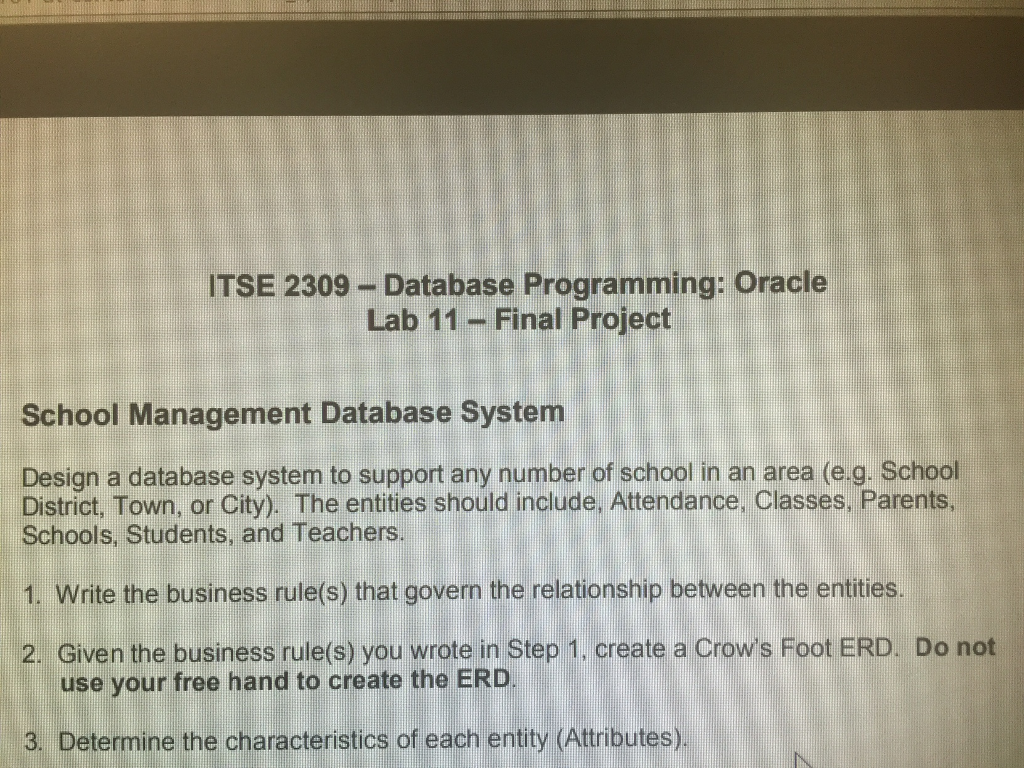
ITSE 2309-Database Programming: Oracle Lab 11- Final Project School Management Database System Design a database system to support any number of school in an area (e.g. School District, Town, or City). The entities should include, Attendance, Classes, Parents, Schools, Students, and Teachers 1. Write the business rule(s) that govern the relationship between the entities. 2. Given the business rule(s) you wrote in Step 1, create a Crow's Foot ERD. Do not use your free hand to create the ERD 3. Determine the characteristics of each entity (Attributes)
Step by Step Solution
There are 3 Steps involved in it

Get step-by-step solutions from verified subject matter experts