



Question: All information is in the question and the table. Grade I Grade II Grade III Profit/square foot $2.50 $4.00 $6.00 Clay 50% 30% 25% Silica
All information is in the question and the table.
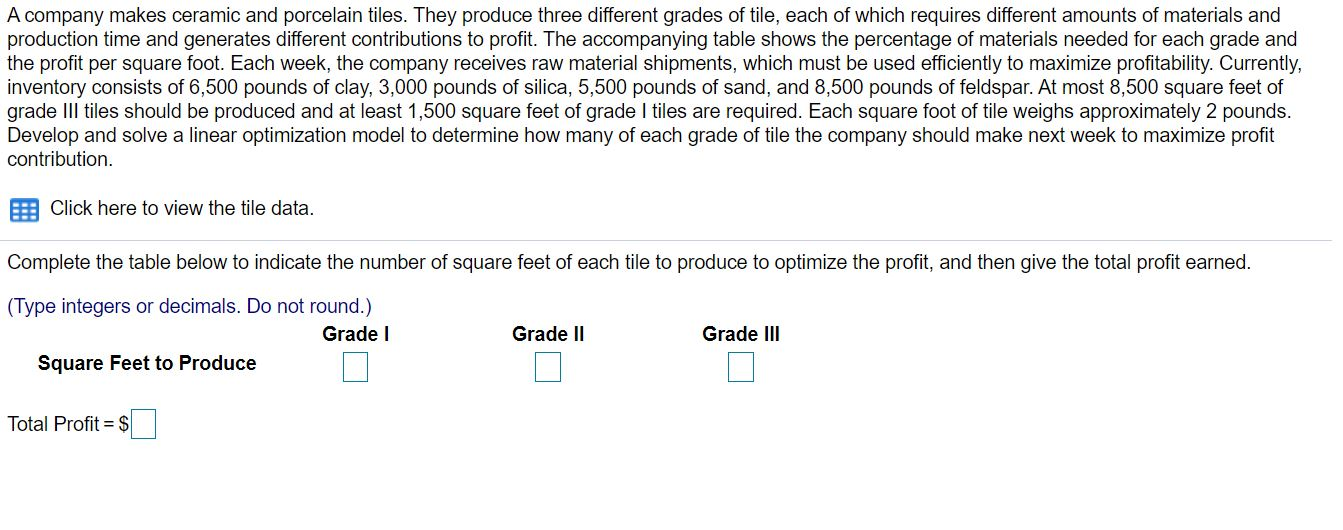
| Grade I | Grade II | Grade III | |
| Profit/square foot | $2.50 | $4.00 | $6.00 |
| Clay | 50% | 30% | 25% |
| Silica | 5% | 15% | 10% |
| Sand | 20% | 15% | 15% |
| Feldspar | 25% | 40% | 50% |
A company makes ceramic and porcelain tiles. They produce three different grades of tile, each of which requires different amounts of materials and production time and generates different contributions to profit. The accompanying table shows the percentage of materials needed for each grade and the profit per square foot. Each week, the company receives raw material shipments, which must be used efficiently to maximize profitability. Currently, inventory consists of 6,500 pounds of clay, 3,000 pounds of silica, 5,500 pounds of sand, and 8,500 pounds of feldspar. At most 8,500 square feet of grade III tiles should be produced and at least 1,500 square feet of grade I tiles are required. Each square foot of tile weighs approximately 2 pounds. Develop and solve a linear optimization model to determine how many of each grade of tile the company should make next week to maximize profit contribution. Click here to view the tile data. Complete the table below to indicate the number of square feet of each tile to produce to optimize the profit, and then give the total profit earned. (Type integers or decimals. Do not round.) Grade 1 Square Feet to Produce Grade II Grade III Total Profit = $
Step by Step Solution
There are 3 Steps involved in it

Get step-by-step solutions from verified subject matter experts