



Question: all information is present, business analytics, all one question Total Unit Price $ 150.00 $ 249.00 Monthly Sales January February 12 11 7 6 March
 all information is present, business analytics, all one question
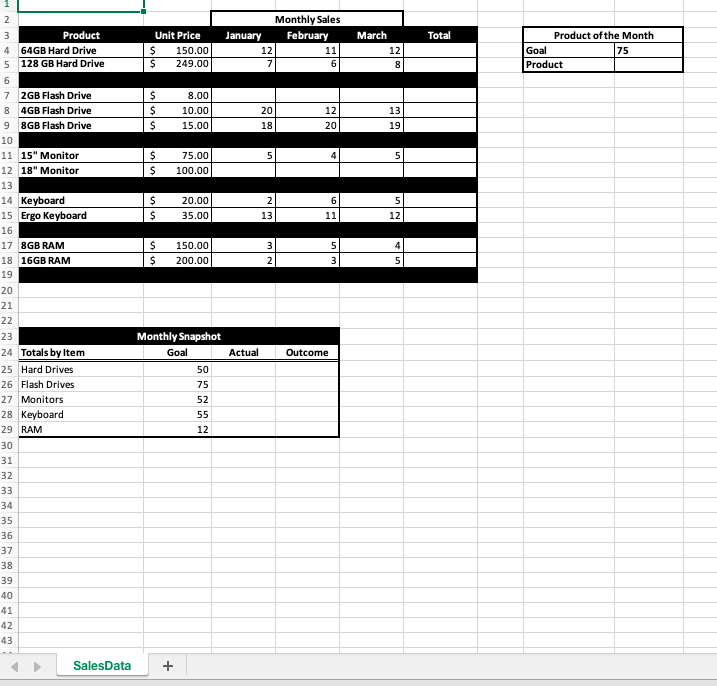
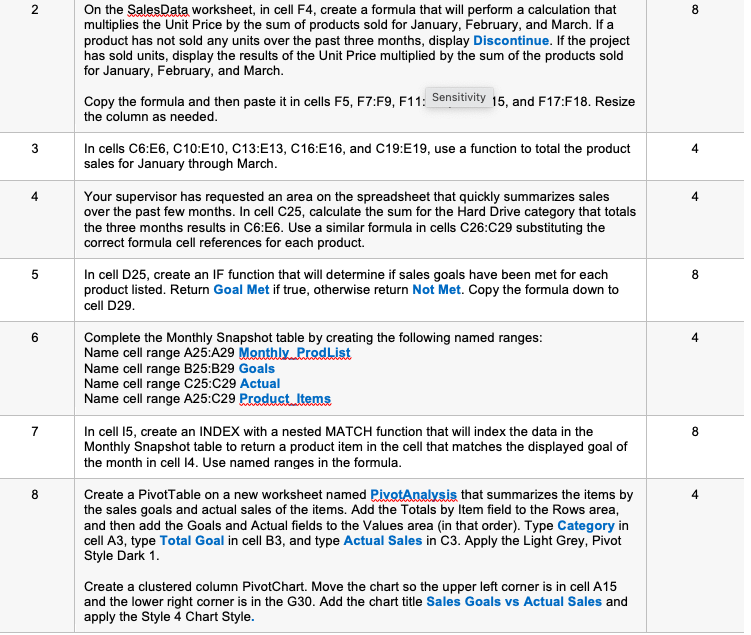
Total Unit Price $ 150.00 $ 249.00 Monthly Sales January February 12 11 7 6 March 12 Product of the Month Goal 75 Product 8 $ $ $ 8.00 10.00 15.00 20 18 12 20 13 19 5 4 5 $ $ 75.00 100.00 $ $ 20.00 35.00 2 13 6 11 5 12 4 $ $ 150.00 200.00 3 2 5 3 5 2 3 Product 4 64GB Hard Drive 5 128 GB Hard Drive 6 7 2GB Flash Drive 8 4GB Flash Drive 9 8GB Flash Drive 10 11 15" Monitor 12 18" Monitor 13 14 Keyboard 15 Ergo Keyboard 16 17 8GB RAM 18 16GB RAM 19 20 21 22 23 24 Totals by Item 25 Hard Drives 26 Flash Drives 27 Monitors 28 Keyboard 29 RAM 30 31 32 33 34 35 36 37 38 Actual Outcome Monthly Snapshot Goal 50 75 52 55 12 39 40 41 42 43 Sales Data + 2 8 3 4 4 4 5 8 On the SalesData worksheet, in cell F4, create a formula that will perform a calculation that multiplies the Unit Price by the sum of products sold for January, February, and March. If a product has not sold any units over the past three months, display Discontinue. If the project has sold units, display the results of the Unit Price multiplied by the sum of the products sold for January, February, and March. Copy the formula and then paste it in cells F5, F7:F9, F11: Sensitivity 15, and F17:F18. Resize the column as needed. In cells C6:E6, C10:E10, C13:E13, C16:E16, and C19:E19, use a function to total the product sales for January through March. Your supervisor has requested an area on the spreadsheet that quickly summarizes sales over the past few months. In cell C25, calculate the sum for the Hard Drive category that totals the three months results in C6:E6. Use a similar formula in cells C26:C29 substituting the correct formula cell references for each product. In cell D25, create an IF function that will determine if sales goals have been met for each product listed. Return Goal Met if true, otherwise return Not Met. Copy the formula down to cell D29. Complete the Monthly Snapshot table by creating the following named ranges: Name cell range A25:A29 MonthlyPredList Name cell range B25:B29 Goals Name cell range C25:C29 Actual Name cell range A25:C29 Product Items In cell 15, create an INDEX with a nested MATCH function that will index the data in the Monthly Snapshot table to return a product item in the cell that matches the displayed goal of the month in cell 14. Use named ranges in the formula. Create a PivotTable on a new worksheet named PixotAnalysis that summarizes the items by the sales goals and actual sales of the items. Add the Totals by Item field to the Rows area, and then add the Goals and Actual fields to the Values area (in that order). Type Category in cell A3, type Total Goal in cell B3, and type Actual Sales in C3. Apply the Light Grey, Pivot Style Dark 1. 6 4 7 8 8 4 Create a clustered column PivotChart. Move the chart so the upper left corner is in cell A15 and the lower right corner is in the G30. Add the chart title Sales Goals vs Actual Sales and apply the Style 4 Chart Style. Total Unit Price $ 150.00 $ 249.00 Monthly Sales January February 12 11 7 6 March 12 Product of the Month Goal 75 Product 8 $ $ $ 8.00 10.00 15.00 20 18 12 20 13 19 5 4 5 $ $ 75.00 100.00 $ $ 20.00 35.00 2 13 6 11 5 12 4 $ $ 150.00 200.00 3 2 5 3 5 2 3 Product 4 64GB Hard Drive 5 128 GB Hard Drive 6 7 2GB Flash Drive 8 4GB Flash Drive 9 8GB Flash Drive 10 11 15" Monitor 12 18" Monitor 13 14 Keyboard 15 Ergo Keyboard 16 17 8GB RAM 18 16GB RAM 19 20 21 22 23 24 Totals by Item 25 Hard Drives 26 Flash Drives 27 Monitors 28 Keyboard 29 RAM 30 31 32 33 34 35 36 37 38 Actual Outcome Monthly Snapshot Goal 50 75 52 55 12 39 40 41 42 43 Sales Data + 2 8 3 4 4 4 5 8 On the SalesData worksheet, in cell F4, create a formula that will perform a calculation that multiplies the Unit Price by the sum of products sold for January, February, and March. If a product has not sold any units over the past three months, display Discontinue. If the project has sold units, display the results of the Unit Price multiplied by the sum of the products sold for January, February, and March. Copy the formula and then paste it in cells F5, F7:F9, F11: Sensitivity 15, and F17:F18. Resize the column as needed. In cells C6:E6, C10:E10, C13:E13, C16:E16, and C19:E19, use a function to total the product sales for January through March. Your supervisor has requested an area on the spreadsheet that quickly summarizes sales over the past few months. In cell C25, calculate the sum for the Hard Drive category that totals the three months results in C6:E6. Use a similar formula in cells C26:C29 substituting the correct formula cell references for each product. In cell D25, create an IF function that will determine if sales goals have been met for each product listed. Return Goal Met if true, otherwise return Not Met. Copy the formula down to cell D29. Complete the Monthly Snapshot table by creating the following named ranges: Name cell range A25:A29 MonthlyPredList Name cell range B25:B29 Goals Name cell range C25:C29 Actual Name cell range A25:C29 Product Items In cell 15, create an INDEX with a nested MATCH function that will index the data in the Monthly Snapshot table to return a product item in the cell that matches the displayed goal of the month in cell 14. Use named ranges in the formula. Create a PivotTable on a new worksheet named PixotAnalysis that summarizes the items by the sales goals and actual sales of the items. Add the Totals by Item field to the Rows area, and then add the Goals and Actual fields to the Values area (in that order). Type Category in cell A3, type Total Goal in cell B3, and type Actual Sales in C3. Apply the Light Grey, Pivot Style Dark 1. 6 4 7 8 8 4 Create a clustered column PivotChart. Move the chart so the upper left corner is in cell A15 and the lower right corner is in the G30. Add the chart title Sales Goals vs Actual Sales and apply the Style 4 Chart Style
Step by Step Solution
There are 3 Steps involved in it

Get step-by-step solutions from verified subject matter experts