







Question: all of question 4, the code is not that important but would really appreciate if you guys can do it. the denominator says 2theta Exercise
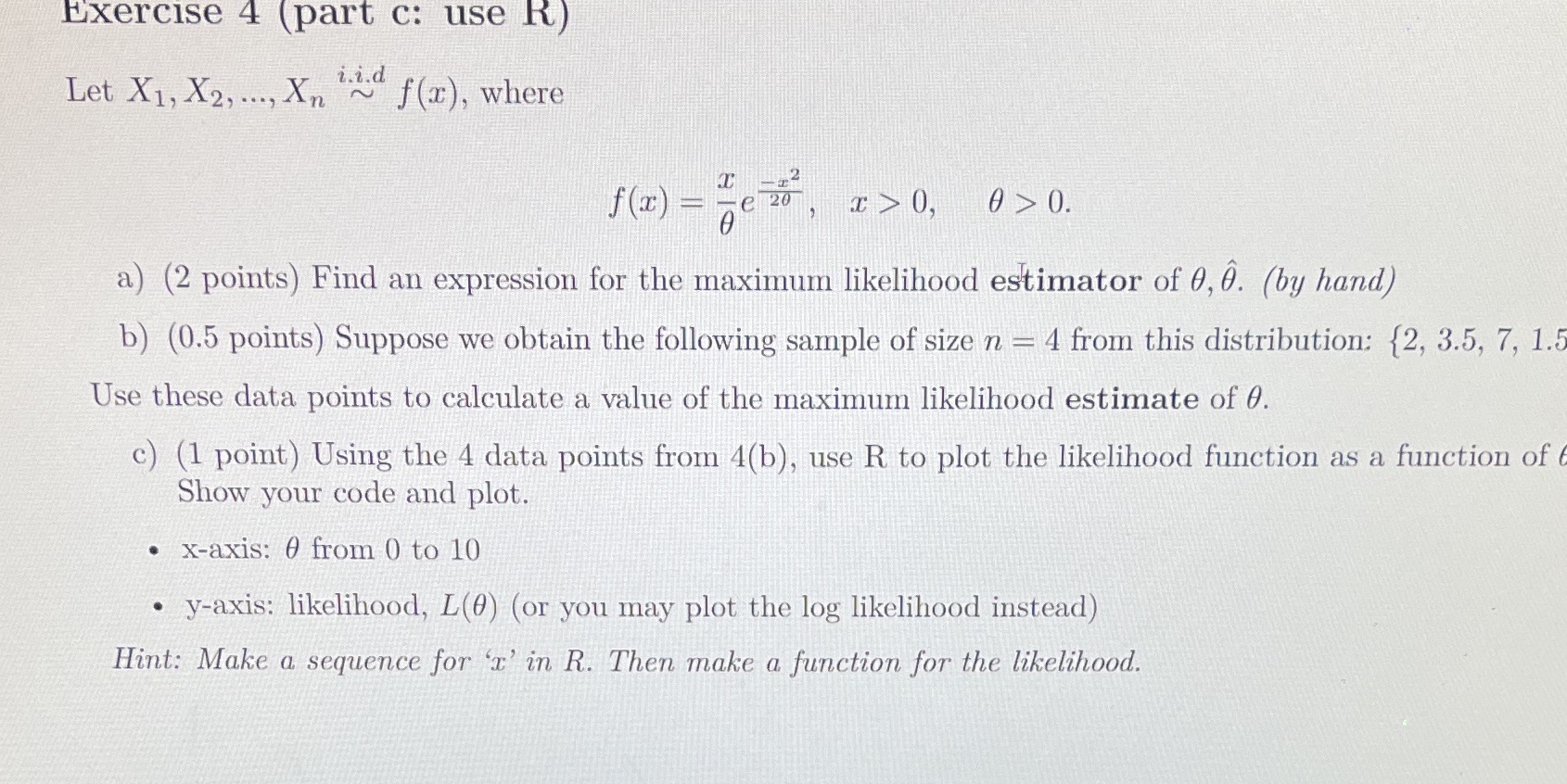
all of question 4, the code is not that important but would really appreciate if you guys can do it.
the denominator says 2theta
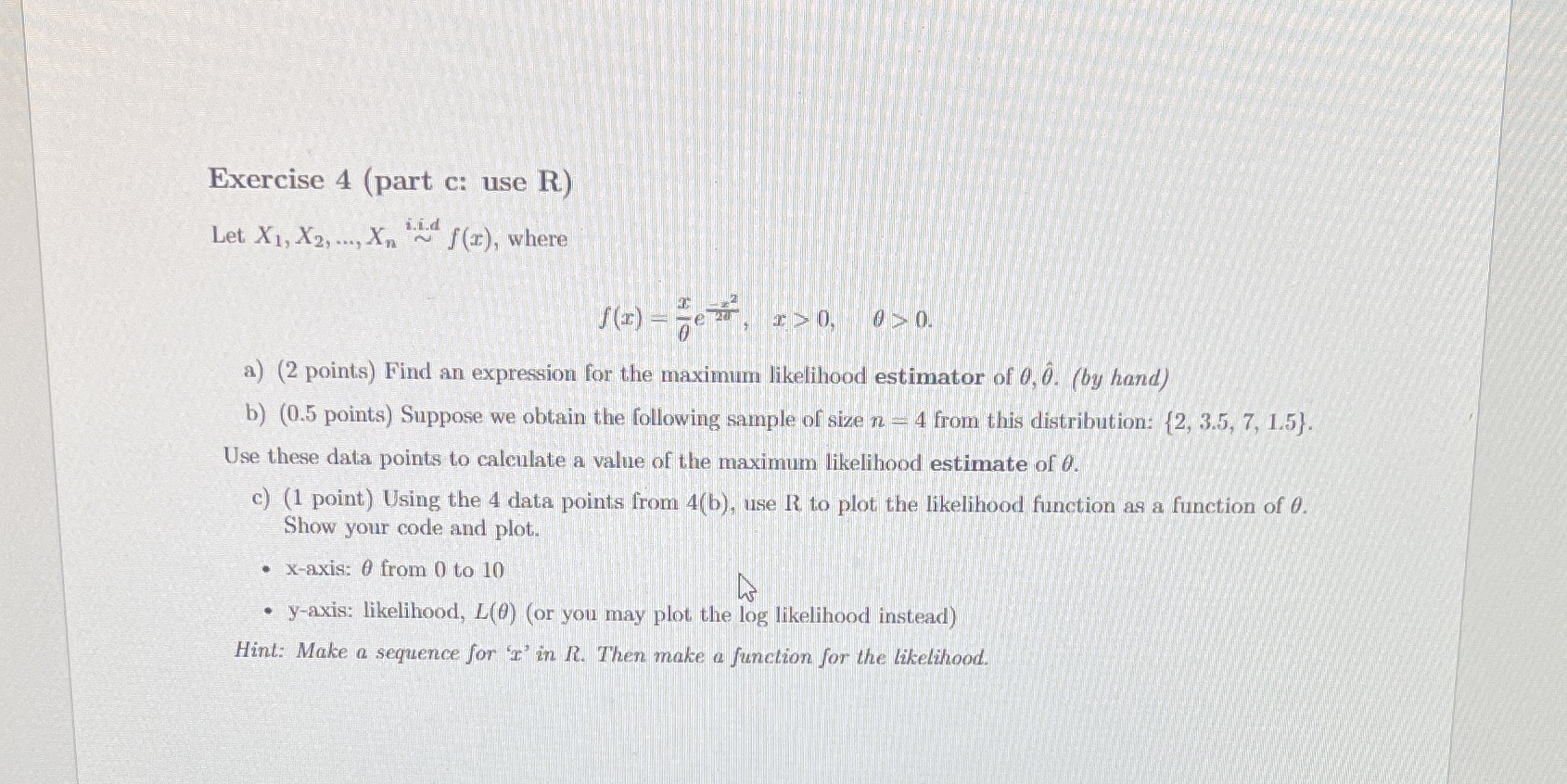
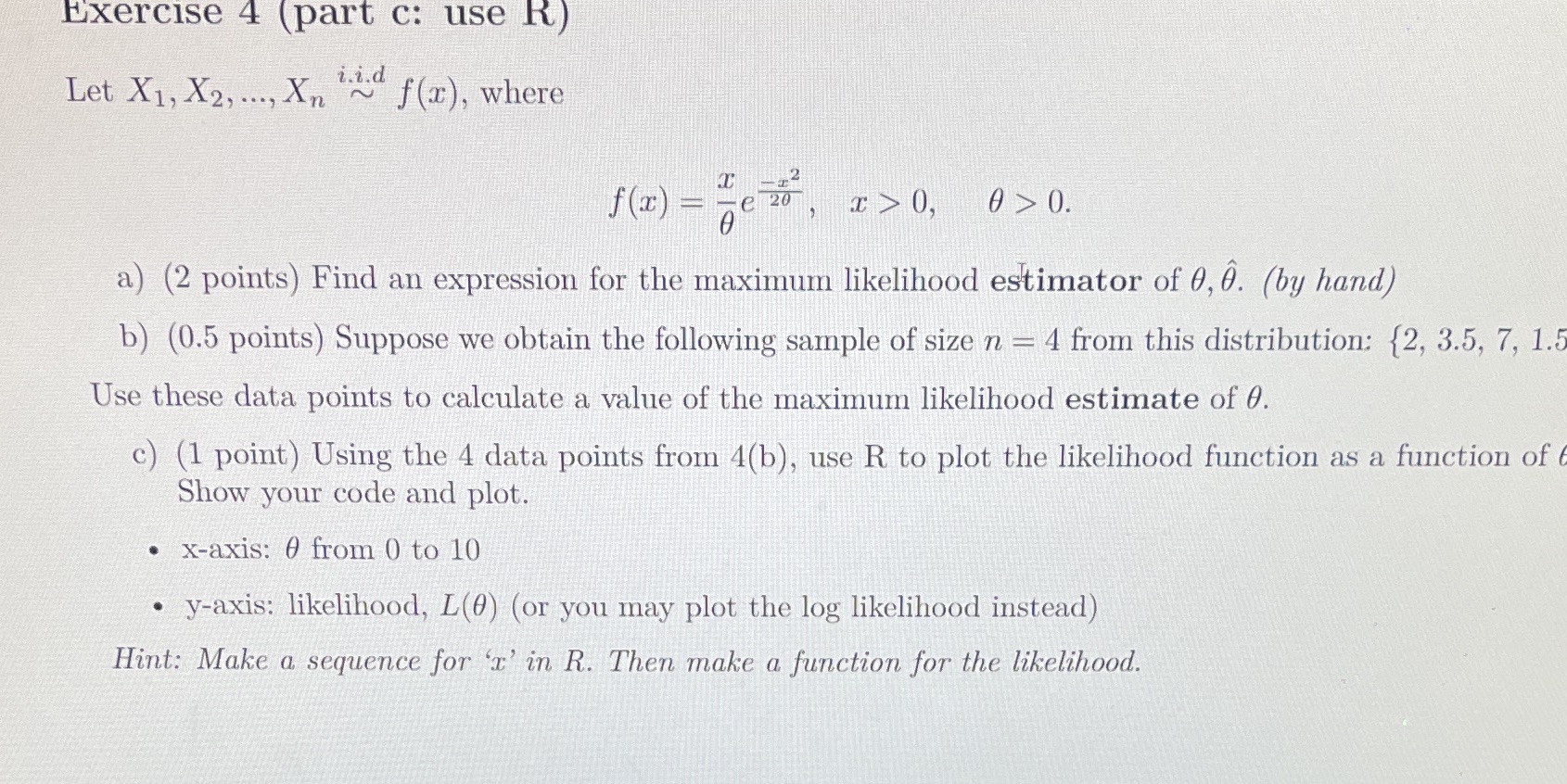
Exercise 4 (part c: use R) Let X1, X2, ..., Xn ~ f(x), where /(z) - ed, 120 030. a) (2 points) Find an expression for the maximum likelihood estimator of 0, 0. (by hand) b) (0.5 points) Suppose we obtain the following sample of size n - 4 from this distribution: {2, 3.5, 7, 1.5]. Use these data points to calculate a value of the maximum likelihood estimate of 0. c) (1 point) Using the 4 data points from 4(b), use R to plot the likelihood function as a function of 0. Show your code and plot. . x-axis: 0 from 0 to 10 . y-axis: likelihood, L(0) (or you may plot the log likelihood instead) Hint: Make a sequence for 'r' in R. Then make a function for the likelihood.Exercise 4 (part c: use R) Let X1, X2, ..., Xn ~f(x), where f (x) = e 20, I > 0, 0> 0. a) (2 points) Find an expression for the maximum likelihood estimator of 0, 0. (by hand) b) (0.5 points) Suppose we obtain the following sample of size n = 4 from this distribution: {2, 3.5, 7, 1.5 Use these data points to calculate a value of the maximum likelihood estimate of 0. c) (1 point) Using the 4 data points from 4(b), use R to plot the likelihood function as a function of Show your code and plot. . x-axis: 0 from 0 to 10 . y-axis: likelihood, L(0) (or you may plot the log likelihood instead) Hint: Make a sequence for 'r' in R. Then make a function for the likelihood
Step by Step Solution
There are 3 Steps involved in it

Get step-by-step solutions from verified subject matter experts
 Study Help