







Question: all parts a) Derive the approximate identity e 1+r, using an appropriate first order approxi- mation. State the empirical condition under which the approximation is
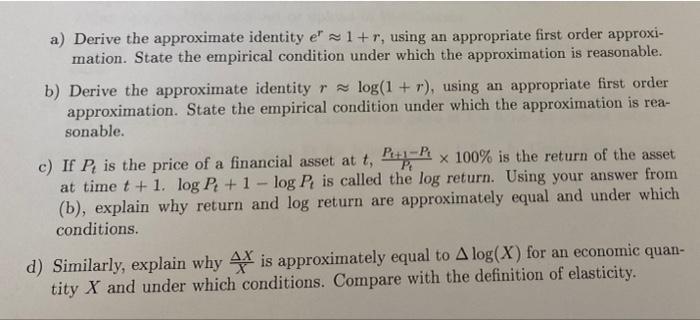
a) Derive the approximate identity e" 1+r, using an appropriate first order approxi- mation. State the empirical condition under which the approximation is reasonable. b) Derive the approximate identity r log(1 + r), using an appropriate first order approximation. State the empirical condition under which the approximation is rea- sonable. c) If P, is the price of a financial asset at t, P+1-P x 100% is the return of the asset at time t + 1. log P + 1 - log P is called the log return. Using your answer from (b), explain why return and log return are approximately equal and under which conditions. PE d) Similarly, explain why 4x is approximately equal to A log(x) for an economic quan- tity X and under which conditions. Compare with the definition of elasticity. a) Derive the approximate identity e" 1+r, using an appropriate first order approxi- mation. State the empirical condition under which the approximation is reasonable. b) Derive the approximate identity r log(1 + r), using an appropriate first order approximation. State the empirical condition under which the approximation is rea- sonable. c) If P, is the price of a financial asset at t, P+1-P x 100% is the return of the asset at time t + 1. log P + 1 - log P is called the log return. Using your answer from (b), explain why return and log return are approximately equal and under which conditions. PE d) Similarly, explain why 4x is approximately equal to A log(x) for an economic quan- tity X and under which conditions. Compare with the definition of elasticity
Step by Step Solution
There are 3 Steps involved in it

Get step-by-step solutions from verified subject matter experts
 Study Help