





Question: All questions atx 3x SECTION 3.4 Limits at Infinity; Horizontal Asymptotes 243 45. Find a formula for a function f that satisfies the following 60.
 All questions atx 3x SECTION 3.4 Limits at Infinity; Horizontal Asymptotes
All questions

243 45. Find a formula for a function f that satisfies the

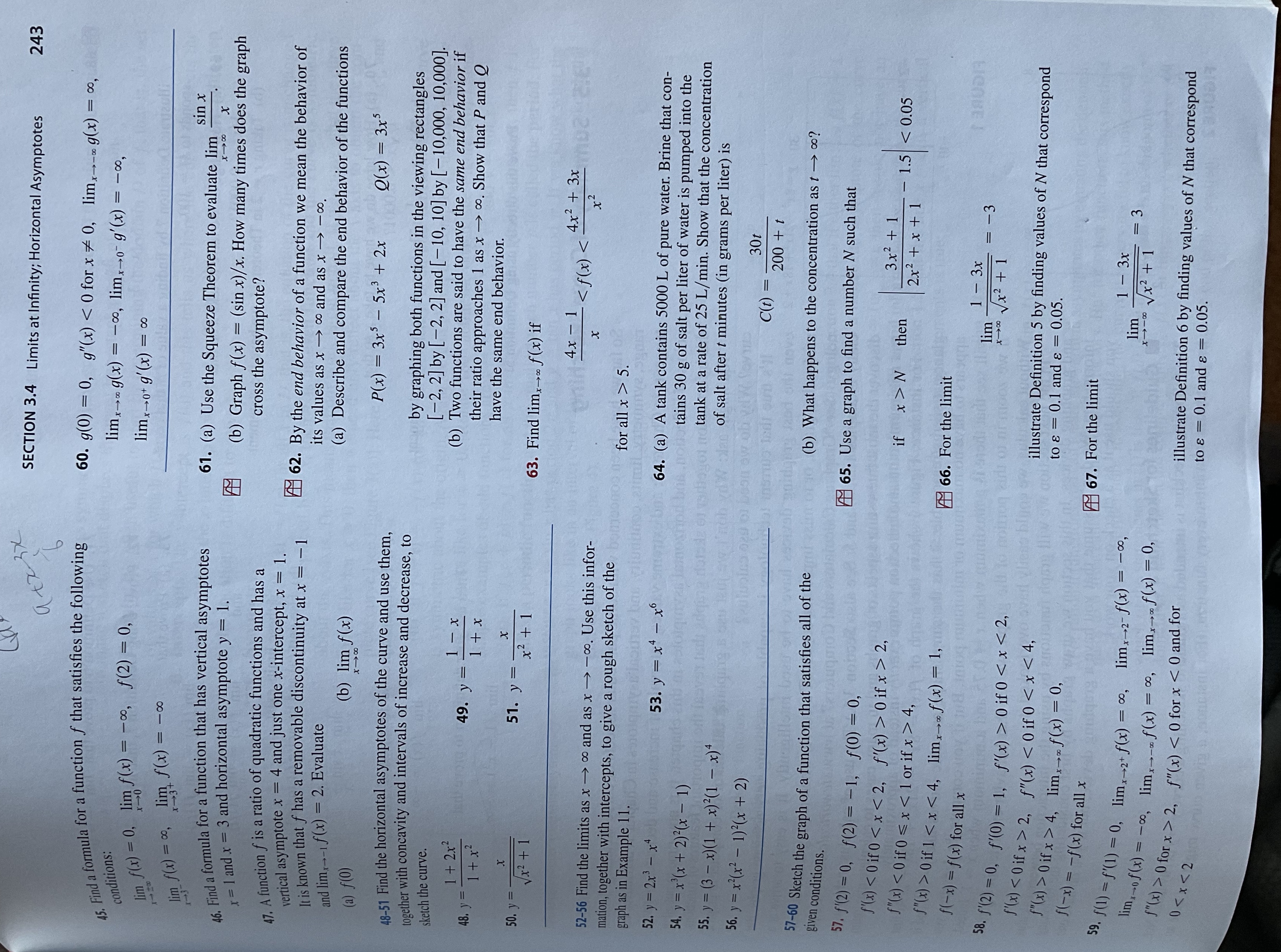
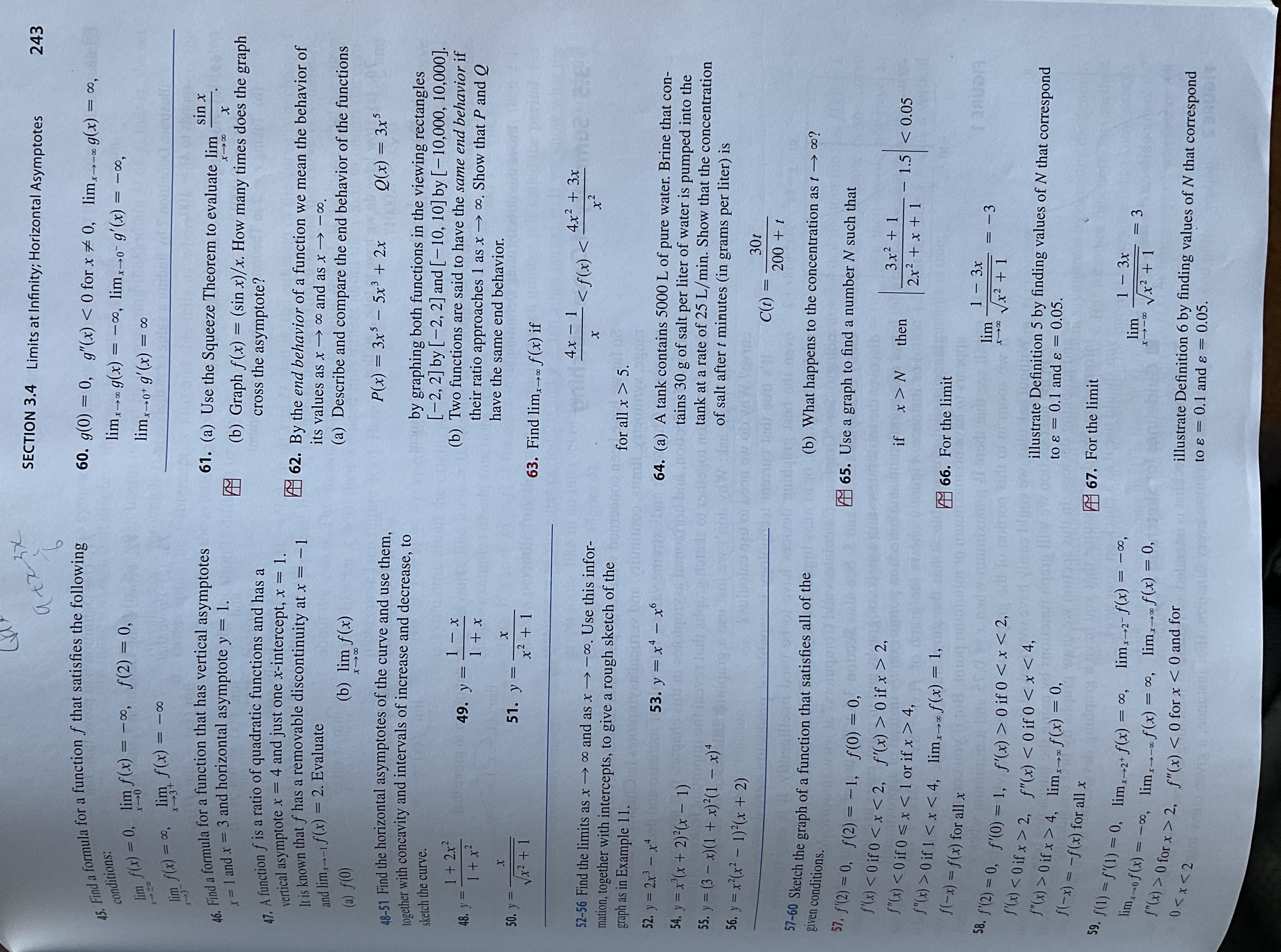
atx 3x SECTION 3.4 Limits at Infinity; Horizontal Asymptotes 243 45. Find a formula for a function f that satisfies the following 60. g(0) = 0, g"(x) co and as x - -co (a) Describe and compare the end behavior of the functions ( a ) f ( 0 ) (b) lim f(x) 48-51 Find the horizontal asymptotes of the curve and use them, P(x) = 3x5 - 5x3 + 2x e (x ) = 3x5 together with concavity and intervals of increase and decrease, to by graphing both functions in the viewing rectangles sketch the curve. [-2, 2] by [-2, 2] and [-10, 10] by [-10,000, 10,000]. 1 + 2x2 49. y = = (b) Two functions are said to have the same end behavior if 48. y = 1 - x 1 + x 2 1 + x their ratio approaches 1 as x -> . Show that P and Q have the same end behavior. x 50. y = Vx2 + 1 51. y = x 2 + 1 63. Find limx -. f(x) if 4x - 1 5. 52. y = 2x3 - x4 53. y = x4 - x6 64. (a) A tank contains 5000 L of pure water. Brine that con- 54 . y = x3 (x + 2) 2 (x - 1 ) tains 30 g of salt per liter of water is pumped into the tank at a rate of 25 L/min. Show that the concentration 55. y = (3 - x)(1 + x)2(1 - xx)+ newalinch willwo olof salt after t minutes (in grams per liter) is 56. y = x2 (x2 - 1) 2(x + 2 ) 30t C(t) = 200 + t 57-60 Sketch the graph of a function that satisfies all of the (b) What happens to the concentration as t -> co? given conditions . 57. f' (2 ) = 0 , f (2 ) = - 1 , f(0 ) = 0, 65. Use a graph to find a number N such that f' ( x ) 0 if x > 2 , f " ( x ) 4 , if x > N then 3x2 + 1 2x2 +x + 1 - 1.5 0if1 > f(x) =1, A 66. For the limit f (- x ) = f (x ) for all x 1 - 3x 58. f '( 2 ) = 0 , f' ( 0 ) = 1, f' ( x ) > 0if0 2 , f " ( * ) 0 ifx > 4 , lim , -, . f ( x ) = 0 , to 8 = 0.1 and & = 0.05. f(-x ) = - f ( x ) for all x A 67. For the limit 59 . f(1 ) = f'(1 ) = 0, lim, - 2+ f(x) = 0, limx-2- f(x) = -co, 1 - 3x lim , -of ( x) = -co, lim,- -. f(x) = 0, limx-. f (x) = 0, lim *- -0 Vx2 + 1 - = 3 0 0 for x > 2 , f" (x )

Step by Step Solution

There are 3 Steps involved in it

1 Expert Approved Answer
Step: 1 Unlock blur-text-image
Question Has Been Solved by an Expert!

Get step-by-step solutions from verified subject matter experts

Step: 2 Unlock
Step: 3 Unlock

Students Have Also Explored These Related Mathematics Questions!