







Question: all questions... MIDTERM EXAMINATION #2 Instructions: This is a closed book and closed notes exam. You may use a calculator if you wish. However, no
all questions...
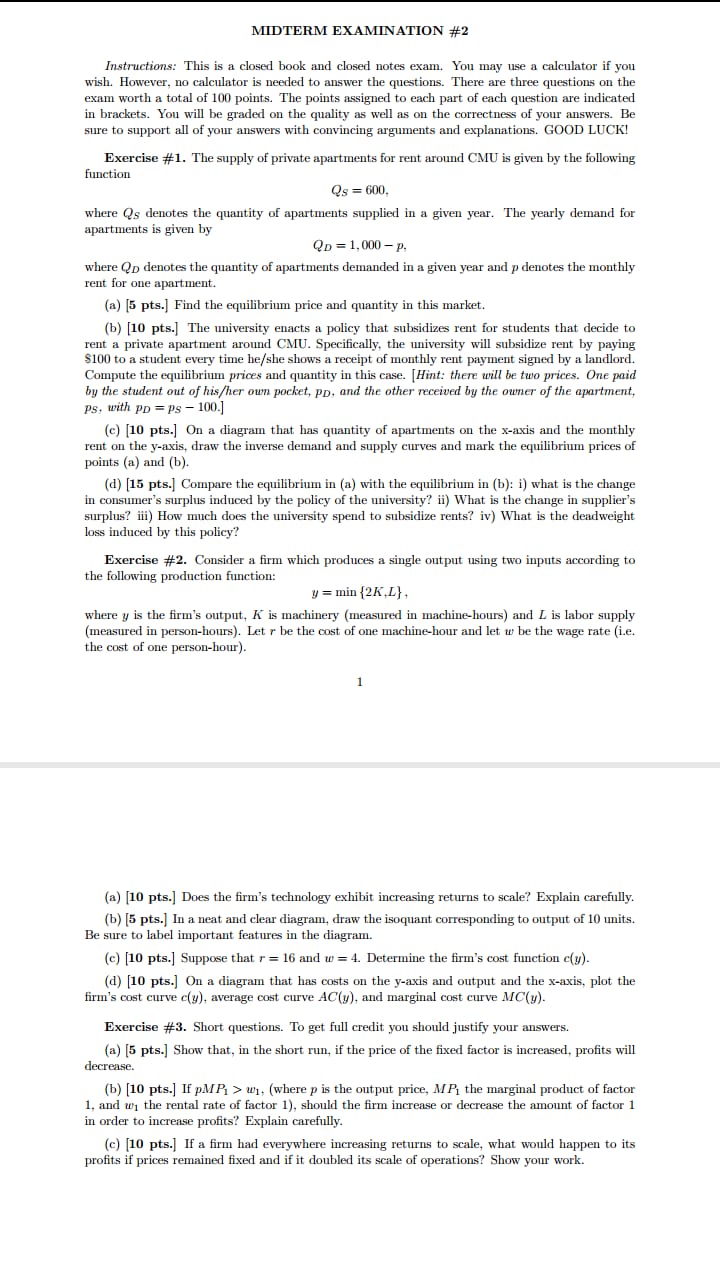
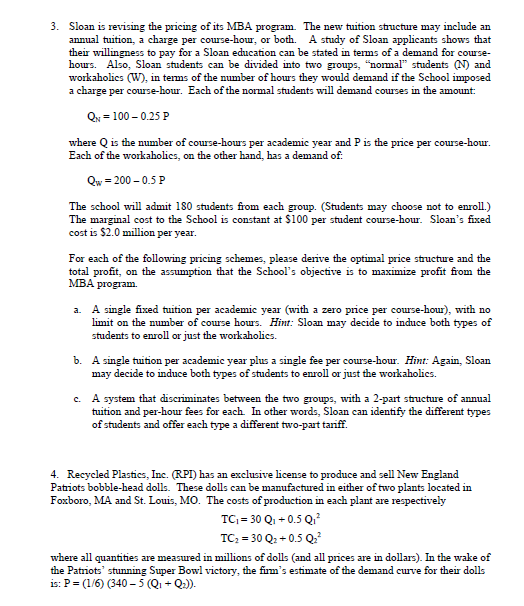
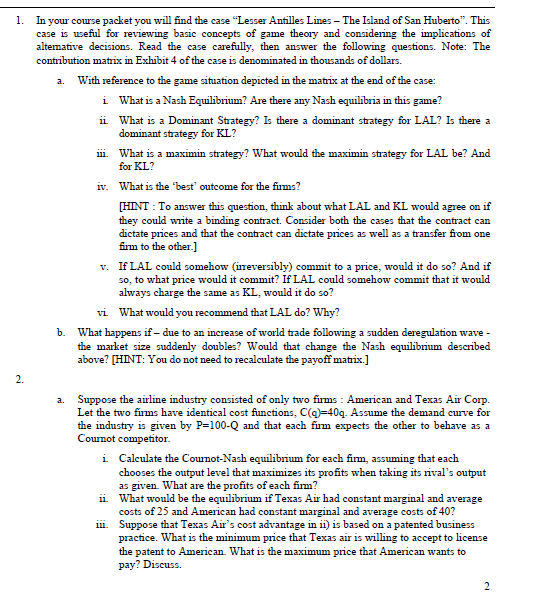
MIDTERM EXAMINATION #2 Instructions: This is a closed book and closed notes exam. You may use a calculator if you wish. However, no calculator is needed to answer the questions. There are three questions on the exam worth a total of 100 points. The points assigned to each part of each question are indicated in brackets. You will be graded on the quality as well as on the correctness of your answers. Be sure to support all of your answers with convincing arguments and explanations. GOOD LUCK! Exercise #1. The supply of private apartments for rent around CMU is given by the following function Qs = 600, where Qs denotes the quantity of apartments supplied in a given year. The yearly demand for apartments is given by QD = 1, 000 - P. where Qp denotes the quantity of apartments demanded in a given year and p denotes the monthly rent for one apartment. (a) [5 pts.] Find the equilibrium price and quantity in this market. (b) [10 pts.] The university enacts a policy that subsidizes rent for students that decide to rent a private apartment around CMU. Specifically, the university will subsidize rent by paying $100 to a student every time he/she shows a receipt of monthly rent payment signed by a landlord. Compute the equilibrium prices and quantity in this case. [Hint: there will be two prices. One paid by the student out of his/her own pocket, pp, and the other received by the owner of the apartment, ps, with PD = ps - 100.] (c) [10 pts.] On a diagram that has quantity of apartments on the x-axis and the monthly rent on the y-axis, draw the inverse demand and supply curves and mark the equilibrium prices of points (a) and (b). (d) [15 pts.] Compare the equilibrium in (a) with the equilibrium in (b): i) what is the change in consumer's surplus induced by the policy of the university? ii) What is the change in supplier's surplus? iii) How much does the university spend to subsidize rents? iv) What is the deadweight loss induced by this policy? Exercise #2. Consider a firm which produces a single output using two inputs according to the following production function: y = min {2K,L}, where y is the firm's output, K is machinery (measured in machine-hours) and L is labor supply (measured in person-hours). Let r be the cost of one machine-hour and let w be the wage rate (i.e. the cost of one person-hour). (a) [10 pts.] Does the firm's technology exhibit increasing returns to scale? Explain carefully. (b) [5 pts.] In a neat and clear diagram, draw the isoquant corresponding to output of 10 units. Be sure to label important features in the diagram. (c) [10 pts.] Suppose that r = 16 and w = 4. Determine the firm's cost function c(y). (d) [10 pts.] On a diagram that has costs on the y-axis and output and the x-axis, plot the firm's cost curve c(y), average cost curve AC(y), and marginal cost curve MC(y). Exercise #3. Short questions. To get full credit you should justify your answers. (a) [5 pts.] Show that, in the short run, if the price of the fixed factor is increased, profits will decrease. (b) [10 pts.] If pMP > w1, (where p is the output price, MP, the marginal product of factor 1, and w the rental rate of factor 1), should the firm increase or decrease the amount of factor 1 in order to increase profits? Explain carefully. (c) [10 pts.] If a firm had everywhere increasing returns to scale, what would happen to its profits if prices remained fixed and if it doubled its scale of operations? Show your work.\f1. In your course packet you will find the case "Lesser Antilles Lines - The Island of San Huberto". This case is useful for reviewing basic concepts of game theory and considering the implications of alternative decisions. Read the case carefully, then answer the following questions. Note: The contribution matrix in Exhibit 4 of the case is denominated in thousands of dollars. With reference to the game situation depicted in the matrix at the end of the case: i What is a Nash Equilibrium? Are there any Nash equilibria in this game? ii What is a Dominant Strategy? Is there a dominant strategy for LAL? Is there a dominant strategy for KL? iii What is a maximin strategy? What would the maximin strategy for LAL be? And for KL? iv. What is the 'best' outcome for the firms? [HINT : To answer this question, think about what LAL and KL would agree on if they could write a binding contract. Consider both the cases that the contract can dictate prices and that the contract can dictate prices as well as a transfer from one firm to the other.] v. If LAL could somehow (unreversible) commit to a price, would it do so? And if so, to what price would it commit? If LAL could somehow commit that it would always charge the same as KL, would it do so? vi. What would you recommend that LAL do? Why? b. What happens if - due to an increase of world trade following a sudden deregulation wave - the market size suddenly doubles? Would that change the Nash equilibrium described above? [HINT: You do not need to recalculate the payoff matrix.] 2 a. Suppose the airline industry consisted of only two firms : American and Texas Air Corp. Let the two firms have identical cost functions, C(q)=40q- Assume the demand curve for the industry is given by P=100-Q and that each fum expects the other to behave as a Cournot competitor. i Calculate the Cournot-Nash equilibrium for each firm, assuming that each chooses the output level that maximizes its profits when taking its rival's output as given. What are the profits of each firm? ii. What would be the equilibrium if Texas Air had constant marginal and average costs of 25 and American had constant marginal and average costs of 40? ili. Suppose that Texas Air's cost advantage in ii) is based on a patented business practice. What is the minimum price that Texas air is willing to accept to license the patent to American. What is the maximum price that American wants to pay? Discuss. 2
Step by Step Solution
There are 3 Steps involved in it

Get step-by-step solutions from verified subject matter experts
 Study Help