







Question: All steps (A, B, C, D, and E) in the below process are necessary to create each finished unit. Task times are shown for each
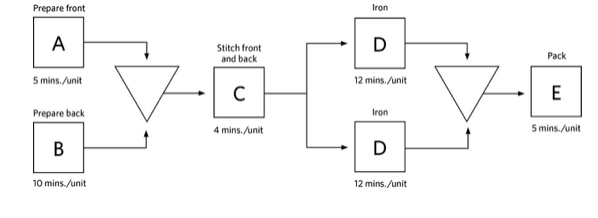
All steps (A, B, C, D, and E) in the below process are necessary to create each finished unit. Task times are shown for each step. A second worker has been hired to duplicate task D. Now shirts that have been through task C go to any one of the two workers on task D. The product still requires the five steps (A, B, C, D, E).
1
a. Refer to the Process Flow Diagram for Making a Shirt, with an Additional Worker. If the entire system (all processes) is operating at full capacity, what is the system cycle time
b. Refer to the Process Flow Diagram for Making a Shirt, with an Additional Worker. Assume the entire process is running at the pace of the bottleneck. Consider only task B. What is the capacity utilization for preparing the back?
c. Refer to the Process Flow Diagram for Making a Shirt, with an Additional Worker. Assume the entire process is running at the pace of the bottleneck. Consider only task D, with both workers ironing shirts. What is the capacity utilization for ironing?
d. Refer to the Process Flow Diagram for Making a Shirt, with an Additional Worker. Assume the demand rate is 12 units/hour and the entire process is running at the throughput rate. Consider only task D, with both workers ironing shirts. What is the capacity utilization for ironing?
e. Refer to the Process Flow Diagram for Making a Shirt, with an Additional Worker. Assume the demand rate is 4 units/hour and the entire process is running at the throughput rate. Consider only task D, with both workers ironing shirts. What is the capacity utilization for ironing?
Prepare front Iron A Stitch front and back D Pack 5 mins./unit 12 mins./unit C E Prepare back Iron 4 mins./unit 5 mins./unit B D 10 mins./unit 12 mins./unitStep by Step Solution
There are 3 Steps involved in it

Get step-by-step solutions from verified subject matter experts
 Study Help