







Question: _All the information and code needed for you to solve this problem is in the tutorial. Here, however, you should talk to your colleagues to
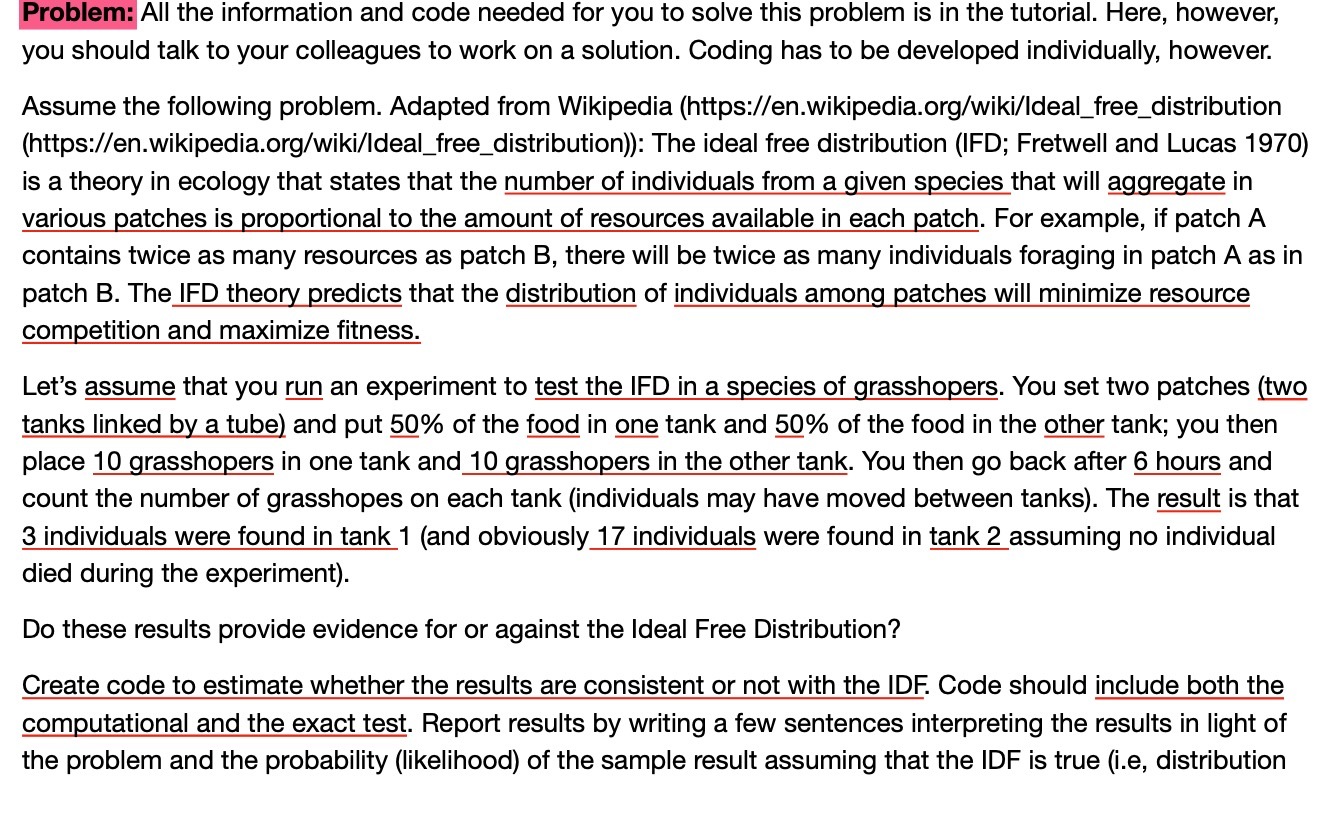
_All the information and code needed for you to solve this problem is in the tutorial. Here, however, you should talk to your colleagues to work on a solution. Coding has to be developed individually, however: Assume the following problem. Adapted from Wikipedia (https://en.wikipedia.org/wiki/Ideal__free_distribution (https://en.wikipedia.org/wiki/ldeal_free_distribution)): The ideal free distribution (IFD; Fretwell and Lucas 1970) is a theory in ecology that states that the number of individuals from a given species that will aggregate in various patches is proportional to the amount of resources available in each patch. For example, if patch A contains twice as many resources as patch B, there will be twice as many individuals foraging in patch A as in patch B. The IFD theoEy predicts that the distribution of individuals among patches will minimize resource competition and maximize fitness. Let's assume that you M an experiment to test the IFD in a species of grasshopers. You set two patches [1w tanks linked by a tube) and put $96 of the 1M in % tank and $96 of the food in the m tank; you then place 10 grasshopers in one tank and 10 grasshopers in the other tank. You then go back after 6 hours and count the number of grasshopes on each tank (individuals may have moved between tanks). The result is that 3 individuals were found in tank 1 (and obviously 17 individuals were found in tank 2 assuming no individual died during the experiment). Do these results provide evidence for or against the Ideal Free Distribution? Create code to estimate whether the results are consistent or not with the IDF. Code should include both the computational and the exact test. Report results by writing a few sentences interpreting the results in light of the problem and the probability (likelihood) of the sample result assuming that the IDF is true G.e, distribution
Step by Step Solution
There are 3 Steps involved in it

Get step-by-step solutions from verified subject matter experts
 Study Help