







Question: Read The consulting process: A multidimensional approach by Kurpius, DeWayne J;Fuqua, Dale R;Rozecki, Thaddeus. Tell us what article you read and your reaction to the
Read The consulting process: A multidimensional approach by Kurpius, DeWayne J;Fuqua, Dale R;Rozecki, Thaddeus. Tell us what article you read and your reaction to the article. Your 'audience' is your peers, so write your reaction to be of the most value to them. It can include things like:
What was new or surprised you?
What you agree or disagree?
What in your own experience corresponds to what you read?
What was the main 'takeaway'?
Should your peers read it or not? Why or why not?
 page 1
page 2
page 3
page 4
page 5
page 6
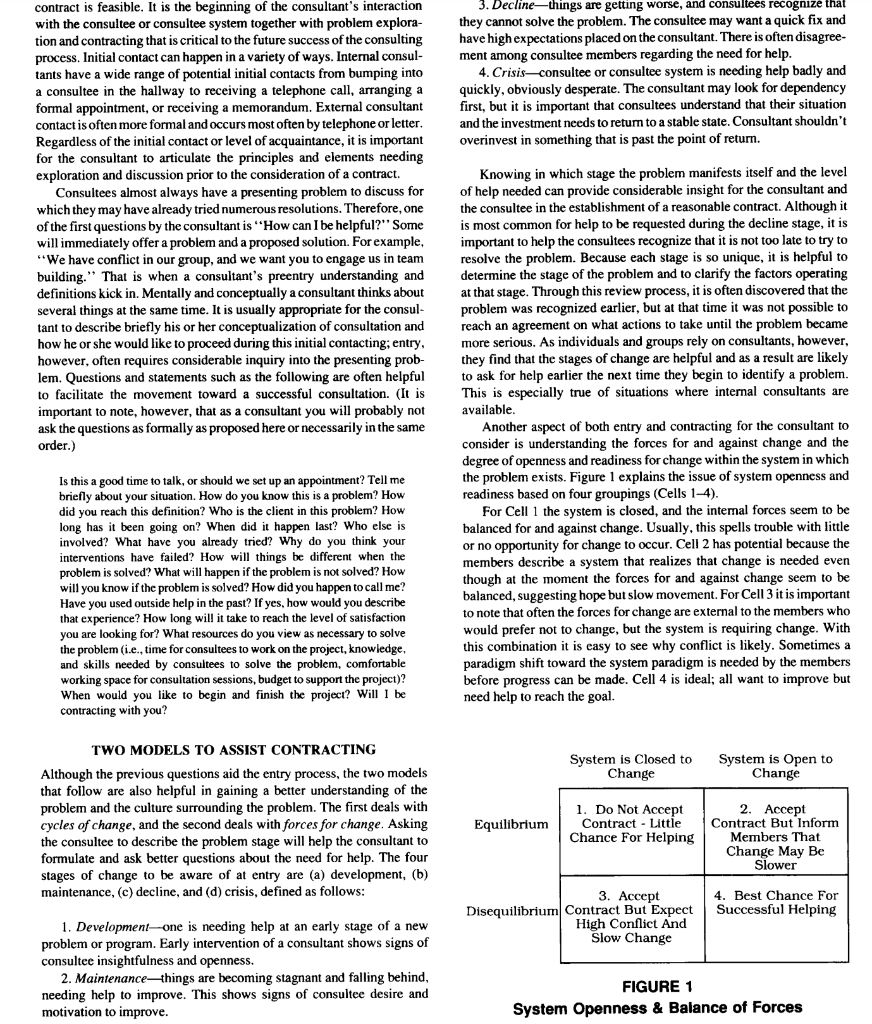
contract is feasible. It is the beginning of the consultant's interaction 3. Decline - things are getting worse, and consultees recognize that with the consultee or consultee system together with problem explora- they cannot solve the problem. The consultee may want a quick fix and tion and contracting that is critical to the future success of the consulting have high expectations placed on the consultant. There is often disagreeprocess. Initial contact can happen in a variety of ways. Internal consul- ment among consultee members regarding the need for help. tants have a wide range of potential initial contacts from bumping into 4. Crisis-consultee or consultee system is needing help badly and a consultee in the hallway to receiving a telephone call, arranging a quickly, obviously desperate. The consultant may look for dependency formal appointment, or receiving a memorandum. External consultant first, but it is important that consultees understand that their situation contact is often more formal and occurs most often by telephone or letter. and the investment needs to retum to a stable state. Consultant shouldn't Regardless of the initial contact or level of acquaintance, it is important overinvest in something that is past the point of return. for the consultant to articulate the principles and elements needing exploration and discussion prior to the consideration of a contract. Knowing in which stage the problem manifests itself and the level Consultees almost always have a presenting problem to discuss for of help needed can provide considerable insight for the consultant and which they may have already tried numerous resolutions. Therefore, one the consultee in the establishment of a reasonable contract. Although it of the first questions by the consultant is "How can I be helpful?" Some is most common for help to be requested during the decline stage, it is will immediately offer a problem and a proposed solution. For example, important to help the consultees recognize that it is not too late to try to "We have conflict in our group, and we want you to engage us in team resolve the problem. Because each stage is so unique, it is helpful to building." That is when a consultant's preentry understanding and determine the stage of the problem and to clarify the factors operating definitions kick in. Mentally and conceptually a consultant thinks about at that stage. Through this review process, it is often discovered that the several things at the same time. It is usually appropriate for the consul- problem was recognized earlier, but at that time it was not possible to tant to describe briefly his or her conceptualization of consultation and reach an agreement on what actions to take until the problem became how he or she would like to proceed during this initial contacting; entry, more serious. As individuals and groups rely on consultants, however, however, often requires considerable inquiry into the presenting prob- they find that the stages of change are helpful and as a result are likely lem. Questions and statements such as the following are often helpful to ask for help earlier the next time they begin to identify a problem. to facilitate the movement toward a successful consultation. (It is This is especially true of situations where internal consultants are important to note, however, that as a consultant you will probably not avable. ask the questions as formally as proposed here or necessarily in the same Another aspect of both entry and contracting for the consultant to order.) consider is understanding the forces for and against change and the degree of openness and readiness for change within the system in which Is this a good time to talk, or should we set up an appointment? Tell me the problem exists. Figure 1 explains the issue of system openness and briefly about your situation. How do you know this is a problem? How readiness based on four groupings (Cells 1-4). did you reach this definition? Who is the client in this problem? How For Cell 1 the system is closed, and the internal forces seem to be long has it been going on? When did it happen last? Who else is balanced for and against change. Usually, this spells trouble with little involved? What have you already tried? Why do you think your or no opportunity for change to occur. Cell 2 has potential because the interventions have failed? How will things be different when the members describe a system that realizes that change is needed even problem is solved? What will happen if the problem is not solved? How though at the moment the forces for and against change seem to be will you know if the problem is solved? How did you happen to call me? balanced, suggesting hope but slow movement. For Cell 3 it is important Have you used outside help in the past? If yes, how would you describe that experience? How long will it take to reach the level of satisfaction to note that often the forces for change are external to the members who that experience? How long will it take to reach the level of satisfaction you are looking for? What resources do you view as necessary to solve would prefer not to change, but the system is requiring change. With the problem (i.e., time for consultees to work on the project, knowledge, this combination it is easy to see why conflict is likely. Sometimes a and skills needed by consuitees to solve the problem, comfortable paradigm shift toward the system paradigm is needed by the members working space for consultation sessions, budget to support the project)? before progress can be made. Cell 4 is ideal; all want to improve but When would you like to begin and finish the project? Will I be need help to reach the goal. contracting with you? TWO MODELS TO ASSIST CONTRACTING Although the previous questions aid the entry process, the two models that follow are also helpful in gaining a better understanding of the problem and the culture surrounding the problem. The first deals with cycles of change, and the second deals with forces for change. Asking the consultee to describe the problem stage will help the consultant to formulate and ask better questions about the need for help. The four stages of change to be aware of at entry are (a) development, (b) maintenance, (c) decline, and (d) crisis, defined as follows: 1. Development-one is needing help at an early stage of a new problem or program. Early intervention of a consultant shows signs of consultee insightfulness and openness. 2. Maintenance - things are becoming stagnant and falling behind, needing help to improve. This shows signs of consultee desire and FIGURE 1 motivation to improve. The two models are easy to use and can provide additional, and and Phase 2 addressing the interventions to be implemented and sometimes critical, information for deciding on the type of contract or evaluated. the feasibility of a contract. Both consultant and consultee can profit greatly from knowing where the problem exists in the change cycle and INFORMATION GATHERING, PROBLEM knowing the degree of system readiness for change. CONFIRMATION, AND GOAL SETTING THE CONTRACTING PROCESS Considerable data are often required when developing a written conShould a planning and contracting meeting be scheduled? If a planning tract. Regardless of when the data-gathering process occurs or what data meeting is necessary to clarify consultee needs and expectations, and it are gathered, it is essential that good data are used to define the problem usually is, agreement with the consultee should be reached on the and to determine the selection of an intervention(s) for solving the following: purpose of the meeting; agenda for the meeting; membership problem. The literature is clear that one of the best predictors of a at the meeting; outcomes expected for the meeting; chairperson for the successful consultation outcome is to have an accurate problem definimeeting; length, time and place of meeting; materials needed by con- tion that both the consultant and consultee agree on (Bergan \& Tombari, sultant and consultee for the meeting; and costs for the meeting, if any. 1976; Fuqua \& Gibson, 1980; Kratochwill \& Bergan, 1990). Recording or note taking at a meeting and information about who will The traditional statement about good data is that they should be valid receive copies of the meeting notes are also important to clarify in and reliable. In consultation this usually requires both qualitative data advance. (participant observation and in-depth interviewing) and quantitative What about setting fees? Internal consultants are usually more time data (things that can be measured or counted). That is, are we measuring conscious than fee conscious; however, for the external consultant, what we say we are measuring (valid data), and are we measuring it suggesting a fee schedule to the consultee can present a problem if he accurately and consistently (reliable data)? Essentially, we want the data or she wants a response early in the first contact. If the question comes that we gather to be useful and dependable. According to Gay (1987), up early, I like to say, "My fee schedule ranges from 'no charge' to ' X ' both qualities are indispensable within the context of the data-gathering (state a fee here) depending on the situation. Let's talk a little more and process. So often in consultation we rely on consensus to determine if then discuss fees." As the inquiring process continues, it will become our data are valid and reliable. To do this we must remember to reach more clear if this is a short-term project of a few hours or a day or an consensus with all who will be affected by the interpretation and usage extended project contract. In any case, the consultant should be ready of the data. Ultimately, the quality of the consultation will be no more to describe a fee schedule. Internal consultants should also be specific successful than is the quality of the information used to define the about the resources needed to complete the contract. Common issues problem and determine the outcome. are time, space, materials, and priorities and who should be involved. Usually the consultant and consultee share the responsibility of Also vital to the success of the consultation, although less concrete at gathering, analyzing, and synthesizing the data. The consultant should the outset, is the establishment of trust among the consultant, consultee, not rush this process, making sure to involve the right people in the and consultee system. According to Weisbord (1990), trusting each interpretation of the data. Without an accurate understanding of the data, other becomes the most essential aspect of the psychological contract, even good data are of little value. Often the consultant will need to be although interpersonal trust alone is not enough to ensure success. active in helping consultees to understand the meaning of the data. Different operational models of consultation also help to clarify the Unintentional misinterpretations (as well as intentional biases) are contract? As indicated under Modes of Consultation in the preceding powerful barriers to the future success of a project. Sometimes it is article (this special issue), "Fundamental Issues in Defining Consulta- necessary to gather data using two different procedures to assess accution," it is not uncommon for the consultant to conceptually draw on racy (e.g., selecting a representative random sample of questionnaire certain modes or models of consultation as a resource for clarifying entry respondents, some of whom will also be interviewed, or assembling and contracting. For example, consultees may implicitly or explicitly interview data into a format that can be developed into a questionnaire state that they want the consultant to do the following: "Solve the for broader sampling). If time allows, small groups can also help with problem for us" (the expert model); "tell us how to solve the problem" either generating new data or confirming data that have already been (the prescriptive model); or, "we don't know exactly what we need but gathered. we know we need help." (Because it is too early to know what model Once the problem is defined, the next important step is to reach may be most helpful, you would need to start with the collaboration agreement on ownership of the problem. At this point it is often helpful model. See pages 607-618 [this special issue] for more definition on to describe attribution theory as an aid to clarify problem ownership. models.) One of the findings in the attribution theory research is referred to as How are individual, department, or organization contracts different? "errors in attribution" or to whom do we attribute the problem cause Individual contracts such as one that a school counselor would have with and who is responsible for the problem solution? One general finding a classroom teacher or a mental health worker would have with a is that (as humans) we tend to attribute our personal problems as being clinician are different from contracting with a school corporation, caused by "the system," but we view problems that others have to be mental health center, or a large department within a larger organization. caused by "the person" (Brickman et al., 1982). Following the error in Individual contracts are less likely to be formally written contracts, attribution concept, it is easy to see how problem ownership can be although some form of written agreement should be developed for every ignored and disowned by all who are involved. For example, in a school contract even if it is just a brief memo. In general, any work done outside situation, if the teacher attributes the problem and solution to the student of individual consultation should have a written agreement framing the and the student attributes the problem and solution to the teacher, it is contract so that all parties know the purpose, objectives, ground rules, unlikely that the counselor-consultant's help will be effective, because expectations, resources needed, and time lines. If an organization-wide no one claims ownership of the problem or solution. contract is developed, probably a consulting team will be necessary to Information usage forms the foundation for any consultation and is develop and carry out the contract. Usually these contracts require two an ongoing part of the total consultation process. Once it has been phases with Phase 1 focusing on the assessment and problem definition decided what information will be gathered, from whom and by whom, and after procedures for data collection have been decided, one needs the process where the consultant, consultee, and often the client as well to explicate how the data will be analyzed, synthesized, interpreted, and need to decide the best possible intervention treatment that was preused and decide who will use them. A few common errors are to gather dicted to be the best solution to the problem. more data than are used, to gather data that are used by too few, or not There are many criteria to consider when searching for the best to gather data at critical points after the initial consultation data have intervention. One of the first sets of criteria developed for classifying been collected. Here are some check points to follow: interventions that should be tested before selecting an intervention is to How confidential are the data? Do forms of defensiveness confuse the decide if the focus is on primary, secondary, or tertiary helping. Caplan meaning of confidentiality? Will the data harm anyone or be used to (1970) referred to these as stages of prevention with primary intervenpunish someone? Who definitely needs to see all the data? Who will tions used to reduce the incidence of the problem occurring again in the present and interpret the data? Does the consultant need a liaison person future; secondary interventions used to treat an already-existing probfor this purpose? What does the consultant do with information that no lem and to also shorten the duration of the existing problem; and tertiary one wants to own? What if the consultee wants to withhold certain data interventions used to comfort the client or prevent a relapse, because from selected others? Where are the data filed and for how long? What problem resolution was unlikely. rassment, denial, or defensiveness? All of these questions and others are important to the success of most consider when selecting an intervention: (a) Diagnostic interventionsconsultation projects. Many of these types of questions, however, are these are interventions used mostly for learning more about individuals, often skipped over and are seldom asked. Consultants need to be sure groups, or systems. Survey feedback is the common method used here. toreflectoneachquestionanddecidehowtoproceedwiththetotaldata(b)Individualinterventions-thesetypesofinterventionsarefocused base for the consultation from preentry to termination. directly on helping humans develop to a higher level of functioning and Helping consultees realize that the problem statement is about the are usually in the form of workshops, seminars, and other educational past and that the proposed solution is about the future is an important approaches. These interventions can also involve working individually point to clarify. Therefore, once the problem is defined, it is important with consultees to help them learn how to understand and handle a for the consultant to help consultees to change their thinking and to begin particular client or situation. (c) Process interventions-these intervento view the problem as a goal to be reached sometime in the future. The tions follow the assumptions set out by Schein (1978, 1990) where he problem becomes the goal from then on. found that in many cases the people experiencing the problem had the SOLUTION SEARCHING AND innate ability to solve the problem but needed help to examine the INTERVENTION SELECTION problem and understand it more clearly. He referred to this type of There is a natural tendency for consultees to desire a quick and early intervention as "process consultation." (d) Structural interventionsintervention. Consultees often have been dealing with the problem for this is one of the areas where considerable confusion seems to exist. The some time, and once they have decided to get outside help they want a overriding dilemma that the consultant and consultee must resolve is quick solution. Solution searching and intervention selection become as whether it is better to focus on changing human factors, such as selecting important as good data and an accurate problem definition. If we have interventions to change human behavior, beliefs, and feelings, or to not allowed our own favorite paradigm to define all problems (I believe focus on changing the structure of the organization, which will in turn in behavioral consultation; therefore I see all problems and solutions change the people. from the behavioral perspective), chances are we will also not err by_ Kurpius (1985) and Kurpius, Fuqua, and Rozecki (1991) have selecting our favorite intervention as the best choice for solving a given presented a model to help consultants to sort out this question. They problem. suggested that human services organizations such as schools, mental In the field of consultation and planned change, one of the first to health centers, and other social service agencies tend to err by defining offer an operational definition of an intervention was Argyris (1970) in most problems in their organizations as being caused by human factors. which he stated, "To intervene is to enter into an ongoing system of Therefore, most of the interventions are directed toward improving relationships, to come between or among persons, groups, or objects for human development by focusing on changing knowledge, beliefs, feelthe purpose of helping them'" (p. 15). D'Angelli (cited in Iscoe \& Harris, ings, motivation, or behavior. On the other hand, organizations such as 1984) defined an intervention from the mental health consultation and those found in business and industry often err on the structural sides by education framework and described it as 'tan intervention at a specific changing policies, procedures, technology, and job definitions when level of analysis pursuing a goal or intent using a technique or strategy" they should be looking at more human-focused interventions. The ideal (pp. 333-360). A summary as well as an extension of the Argyris and approach is always to consider both approaches, human and structural, and then decide which is more likely to produce the outcome desired. D'Angelli position was offered by Carkhuff (1983). Most of the time both types of interventions are needed because at the An intervention is both a response and an initiative. It is a response to a problem definition stage of the consulting process, some problems are situation that defines a need. It is a response to a deficit or to what is not defined as human problems and some are defined as structural problems. present. At the same time, it is an initiative to influence that situation to Why do interventions succeed or fail? The best predictor of success fill in what is not present, to transform the deficits into assets. In short, for any intervention is to have an accurate problem definition that is an intervention is an attempt to make a difference. (p. 163) owned by the consultee and the consultee's client. The next best predictor is to have selected the correct intervention that is also owned As is highlighted by the aforementioned definitions, an intervention by the consultee and consultee's client. In McClelland's (1978, 1989) begins early in the consultation and may continue beyond termination. lifelong work in motivation analysis, he found that for change to take This means that everything the consultant does has the potential to place, it is necessary for both the consultee and the client to understand influence the consultee person and system in some way. Although this and accept the problem definition and the proposed solution. Other is an important factor for consultants to be aware of, there is a stage in factors that hinder success are the following: diagnosing too much Remember, perceived failure may not be failure, but instead may be an important finding offering a statement about what is lacking in the contract and what is needed to recycle and move ahead. Too often a premature decision is made to terminate because the heat has been turned up and the consultee (and sometimes the consultant) see that the best way out is to stop the consultation. Once the consultant leaves the scene, it is easy to blame the consultant for the failure and then retum to business as usual with that problem unresolved and many more problems to follow, which may also go unsolved. If the consultation is successful, the termination elements are similar to those mentioned earlier for a failed consultation. The difference is that there is less stress on the parties involved, because success is overvalued and failure is undervalued. As one can understand, if new learning is the overriding goal of any change project, new learning occurs under both success and failure conditions, but we cognitively and emotionally treat ourselves better if we succeed in reaching our objective. As part of the termination of a successful project, the following should be considered: Inform all appropriate members that termination is forthcoming and say when and why; explain the effect of the interventions and the objectives that have been met; recognize members and processes that contributed to the success; and reflect on how the work culture may have improved as a result of the consultation. CONCLUSION The process stages that consultants and consultees engage in are presented in linear form, but under most circumstances, the process is more circular than linear. For example, some forms of contracting may begin as early as entry and occur again during intervention. How one defines consultation as well as the different models used to help consultees conceptualize their situation are also influential elements that recycle throughout the consulting process. Certainly how one defines one's self at preentry has a significant and long-lasting affect on how the consulting process unfolds and develops over time. The consulting process seems to work similarly regardless of whether the consultant is internal or external or is doing individual or group consultation. Some differences may occur depending on whether the consultant is a process helper or a content helper, although good content-focused consultants often possess excellent process skills and use them as a regular part of the consulting process. Because the process activities that consultants engage in are so central to reaching the outcomes desired in consultation, it is important for consultants to monitor their work and take advantage of objective feedback opportunities whenever possible. In this regard there is no one particular step that is necessarily more critical than are the others; it is unlikely, however, that the solved problem will remain solved if only the symptoms to the problem are defined and addressed
Step by Step Solution
There are 3 Steps involved in it

Get step-by-step solutions from verified subject matter experts
 Study Help