







Question: Although big-O notation determines a growth rate of a function, sometimes a worse algorithm may outperform a better algorithm for very small input sizes n.
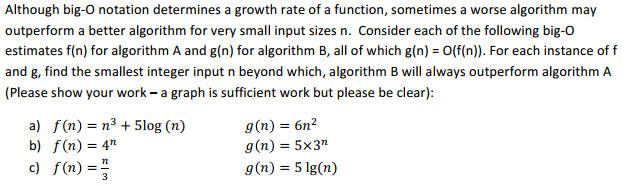
Although big-O notation determines a growth rate of a function, sometimes a worse algorithm may outperform a better algorithm for very small input sizes n. Consider each of the following big-o estimates f(n) for algorithm A and g(n) for algorithm B, all of which g(n) = 0(f(n)). For each instance of f and g, find the smallest integer input n beyond which, algorithm B wil always outperform algorithm A (Please show your work- a graph is sufficient work but please be clear) a) f(n) = n3 + 510g (n) b) f(n)=4n c) f(n)= g (n) = 6n2 g(n) = 53" g (n) = 5 lg(n)
Step by Step Solution
There are 3 Steps involved in it
1 Expert Approved Answer
Step: 1 Unlock

Question Has Been Solved by an Expert!
Get step-by-step solutions from verified subject matter experts
Step: 2 Unlock
Step: 3 Unlock
 Study Help