Question: AMPL model please Problem 5) From Chapter 5 of Taha book, formulate the following problem as a balanced transportation problem in AMPL and solve it.
AMPL model please
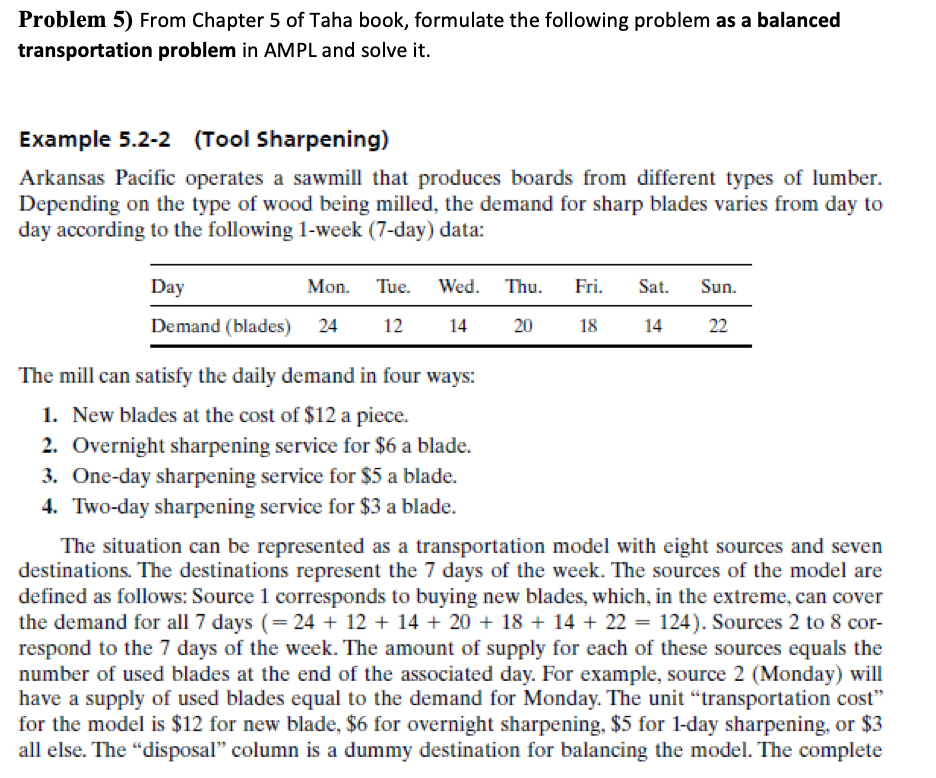
Problem 5) From Chapter 5 of Taha book, formulate the following problem as a balanced transportation problem in AMPL and solve it. Example 5.2-2 (Tool Sharpening) Arkansas Pacific operates a sawmill that produces boards from different types of lumber. Depending on the type of wood being milled, the demand for sharp blades varies from day to day according to the following 1-week (7-day) data: Tue. Wed. Thu. Fri. Sat. Sun. Day Mon. Demand (blades) 24 12 14 20 18 14 22 The mill can satisfy the daily demand in four ways: 1. New blades at the cost of $12 a piece. 2. Overnight sharpening service for $6 a blade. 3. One-day sharpening service for $5 a blade. 4. Two-day sharpening service for $3 a blade. The situation can be represented as a transportation model with eight sources and seven destinations. The destinations represent the 7 days of the week. The sources of the model are defined as follows: Source 1 corresponds to buying new blades, which, in the extreme, can cover the demand for all 7 days (= 24 + 12 + 14 + 20 + 18 + 14 + 22 = 124). Sources 2 to 8 cor- respond to the 7 days of the week. The amount of supply for each of these sources equals the number of used blades at the end of the associated day. For example, source 2 (Monday) will have a supply of used blades equal to the demand for Monday. The unit "transportation cost" for the model is $12 for new blade, $6 for overnight sharpening, $5 for 1-day sharpening, or $3 all else. The "disposal" column is a dummy destination for balancing the model. The complete Problem 5) From Chapter 5 of Taha book, formulate the following problem as a balanced transportation problem in AMPL and solve it. Example 5.2-2 (Tool Sharpening) Arkansas Pacific operates a sawmill that produces boards from different types of lumber. Depending on the type of wood being milled, the demand for sharp blades varies from day to day according to the following 1-week (7-day) data: Tue. Wed. Thu. Fri. Sat. Sun. Day Mon. Demand (blades) 24 12 14 20 18 14 22 The mill can satisfy the daily demand in four ways: 1. New blades at the cost of $12 a piece. 2. Overnight sharpening service for $6 a blade. 3. One-day sharpening service for $5 a blade. 4. Two-day sharpening service for $3 a blade. The situation can be represented as a transportation model with eight sources and seven destinations. The destinations represent the 7 days of the week. The sources of the model are defined as follows: Source 1 corresponds to buying new blades, which, in the extreme, can cover the demand for all 7 days (= 24 + 12 + 14 + 20 + 18 + 14 + 22 = 124). Sources 2 to 8 cor- respond to the 7 days of the week. The amount of supply for each of these sources equals the number of used blades at the end of the associated day. For example, source 2 (Monday) will have a supply of used blades equal to the demand for Monday. The unit "transportation cost" for the model is $12 for new blade, $6 for overnight sharpening, $5 for 1-day sharpening, or $3 all else. The "disposal" column is a dummy destination for balancing the model. The complete









 Study Help