Question: An assembly operation is designed such that each assembly operation involves the attachment of a component to the existing base frame, a hopper-feeder is used
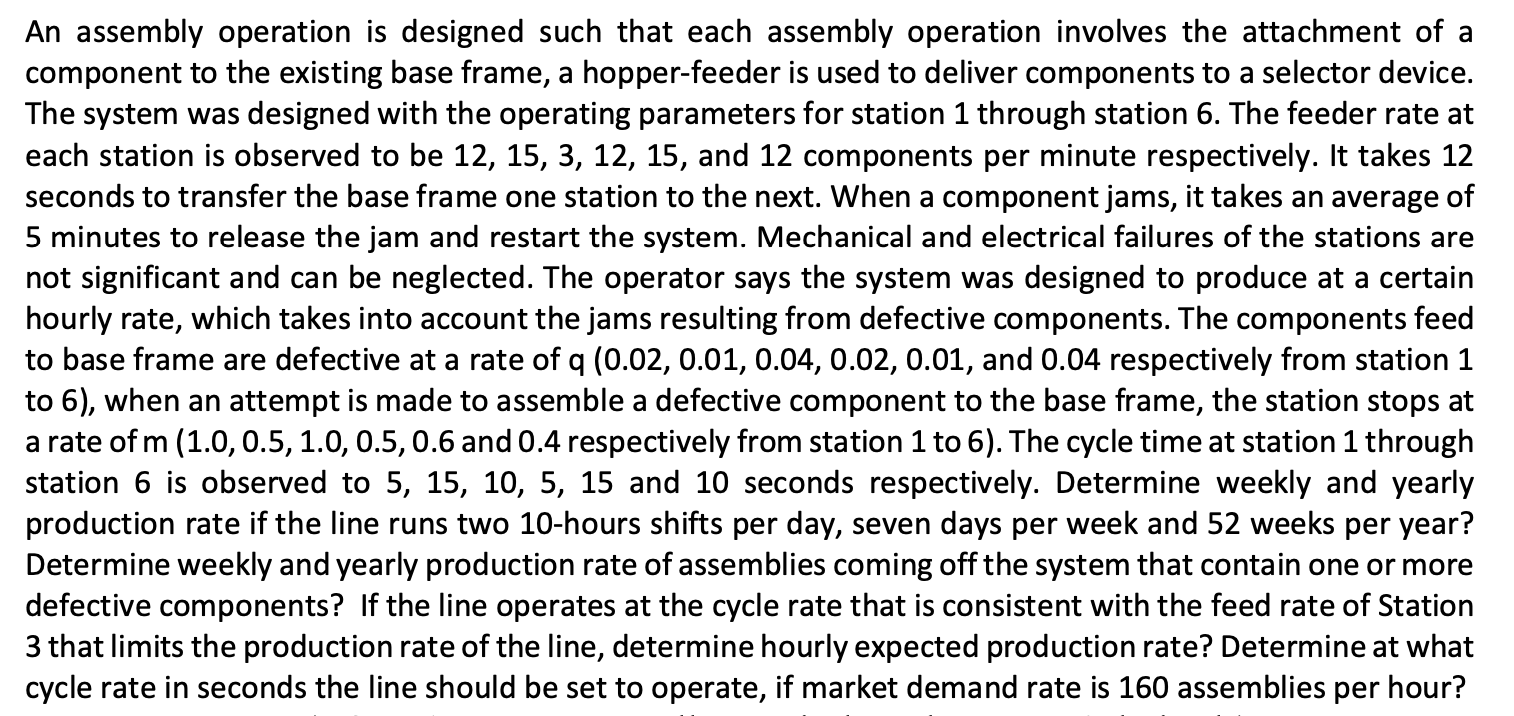
An assembly operation is designed such that each assembly operation involves the attachment of a component to the existing base frame, a hopper-feeder is used to deliver components to a selector device. The system was designed with the operating parameters for station 1 through station 6. The feeder rate at each station is observed to be 12, 15, 3, 12, 15, and 12 components per minute respectively. It takes 12 seconds to transfer the base frame one station to the next. When a component jams, it takes an average of 5 minutes to release the jam and restart the system. Mechanical and electrical failures of the stations are not significant and can be neglected. The operator says the system was designed to produce at a certain hourly rate, which takes into account the jams resulting from defective components. The components feed to base frame are defective at a rate of q (0.02, 0.01, 0.04, 0.02, 0.01, and 0.04 respectively from station 1 to 6), when an attempt is made to assemble a defective component to the base frame, the station stops at a rate of m (1.0, 0.5, 1.0, 0.5, 0.6 and 0.4 respectively from station 1 to 6). The cycle time at station 1 through station 6 is observed to 5, 15, 10, 5, 15 and 10 seconds respectively. Determine weekly and yearly production rate if the line runs two 10-hours shifts per day, seven days per week and 52 weeks per year? Determine weekly and yearly production rate of assemblies coming off the system that contain one or more defective components? If the line operates at the cycle rate that is consistent with the feed rate of Station 3 that limits the production rate of the line, determine hourly expected production rate? Determine at what cycle rate in seconds the line should be set to operate, if market demand rate is 160 assemblies per hour? An assembly operation is designed such that each assembly operation involves the attachment of a component to the existing base frame, a hopper-feeder is used to deliver components to a selector device. The system was designed with the operating parameters for station 1 through station 6. The feeder rate at each station is observed to be 12, 15, 3, 12, 15, and 12 components per minute respectively. It takes 12 seconds to transfer the base frame one station to the next. When a component jams, it takes an average of 5 minutes to release the jam and restart the system. Mechanical and electrical failures of the stations are not significant and can be neglected. The operator says the system was designed to produce at a certain hourly rate, which takes into account the jams resulting from defective components. The components feed to base frame are defective at a rate of q (0.02, 0.01, 0.04, 0.02, 0.01, and 0.04 respectively from station 1 to 6), when an attempt is made to assemble a defective component to the base frame, the station stops at a rate of m (1.0, 0.5, 1.0, 0.5, 0.6 and 0.4 respectively from station 1 to 6). The cycle time at station 1 through station 6 is observed to 5, 15, 10, 5, 15 and 10 seconds respectively. Determine weekly and yearly production rate if the line runs two 10-hours shifts per day, seven days per week and 52 weeks per year? Determine weekly and yearly production rate of assemblies coming off the system that contain one or more defective components? If the line operates at the cycle rate that is consistent with the feed rate of Station 3 that limits the production rate of the line, determine hourly expected production rate? Determine at what cycle rate in seconds the line should be set to operate, if market demand rate is 160 assemblies per hour









 Study Help