







Question: An auditor is applying statistical sampling for attributes to the testing of extensions of 1000 line items on sales invoices. A deviation is defined
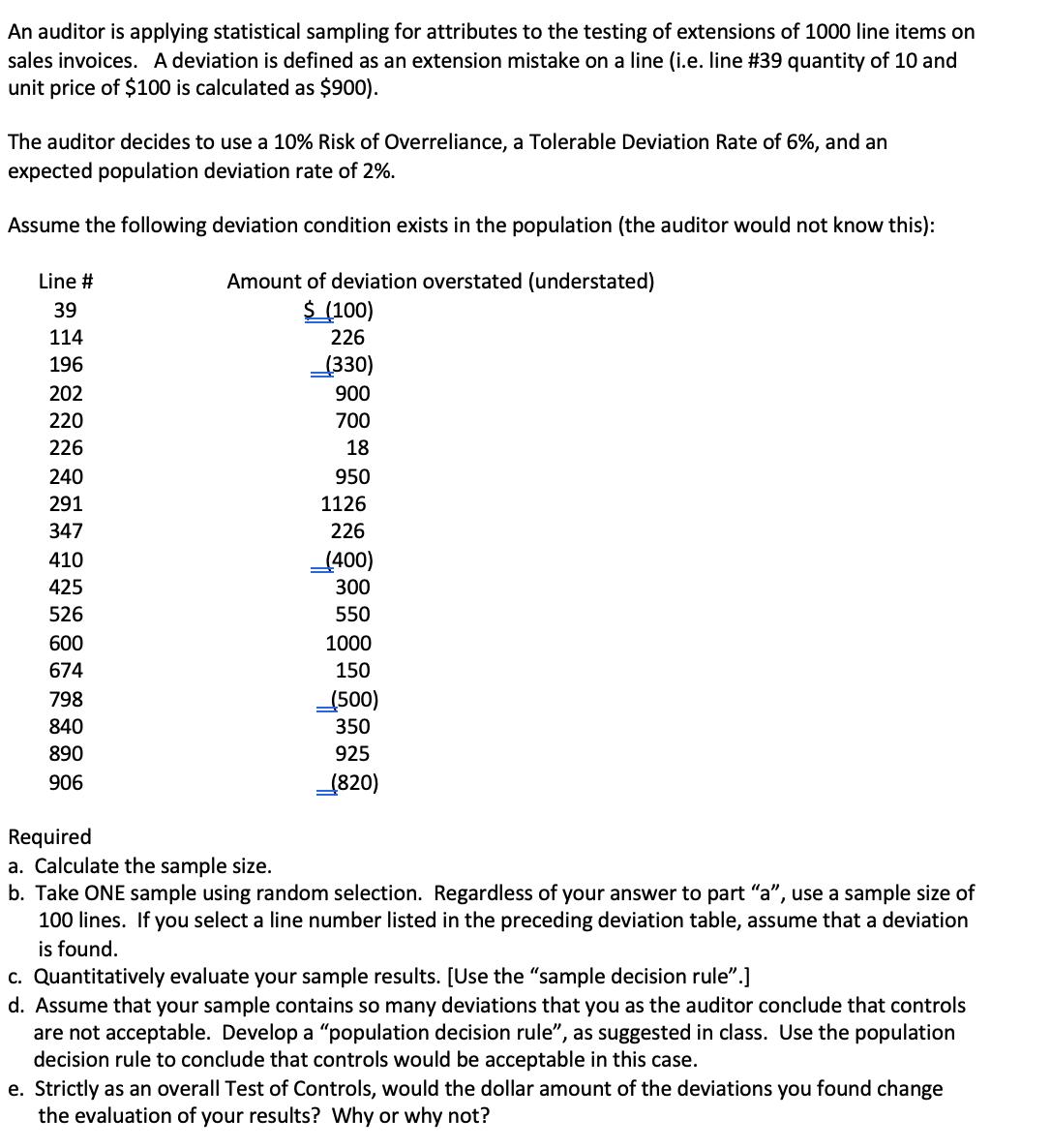
An auditor is applying statistical sampling for attributes to the testing of extensions of 1000 line items on sales invoices. A deviation is defined as an extension mistake on a line (i.e. line #39 quantity of 10 and unit price of $100 is calculated as $900). The auditor decides to use a 10% Risk of Overreliance, a Tolerable Deviation Rate of 6%, and an expected population deviation rate of 2%. Assume the following deviation condition exists in the population (the auditor would not know this): Line # Amount of deviation overstated (understated) 39 $ (100) 114 226 196 330) 202 900 220 700 226 240 950 291 1126 347 226 410 (400) 425 300 526 550 600 1000 674 150 798 (500) 840 350 890 925 906 (820) Required a. Calculate the sample size. b. Take ONE sample using random selection. Regardless of your answer to part "a", use a sample size of 100 lines. If you select a line number listed in the preceding deviation table, assume that a deviation is found. c. Quantitatively evaluate your sample results. [Use the "sample decision rule".] d. Assume that your sample contains so many deviations that you as the auditor conclude that controls are not acceptable. Develop a "population decision rule", as suggested in class. Use the population decision rule to conclude that controls would be acceptable in this case. e. Strictly as an overall Test of Controls, would the dollar amount of the deviations you found change the evaluation of your results? Why or why not?
Step by Step Solution
3.50 Rating (170 Votes )
There are 3 Steps involved in it
To address the question lets go through each part step by step a Calculate the sample size To determine the sample size well use the formula for sampl... View full answer

Get step-by-step solutions from verified subject matter experts
 Study Help