



Question: An engineer is currently tasked with designing a steel beam which is to support a flooring system above it . The weight of the flooring
An engineer is currently tasked with designing a steel beam which is to support a flooring system above it
The weight of the flooring system will act as a distributed load over the length of the beam, which in turn will
cause the beam to bend, and deflect. It is your task to check that the crosssection for this beam below is
suitable subject to the design constraints given: both "Strength" and "Serviceability".
Satisfying strength ensures that stresses within the structural or mechanical member do not exceed critical values that
would cause them to fail, or exhibit other undesirable mechanical responses. In this case, we wish to ensure that no part of
the material reaches yield. Satisfying serviceability constraints ensure that deformations of a structural or mechanical
member do not exceed critical values that would prevent them from performing their desired function. In this case, we wish
to minimise any deflections of the beam so that the floor above it does not 'sag'
The member can be modelled as a simply supported beam carrying a UDL of across its
span.
The length of the beam between supports is The Young's modulus of the material is
GPa
The beam rests on supporting joists, which may be modelled as roller supports in our analysis as they only
constrain motion of points A and in the vertical direction. Since there are no lateral loads acting on the
system, equilibrium of horizontal forces is already satisfied.
Limits of Design
Firstly, we calculate the limits for our design which need to be satisfied.
Strength
The yield stress of the steel material is MPa. In this case, we will design strength according to a factor of safety
of
Therefore, the maximum allowable stress in the material is given by:
MPa
The factor of safety ensures that the design of the material is such that it does not come close to reaching its critical value.Serviceability.
The following is an extract from Table C in the AustralianNew Zealand Standards for Structural Design
actions AS:
This extract from the table provides limits for deflections for various structural components to satisfy
serviceability. In this case, we are interested in the row related to "Floor joistsBeams in order to reduce the
occurrence of 'sagging' of the beam.
Therefore we need to ensure the deflection of the midspan of the beam is below "Span where span
refers to the length of the beam between supports.
Loading of Member
Using equilibrium, calculate the two vertical support reactions acting on the beam:
upwards positive
upwards positive
Give an expression for the internal bending moment of the beam as a function of along the beam. Please
take as positive from left to right, with origin at
use the positive sign convention for bending
moment taught in class
The only unknown in your expression should be Please enter exact known values of all other parameters
use fractions rather than decimalsStrength Analysis
The crosssection of the beam here is the Isection" shown below. The dimensions are given as:
With reference to the origin shown above, what is the vertical coordinate of the centroid for this crosssection:
What is the second moment of area about the horizontal axis passing through the centroid:
For a linear elastic material, the depth of the centroid is also the depth of the neutral axis.
Calculate the maximum internal bending moment within the beam this occurs at the midspan:
What is the largest magnitude of stress due to bending acting on the crosssection calculate stress at
extreme points of crosssection top and bottom fibres and then give magnitude of largest stress:
MPa
Does this stress satisfy the design constrain for strength? Serviceability Analysis
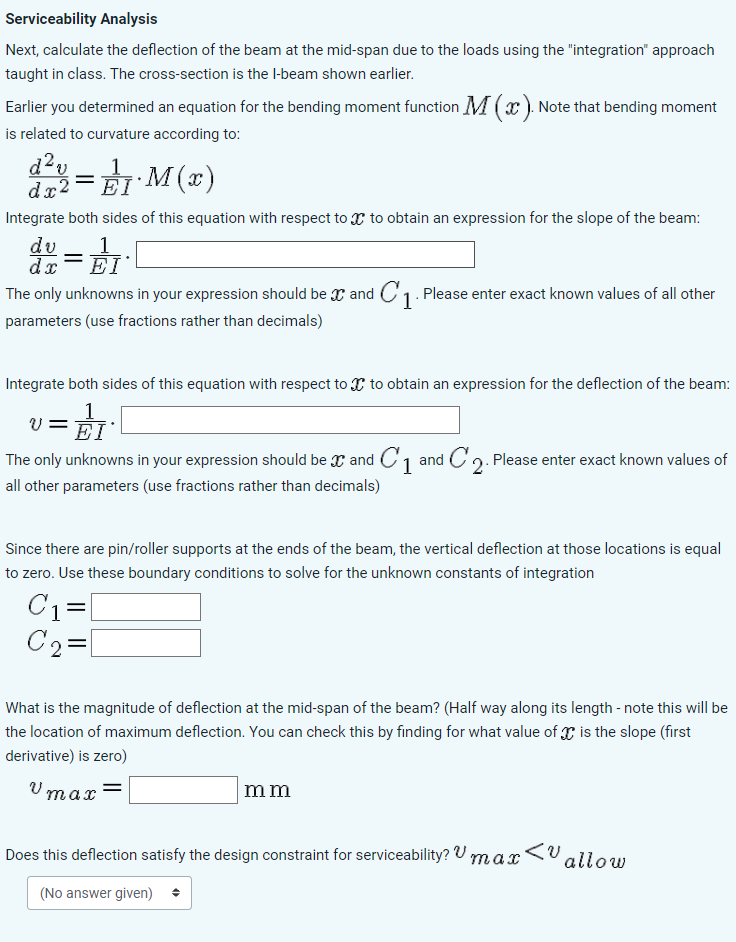
Next, calculate the deflection of the beam at the midspan due to the loads using the "integration" approach
taught in class. The crosssection is the lbeam shown earlier.
Earlier you determin
Step by Step Solution
There are 3 Steps involved in it
1 Expert Approved Answer
Step: 1 Unlock

Question Has Been Solved by an Expert!
Get step-by-step solutions from verified subject matter experts
Step: 2 Unlock
Step: 3 Unlock