







Question: An engineer is installing an openend mercury manometer attached to a pipe that will eventually carry pressurized gas. While the pipe is open to the
An engineer is installing an openend mercury manometer attached to a pipe that will eventually carry pressurized gas. While the pipe is open to the atmosphere, she adds enough mercury into the manometer so that the mercury level in both arms of the manometer is i=720.0 mm above the bottom of the manometer (see figure 1). Figure 1. An open-end mercury manometer is attached to an empty pipe that is open to the atmosphere. The U-shaped tube of the manometer is filled with mercury that is at the same level in both arms. The distance from the bottom of the manometer to the fluid level is labelled h subscript i. Figure 1 Figure 2. An open-end mercury manometer is attached to a pressurized pipe, with arrows indicating the flow of gas through the pipe. The U-shaped tube of the manometer is filled with mercury. The mercury level in the open end arm of the manometer is at the top of the arm. The mercury level in the arm of the manometer connected to the pipe is much lower. The distance from the bottom of the manometer to the fluid level at the open end is labelled h subscript f. Figure 2 If the end of the open arm of the manometer is f=1080.0 mm above the bottom of the manometer, what is the maximum pressure (gauge) of the pressurized gas that the pipe can carry before the mercury spills out of the open end of the manometer (see figure 2)?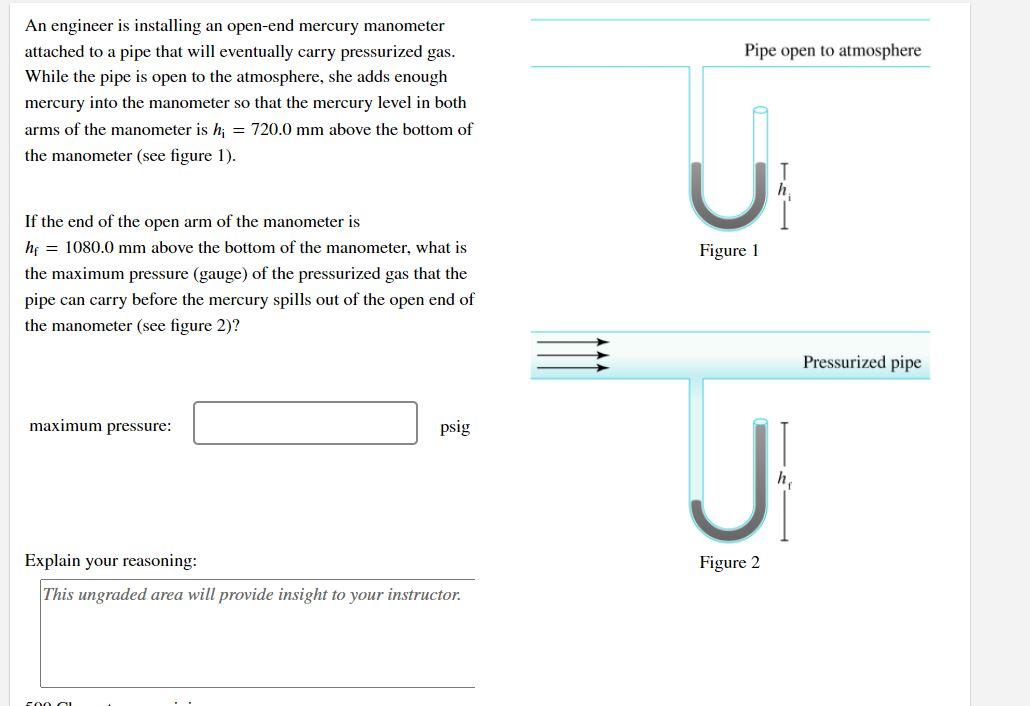
Pipe open to atmosphere An engineer is installing an open-end mercury manometer attached to a pipe that will eventually carry pressurized gas. While the pipe is open to the atmosphere, she adds enough mercury into the manometer so that the mercury level in both arms of the manometer is h; = 720.0 mm above the bottom of the manometer (see figure 1). C Figure 1 If the end of the open arm of the manometer is he = 1080.0 mm above the bottom of the manometer, what is the maximum pressure (gauge) of the pressurized gas that the pipe can carry before the mercury spills out of the open end of the manometer (see figure 2)? Pressurized pipe maximum pressure: psig J Figure 2 Explain your reasoning: This ungraded area will provide insight to your instructor
Step by Step Solution
There are 3 Steps involved in it

Get step-by-step solutions from verified subject matter experts
 Study Help