







Question: An experimental engine, Fig. 1 heats argon electrically to a state of 1000 K and 30 kg/m in section (4) Use Table 7-3 for fluid
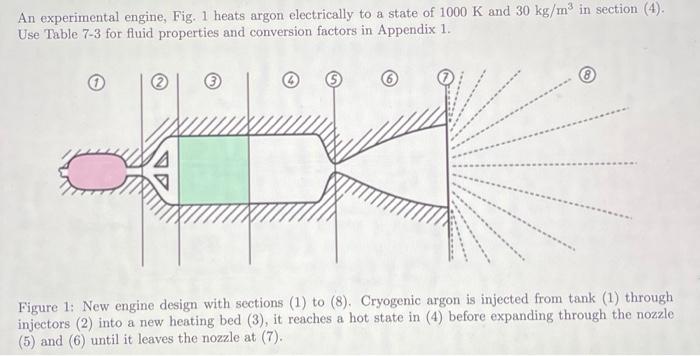

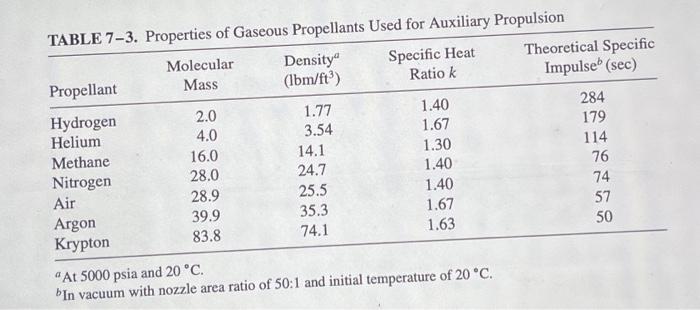
An experimental engine, Fig. 1 heats argon electrically to a state of 1000 K and 30 kg/m in section (4) Use Table 7-3 for fluid properties and conversion factors in Appendix 1. AN Figure 1: New engine design with sections (1) to (8). Cryogenic argon is injected from tank (1) through injectors (2) into a new heating bed (3), it reaches a hot state in (4) before expanding through the nozzle (5) and (6) until it leaves the nozzle at (7) 1. Assuming the heated gas behaves like an ideal gas, what is the pressure in the combustion chamber (4)? 2. What is the Mach number in (5)? 3. Assuming isentropic flow through a nozzle, what is the the velocity at (5)? 4. How could the engine be improved? TABLE 7-3. Properties of Gaseous Propellants Used for Auxiliary Propulsion Molecular Density Specific Heat Theoretical Specific Propellant Mass (Ibm/ft) Ratio k Impulseb (sec) 2.0 Hydrogen 1.77 284 1.40 Helium 4.0 3.54 1.67 179 Methane 16.0 14.1 1.30 114 28.0 Nitrogen 24.7 1.40 76 Air 28.9 25.5 1.40 39.9 Argon 35.3 57 1.67 83.8 Krypton 74.1 50 1.63 "At 5000 psia and 20 C. In vacuum with nozzle area ratio of 50:1 and initial temperature of 20 C. 74
Step by Step Solution
There are 3 Steps involved in it

Get step-by-step solutions from verified subject matter experts
 Study Help