







Question: An Extended Malthusian Model (55 points) Let us consider & Malthusian economy in which the population size is governed by the following Low of motion:
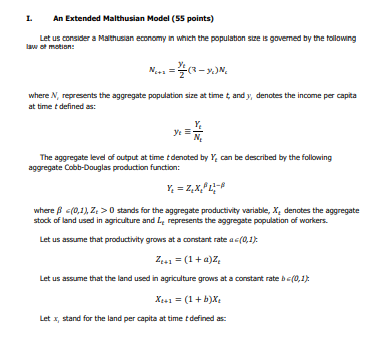
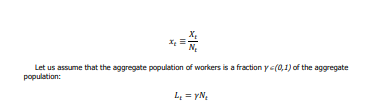
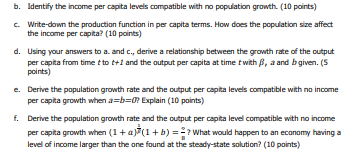
An Extended Malthusian Model (55 points) Let us consider & Malthusian economy in which the population size is governed by the following Low of motion: where N, represents the aggregate population size at time & andy, denotes the income per capita at time & defined as: 35 The aggregate level of output at time +denoted by 1, can be described by the following aggregate Cobb-Douglas production function: where @ =(0,1), Z: 3 0 stands for the aggregate productivity variable, X, denotes the aggregate stock of land used in agriculture and Ly represents the aggregate population of workers. Let us assume that productivity grows at a constant rate a c(0,1): Im= (1+a)Z Let us assume that the land used in agriculture grows at a constant rate be(0, 1): Xml = (1+ b)X. Let x, stand for the land per capita at time f defined as:IE IN Let us assume that the aggregate population of workers is a fraction pad, 1) of the aggregate population: LE = FNb. Identify the income per capita levels compatible with no population growth. (10 points) c. Write-down the production function in per capita terms. How does the population size affect the income per capita? (10 points) d. Using your answers to a. and c., derive a relationship between the growth rate of the output per capita from time & to to1 and the output per capita at time f with (, a and b given. (5 points) e. Derive the population growth rate and the output per capita levels compatible with no income per capita growth when a=b=of Explain (10 points) f. Derive the population growth rate and the output per capita level compatible with no income per capita growth when (1 + a] (1 + b) = =?What would happen to an economy having a level of income larger than the one found at the steady-state solution? (10 points)
Step by Step Solution
There are 3 Steps involved in it

Get step-by-step solutions from verified subject matter experts
 Study Help